
When your teen tells you she is gay. How parents can deal with the situation
Dr Meghna Singhal
Did the headline catch your attention? This is a critical subject every parent needs to be aware of. Read on for knowing how to deal with your teen coming out of the closet

As a psychotherapist specializing in child and adolescent mental health, I often come across parents who bring in their teen and tell me that one-liner - He says he is gay. Fix him!
Times have changed at a brisk pace, but our change of attitude toward homosexuality has moved at a snail's pace. As a society, we still look at lesbians, gays, bisexuals, transgenders, and queers- the LGBTQ+ community with fear, disgust, and even contempt.
Despite the historic Supreme Court verdict in 2018 that ruled section 377 of the penal code as unconstitutional, homosexuality is perceived as an illness, an odious and revolting disease.
It's a similar story every time. A bleary-eyed young person who overcame months, perhaps even years, of doubt, shame, and confusion, had to gather all his strength to come out to his parents. And his understandably distressed parents, crying one moment, angry the next didn't really know what to do with this supposed confession.
Before they found their way to my office, there have been blow-ups, several of them. There has usually been disbelief, followed by anger, and hurtful remarks hurtled at each other.
This is not a standalone reaction. It is common in almost all cases. In some cases, there is manipulation, in others threatening. But there is most probably shaming.
So what can parents do? How should they respond to their teen? How can parents and their teens together traverse the treacherous path that coming out of the closet often entails?
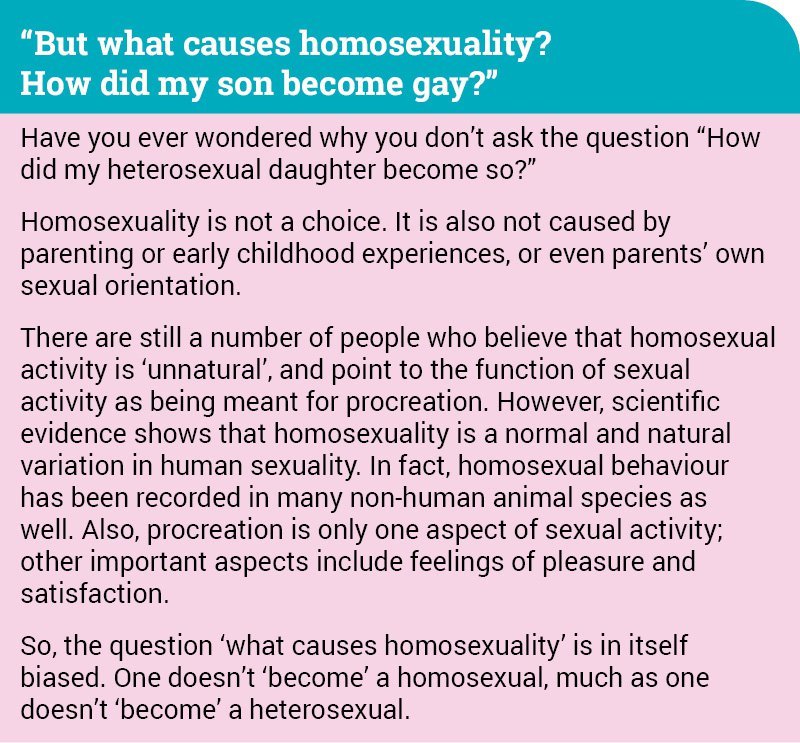
Your likely arguments against homosexuality
- Gays can't have children and therefore should not be allowed to get married
Counter-argument: If having children were the sole criteria of marriage, even the elderly or infertile couples would not be allowed to get married! And what about the couples who choose to be child-free? Everyone has the right to choose whether or not to have children. - Being gay is immoral
Counter-argument: There is nothing immoral about acknowledging (both at the societal and legal level) the love between two consenting adults. There is no evidence that homosexuality harms the moral fabric of society. The 11 countries where gay marriage is legal are well and functioning smoothly. It is the mark of an egalitarian and mature society to accommodate and accept diversity. - If everyone was gay, humankind would cease to exist
Counter-argument: Firstly, everyone can never be the same. Where humankind exists, there will always be diversity. Secondly, gay people (just like heterosexuals) can and do have children through surrogates and donors.
Knowing what you're feeling
The firestorm of conflicting emotions you experience when your child comes out of the closet is common and understandable. How can you, as a parent, process this emotional avalanche and respond to your child in a rational and sorted manner? The best way is by planning a respectful discussion with your child. Remember, shouting and blaming will not help. It will only create resentment between you and your child.
However, if you're far from it and if there has already been a blow-up (or several of them), worry not. You can still establish the boundaries of respectful communication. I suggest to the parent to apologize for the hurtful words (or actions) and request their child for an opportunity to start over on a different footing.
If you are thinking about why you should be the one to apologize, I'd gently suggest you think about your goal here. Is your goal to create more distance between you and your child or get closer to your child? After all, if your child views you as her adversary, she is unlikely to listen to you. It would also help to remember that your disappointment is stemming from a feeling of love and protection for your child.
Since you can only control your behavior (not your child's), the main focus must be yourself, not your child. Start by asking yourself some of these questions:
- Do I understand (without judgment) what my child is saying? Do I understand what she is going through? If not, what is preventing me from gaining that understanding? Is it about my beliefs or my fear for her future, or both?
- Is my partner on the same page as I? Can I even begin to tackle this situation if we're not united in our approach?
- Am I blaming myself for the way my child has turned out?
- Do I need support? Could I talk to someone in my family or friends' circle who will likely be non-judgmental and understanding? Should I look for professional help?
PARENT SPEAK
Suresh Anil*, a father from Chennai, discusses how his daughter, who was 16 at the time, revealed to him that she is gay. He had no idea of her sexual orientation prior to that conversation. The revelation did not shock or disappoint him. He took it in his stride. The only concern he had was for the safety and future, which he opines would have been there even if his daughter was a heterosexual. He also remembers telling her that he won't go announcing to the whole world of her orientation and will limit it only to a few family members and close friends. He also wanted his daughter to tell him if anyone in this close circle or otherwise makes any sort of discriminatory or prejudiced statements. He then initiated a series of ongoing conversations with his daughter about handling such comments, empowering her to fight her own battles.
Today his daughter is happily pursuing her undergraduate studies from an Ivy League University, and is an advocate for LGBTQ+ issues.
Empathizing with your child
Put yourself in your child's shoes and imagine what it must be like for him to disclose his sexual orientation to you. It is often said that coming out of the closet is a three-step process, the first of which is 'knowing oneself' or internal coming out (Coming out to their family and openly living as LGBTQ+ are the other two steps). Having been raised in a society that is either ignorant of or openly hostile toward homosexuality, it must have been extremely confusing and scary to realize that one, unlike peers, doesn't feel attracted to the opposite sex. Your child may also have already been exposed to ridicule or discrimination if his mannerisms are perceived as 'girly' (a common myth is that homosexual men display feminine behaviors).
This is also why many teens try to suppress their feelings to meet societal expectations, to fit in, or avoid upsetting their parents. However, this only increases their risk of experiencing depression, anxiety, suicide, and other mental health issues.
The good news, however, is that you don't have to accept your child's sexuality before you begin to start empathizing with her. What would be helpful is saying something like, "It must have been quite difficult for you to say this to us. But we're glad you shared this with us. We would rather know what you're going through than you hiding or suppressing yourself. We want to be there for you no matter what." Continue to express love and support toward your child, even if you're not quite sure how to process your own feelings. Even if you disagree with your child, she will require your support, validation, and love to develop into a healthy adult.
Communicating with your child
It is not only helpful but also desirable, to communicate to your child the difficult array of emotions you're feeling. You could say something like, "This is obviously something you've been pondering for a while. Though we are quite shocked (or disturbed or whatever is your predominant feeling), we appreciate your honesty. Give us some time to reflect on what you have shared with us before we talk further."
Once your initial shock and anger have subsided, you could initiate a series of ongoing discussions with your child with the aim of understanding him better. Remember that your goal is to maintain a relationship with your child, and that will entail both you and your child stretching yourselves to understand each other. Some questions you may ask your child are:
|
It is important to remember that neither you nor your child can have immediate resolutions; both of you will be in discovery mode for an extended period of time. Also, it is wise to not take any emotional decisions. Coming out is not a one-time process. As your child gets more comfortable with his sexuality, he will disclose to more people and may inch closer to self-acknowledgment and self-acceptance.
While you have ongoing discussions with your child, I suggest to the parents to do the following:
- Be there for your child. When your child talks, just listen without jumping in to correct or talk. Listen without your blinders and without judgment. Just be there for your child.
- Educate yourself. There are many words and phrases used about and within the LGBTQ+ community. You could read up on the issues the queer community commonly faces (books such as Mom, Dad I'm Gay: How Families Negotiate Coming Out by Ritch Savin-Williams), and watch movies such as I Am, My Brother...Nikhil, Aligarh, and Ek Ladki ko Dekha To Aisa Laga. Doing so will help sensitize you and facilitate clearer discussions with your child. It could help you empathize. You could even connect with parents of other children who identify as being queer and form a support group.
- Stand up for your child. Looking at homosexuality as a human right rather than a morality issue will enable you to have an empathic outlook. Stand up for your child when they are teased or mistreated. Help your child deal with the bullying they might be facing.
- Look out for danger signs. Be on the lookout for signs that your child may require mental health support due to issues such as depression, anxiety, suicidality, or low self-esteem. Help your child access professional help.
While it is important to know what to do, it is equally important to know what not to do:
- Don't contribute to the stigma. Strictly avoid using pejorative slang such as faggot or sissy or sharing slurs or jokes based on sexual orientation.
- Don't tell your child they can change. Encouraging your child to wait because they're young and 'don't know any better' or hoping that they will 'become heterosexual' in the future is not going to help.
- Don't pander to fear-mongering. Saying things like, "You will get AIDS" or "If you go for a Pride march, you will be beaten up by the police" is not only unhelpful, it could scare your child back into the closet. Get your facts right; don't put the weight of your fears or homophobic beliefs on your child's shoulders.
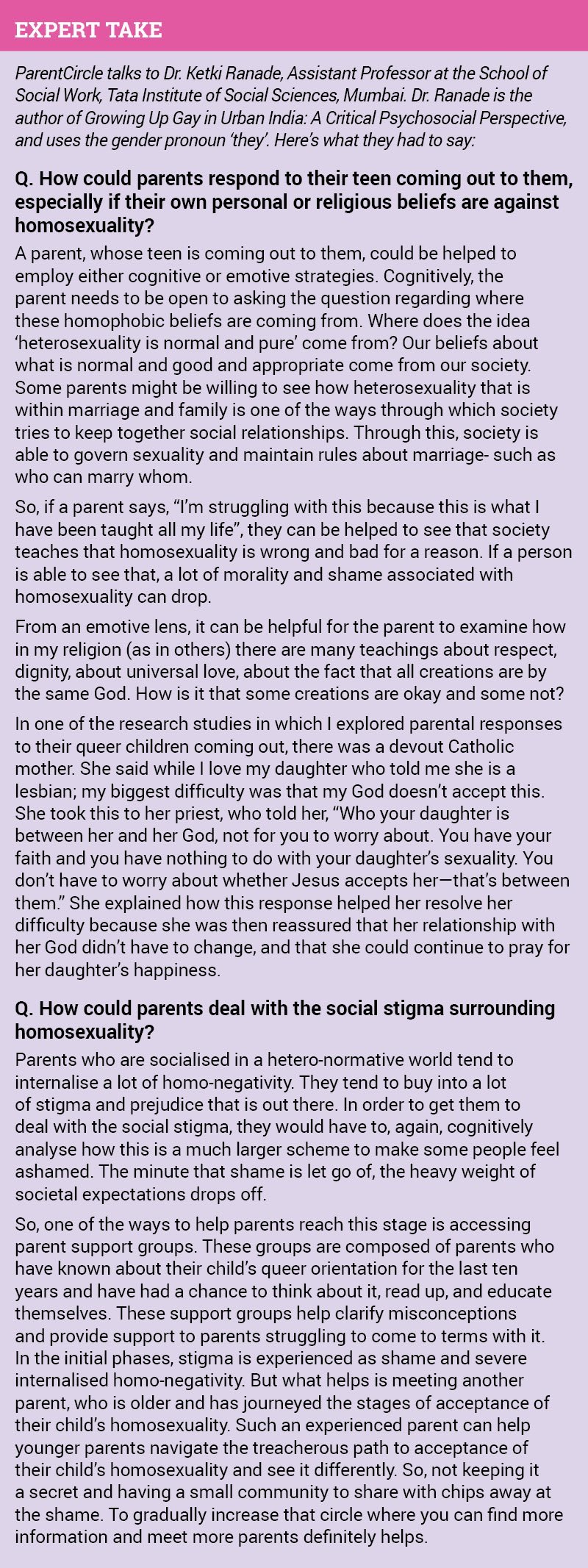
Even if you're having difficulty understanding your child's identity, not withdrawing from your role as a parent is one of the most important things you could do. It will enable your child to feel loved and accepted, especially at a time when they might be grappling with fear and confusion or dealing with being victimized.
*Name changed for confidentiality
In a Nutshell
|
What you can do right away
- Educate yourself in order to get more information and clarify misconceptions about homosexuality, read books, watch movies, and connect with other parents with children who identify as being queer
- Be on the lookout for signs that your child may require mental health support due to issues such as depression, anxiety, suicidality, or low self-esteem. Help your child access professional help
- Don't contribute to the stigma surrounding homosexuality by using pejorative slangs such as faggot or sissy or sharing slurs or jokes based on sexual orientation





























Comments
Edit
Comment Flag
Cancel Update