
Learning Maths With The Abacus. Be Amazed By Your Child's Speed and Accuracy Of Calculations
Shashwathi Sandeep
Ever wondered how kids learning with an Abacus find maths easy to learn? Here's everything on how to use the Abacus to teach maths, and why it makes your children incredibly smart in calculations.
- 19.3K
- 2
- 1
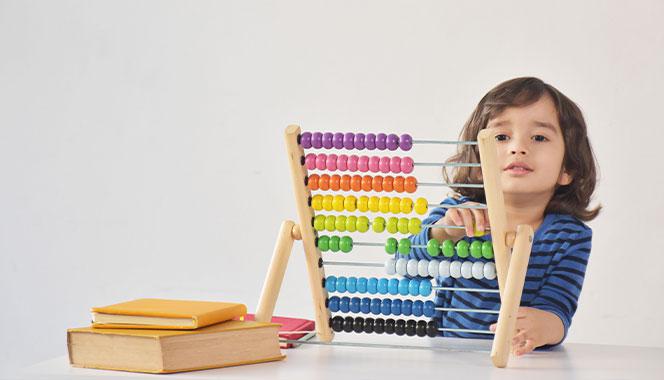
In today's world, where everything is instant and on a fast-track mode, many parents consider the Abacus to be a quick method to learn maths. Experts, who vouch for the tool, believe the Abacus helps your child concentrate better and calculate faster. So, here is an A-Z guide on everything you want to know about Abacus Maths including how to use the Abacus, and whether it is the right choice for your child.
What is the Abacus?
Abacus is a centuries-old calculating tool believed to have originated in Babylon about 5000 years ago. The device has rows of wires set inside a frame. Beads or balls can be slid on these wires. Long before numbers were even invented, people used to rely on Abacus to calculate numbers. Legend has it that back then, the beads too were not present. People presumably calculated by moving stones or beans around in grooves or on tablets.
A sneak peek into the world of Abacus
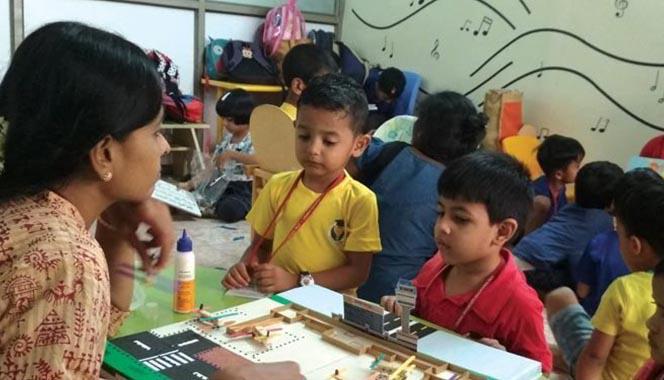
We were curious to know what really happens in an Abacus Maths class. So, we headed to SIP Academy in Adambakkam, Chennai, which combines Abacus Maths, Brain Gym, and Speed Writing. Here's what we observed:
The different levels of Abacus
Levels of Abacus
In most cases, there are eight levels in Abacus learning. Some institutes also have advanced programs where children perform many complex arithmetic functions.
- Level 1: Simple addition and subtraction with single digits using Abacus.
- Level 2: Addition and Subtraction of two-digit numbers with Abacus, and addition and subtraction of single digits without Abacus.
- Level 3: Without Abacus - two digits, and with Abacus - three digits. Introduction to a simple multiplication.
- Level 4: Two-digit Multiplication and single-digit division
- Level 5: Three-digit multiplication and two-digit division
- Levels 6 and 7: Digits will be increased to four, five, and six for addition, subtraction, multiplication, and division.
- Level 8: Six to seven digits addition and subtraction, and four-digit multiplication without Abacus. The students do not use Abacus physically after the 7th level.
What we observed
Children of different age groups were engaged in different levels of Abacus Maths learning. The first level starts with children using the actual Abacus instrument. The second level includes visualization where the children actually visualize the Abacus in their mind and do the calculations. The difficulty increases with each level, and so does the child's ability to focus. In fact, when we interacted with the children in Level 1, they were so excited to move those beads up and down and show us how it's done.
There is also a grand module level, which is similar to the grandmaster level in chess. What we observed here left us in complete awe. The children would be working on 'addition'. The teacher then began dictating twenty big numbers at a time and the moment she stopped, all the children immediately told her the answer. Not just that; she asked them cube roots of numbers such as 72 or 85, and in a few seconds, the children were ready with the responses. In short, the children in the class were able to do calculations that normally require a calculator, in a flash and without much effort. That, we thought, was really amazing!
How to use Abacus for children?
Let's now see how Abacus is taught. In the first level, the teachers teach the concept of the Abacus with the help of the instrument. There are workbooks with simple problems of addition and subtraction, which the teacher and the children solve together. From the next level, the Abacus is used only as a visualization tool. The teacher, who herself has undergone training for the same, focuses children's energy to visualize the instrument in their head and move the beads up and down mentally.
Benefits of the Abacus
- Since the child calculates by visualizing the numbers, he develops concentration, visual memory and retention skills, besides being able to recall details in life experiences as well, and not just in mathematics.
- The child's speed and accuracy levels for calculating even large numbers improve.
- The listening skills of the child are better in an Abacus Maths class. The teacher reads out the numbers continuously, the child retains the numbers in their memory and does the calculations simultaneously.
- More importantly, learning Abacus Maths removes a child's fear of numbers.
Abacus FAQs
How much of it is practical and how much is theoretical?
Abacus Maths is completely practical. There are no books to mug up or study materials to memorize; Children just must learn through the Abacus instrument.
What is the duration of the class?
Most of the classes are for about two hours, once a week. Each level takes around 12-16 weeks to complete.
What should be the minimum age of the child?
Your child can be even as young as five years old. In fact, the earlier your child starts learning Abacus, the faster she can calculate numbers. She also gains an immense amount of confidence.
Are children given homework?
The children are given practice sheets once every week. It takes about 10 to 15 minutes to solve them.
Are there tests?
There are tests occasionally, just to assess how much of the concept the child has understood.
How much time outside of class should a child spend?
Apart from the practice work that is given in the class, it really depends on you and your child's choice, whether you want to practice it every day. Usually, when a child starts going to the class, he unconsciously starts using it in everyday life too.
What tools do they use to teach Abacus Maths?
The only teaching tool required to teach Abacus Maths is the Abacus itself. Basically, the Abacus has a number of beads that represent ones, tens, hundreds, and thousands places values. Depending on the calculations, these beads are moved up and down.
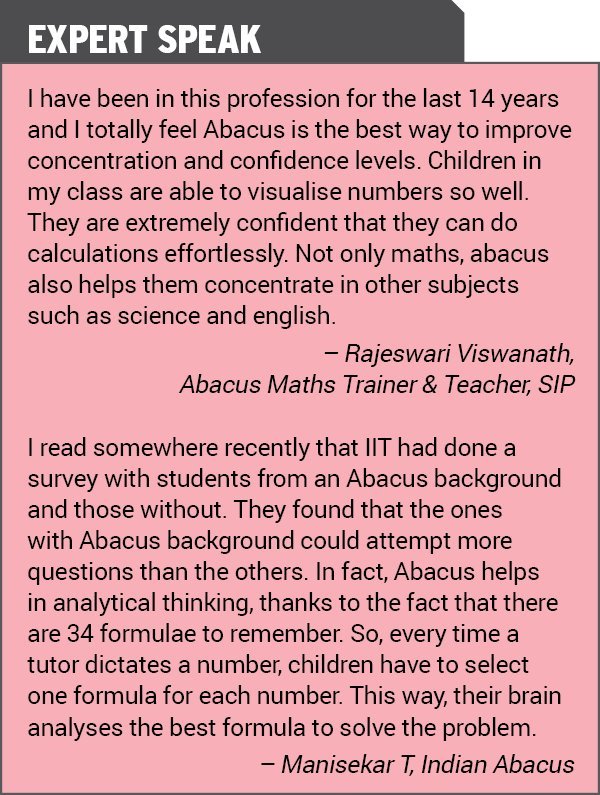
Parent speak
I heard about Abacus Maths from one of my neighbors since her son had done the course. I just went with the expectation that my daughter will be able to do maths better, but surprisingly, she has gained a lot more than that. Her memory and concentration levels have improved a lot. It has also brought in a certain amount of discipline into her studies in particular, and life in general. This whole summer, whenever she was lazing around, she was only practicing Abacus Maths! - Visalatchi Somasundaram, Chennai
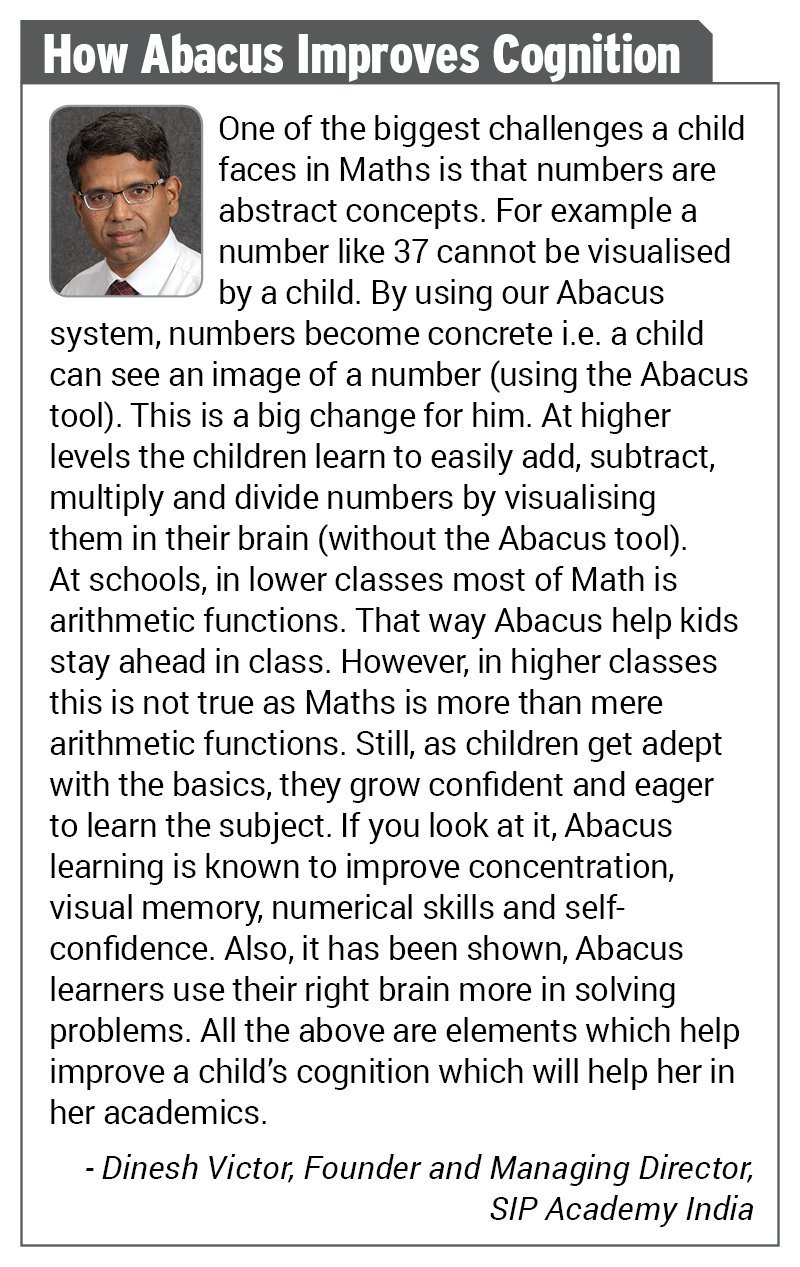
Student speak:
It has been a while that I have been coming to Abacus class and I really love it. It is so interesting and I have become so fast in calculations even in class. It is actually very easy to learn; it looks difficult but it is so easy. - Kevin Smith, 10 years
I have just started off with these classes. It is my third class; I love the way these beads move. It is so easy to calculate numbers with this. It is so much fun! - Rishabh Prashant, 6 years
I am now in the Grand Module level and it has been really great to learn Abacus Maths. The visualization concept, especially, has helped me a lot. Now, I do all my calculations in my mind. It has also helped me perform better in other subjects like Science. - Sangeetha Sivakumar, 15 years
With so many benefits, it surely seems Abacus is a life skill that your child may want to acquire. Let them get an opportunity to explore it by themselves and find out what's in store for them.
The Dot maths program for kindergarten is based on the learning trajectories of children and builds a strong conceptual foundation in maths. The program nurtures a love for maths in young children.


























Comments
Simi Ramesh Dec 24, 2019
Edit
Comment Flag
Cancel Update