
Here's how you can help your preschooler learn math using everyday objects and situations
Sriram Naganathan
Early math skills predict subsequent school success. Read on to find out how to help your preschooler develop a knack for math using things you can find easily at home
- 3.1K
- 3
- 1
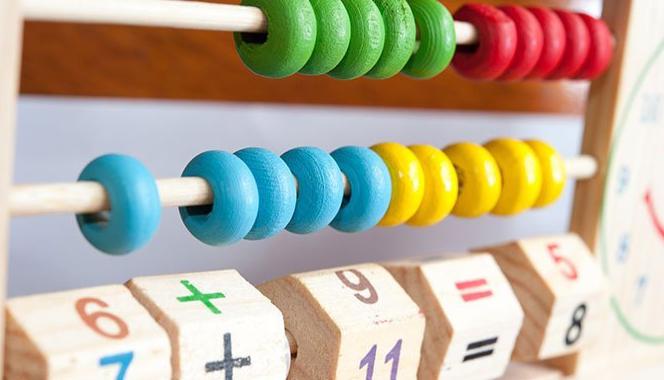
For all children, more specifically for preschoolers, learning happens in a way without the children being aware that they are “learning” something. We all know that is how children learn languages—they observe how adults use language, try out, make mistakes, correct them, get it right, consolidate their learning. Learning happens continuously and subconsciously, spanning various knowledge domains.
Can this process apply to domains other than languages such as mathematics? Yes. Thinking mathematically can start even before your child begins to learn numbers formally.
However, is helping your child to think mathematically important when they are a preschooler? Research has consistently demonstrated that young children’s math skills are important predictors of their subsequent school success. Math skills measured at the preschool level predict not only later math achievement but also reading achievement. Furthermore, both researchers and key advocacy groups have called for an increased emphasis on early childhood math, highlighting that young children are capable of learning complex and advanced math. Despite both the research on its importance and calls from advocacy groups, math receives scant attention in early childhood classrooms.
Broadly speaking, three sets of abilities are important for building math prowess in later life. The first is the ability concerning deductive reasoning, pattern recognition, and classifying and sorting. The second is the ability to calculate. The third is the skill involving spatial recognition, which helps in domains ranging from geometry to architecture. All these skills are required to solve real-life problems as well as problems in pure math in later life.
Let us examine the first set of abilities—deductive reasoning, pattern recognition, and classifying and sorting—and what we can do to encourage mathematical thinking in very young children without making it explicit.
Deductive reasoning
The only kind of reasoning accepted in math is what is called “classical deductive” reasoning. The rather famous example goes like this:
All men are mortal.
Socrates is a man.
So, Socrates is mortal.
Deductive reasoning, in which there is absolutely no room for speculation, forms the bedrock of mathematical thinking. The inference is inescapable. Getting children to absorb deductive reasoning would help them absorb the rigor with which math is to be pursued later.
Can you help your preschooler develop logic and deductive reasoning?
Yes, but you have to be careful in making it simple without distorting. For example, suppose your child Rohan has all the toys only in two colors, say, in yellow and green. If you say to your other child, “Rohan is playing with his toy and its color is not green,” it makes sense for your child to infer that their sibling Rohan is playing with a yellow toy. This is deducted from the premise that all of Rohan’s toys are only in green or yellow color.
You can convert this into a game too. What conclusions can be reached from the following statements?
- There are only two kinds of birds in our garden—cuckoos and parrots. Lulu is not a parrot. (Conclusion: So, Lulu is a cuckoo.)
- Naresh has his weekly swimming class on either Wednesday or Friday. He just found out that the class this week is not on Wednesday. (Conclusion: So, the next class is on Friday.)
- All birds have beaks and feathers. Crow is a bird. (Conclusion: So, crows have beaks and feathers.)
- It’s dangerous to ride a cycle when the traffic is heavy on the road. The traffic is heavy on the road now. (Conclusion: So, it’s dangerous to ride a cycle on the road now.)
- All cats have a good sense of smell. Rosy is a cat. (Conclusion: So, Rosy has a good sense of smell.)
If your child is up to it, you might encourage them to spot errors in this logic that is critical for developing math skills. For example, saying, “All crows are black. Babloo is black. So, Babloo is a crow,” is invalid reasoning. (All crows are black does not mean all that is black is a crow.)
You could try the following (wrong conclusions are in brackets):
- All film actors are handsome. Vinod is handsome. (So, Vinod is an actor.)
- All birds in India fly. Butterflies in India fly. (So, butterflies in India are birds.)
- You can make sweets with milk. Mysore pak is a sweet. (So, Mysore pak is made of milk.)
- Cows give milk. Goats give milk. (So, goats are cows.)
- All swans are white. Dimple’s frock is white. (So, Dimple’s frock is a swan.)
Caution: Don’t be tempted to convert this into a lesson in logic. See if your child is getting a sense of right and wrong. That’s enough at this stage.
Pattern recognition
Preschoolers are good pattern-sniffers. In their study, titled ‘Assessing the development of preschoolers’ mathematical patterning,’ published in the Journal for Research in Mathematics Education, Australian researchers Marina Papic, Joanne Mulligan and Michael Mitchelmore describe that preschoolers can be taught pattern awareness effectively, and this might have a positive impact when they begin acquiring both computational and mathematical skills later.
Well, what is a pattern? It is any regularity in which the items are related to one another and is predictable. Patterns occur everywhere—in nature (seasons, day and night, the phases of the moon, etc.) as well as in domains such as music, poetry and math.
So, what can you do to strengthen the pattern sniffing abilities of your child?
- Begin with something as simple as getting your child to place toy blocks in two colors - say, red and green - one after the other. Steadily increase the number of colors. Can she do blue, green, yellow, red, white, blue, green...? How about red, yellow, yellow, green, red...? Make it more challenging progressively but only if you sense that the child is keen to face tougher challenges.
- Encourage children to translate patterns identified in one set of objects into another. For example, an ABCC pattern might be translated as 'cat, dog, goat, goat' pattern.
- Can your child spot errors in patterns? You can begin with simple pattern errors such as Red, White, Black/Red, White, Black/Red, Black, White/Red, White, Black. Can she rectify the error? This could be easier done in objects like color blocks.
- If you are driving with your child, check if she can notice the patterns in traffic lights - (green, amber and red/red, green/green, amber, red). There might be patterns in number plates of vehicles (XY-12-4567 - these always begin with two letters, followed by two digits and then four digits), PIN codes (always six digits with all entities in the state starting with the same number for PIN code), etc.
In general, children love to identify patterns. Once trained to spot patterns, they tend to see patterns everywhere, in the environment and eventually in human behavior too. That’s how they get to know when to pester their parents to get what they want!
Classification and sorting
The ability to classify and sort comes before learning numbers, and is closely related to pattern recognition. It involves finding things that are alike, based on some quality or the other, such as color, height or weight. For example, different school buses pick up students from specific areas. One could classify animals based on the number of legs: Two (humans, birds), four (cows, horses, cats), six (insects like mosquitos), eight (spiders) and so on.
You can create a game to get your child to classify just about anything—toys, household objects, cars or living things. Once classified, the items in a group may be further classified if your child is still interested in pattern recognition. For example, flying living things—birds, butterflies, insects, bats and so on. Children may be encouraged to find out in what ways two items in the same group are similar and dissimilar.
Here are a few suggestions for ways to engage your child.
1. Take a ball, a cellphone, a matchbox, a notebook and a cylindrical object (say, a log of wood). Ask your child which of them will roll and which ones will slide if placed on top of a slide. (Ball and log of wood will roll; matchbox and cellphone will slide.) You could pick more objects to check if they will roll or slide—laddoo, notebook, orange, apple, key chain.
Initially, you may have to show the object and then check if it will roll or slide. You could then move to just imagining the object without seeing it. This could be converted into a game too, with the condition that the object could be found in the house some time and one cannot repeat mentioning it (“Alright, show me something that will ... roll!”).
However, remember, this challenge is a bit tricky. Says a parent of a preschooler, “When I asked my son this question, he said it depends. Sometimes, the surface is rough and objects may not slide or roll.” Now, if you face a clever answer like this, remember to appreciate the child for being observant. He has begun understanding the concept of “friction.”
2. Which is the oldest object in your house? It could be a grandfather clock, the child’s grandmother’s saree or a wedding album of photos. How old is it? Which is the “youngest”? Some gadget that you bought last week, perhaps, or the morning newspaper? Which is the smallest? Which is the largest? You could make it even more fun by adding questions like, “Which is the oldest object in our house and how did it get here?” or “Who is the oldest relative in our extended family?” If your child shows some curiosity, encourage them to talk to some of the elders in the family or extended family.
3. How many objects in this room are in the color white (or blue or green)? Let your child come up with the names of the objects in the particular color. You can then say, “So, we have five things in white in this room.” You may tweak the question to ask about the shapes of objects. You don’t have to ask, “How many?” but by attaching a number to the list of items the child comes up with, you are providing an opportunity for the child to pick up some numerical sense too.
4. Other activities to do with your preschooler—sorting laundry clothes in terms of price charged, size; sorting clothes put in the washing machine according to fabric (silk, cotton, denim), color (white, nonwhite); sorting books according to their height on the shelf; sorting fruits for a fruit salad (citrus—orange, sweet lime; various types of bananas; hill fruits—apple, peach, plum). Some of these lend themselves to be tweaked as games.
Research by Duncan and colleagues (2007) titled 'School Readiness and Later Achievement', published in Developmental Psychology concludes that early math skills have the greatest predictive power, followed by reading and then attention skills. Another study by Lubinski and colleagues (2014) concludes that for both males and females, mathematical precocity early in life predicts later creative contributions and leadership in critical occupational roles. Such is the importance of pre-number mathematical thinking skills. What's more, initiating very young children into mathematical thinking is likely to prevent a phobia of math later in their school years when they begin wrestling with numbers and equations.
In a nutshell
- Encouraging mathematical thinking in very young children is likely to help them progress in creative and innovative thinking in later years.
- Parents should help preschoolers pick up math-related skills without making it an explicit teaching-learning experience.
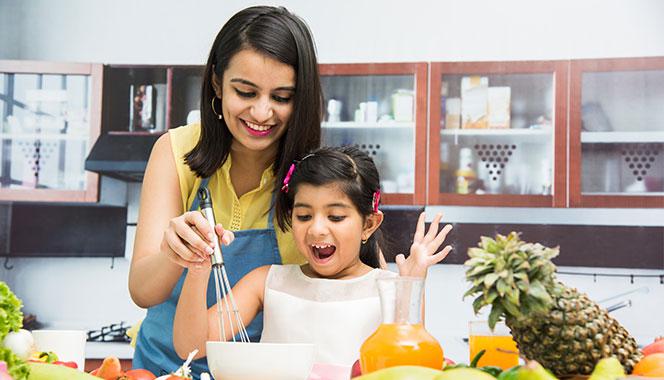
- The kitchen is a great place for children to learn about measurement and weights.
- Children love discovering patterns and plenty of opportunities exist to engage them in pattern sniffing.
What you can do right away
- When you think of a math-related activity, see if it can be converted into a game
- On your walk to the bus stop or to the playground, ask your preschooler the different ways in which she can classify different plants and/or leaves (according to size, color, etc.).
Enhance early math skills with The Dot math program for pre-primary children. This program is tailored for LKG students, ensuring the development of numeracy skills and number sense. Children are encouraged to interact with their environment to learn about shapes and spatial relationships. The program establishes a strong mathematical foundation in children.


















Comments
Jayanthan Dec 4, 2020
Edit
Comment Flag
Cancel Update