
STEM for Girls: Be bold and believe in yourself
Vani Venugopal
On the occasion of National Girl Child Day (January 24), we spoke to Dr Srimathy Kesan — founder and CEO of Space Kidz India—about women in science, technology, engineering and mathematics (STEM); gender bias and gap; and encouraging girls to embrace science studies and jobs
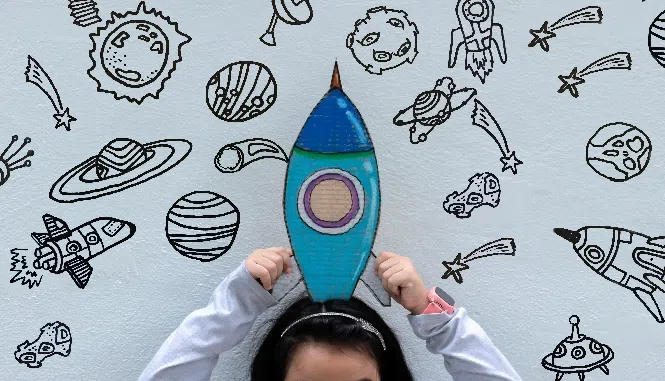
Close your eyes and think of a scientist. Who comes to your mind? A man or a woman? You’re not alone if the scientist you pictured was a man. In fact, most of us would instantly think of a man. While this reflects gender stereotypes that have been ingrained in us, it’s sadly not far from the truth. Currently, there are far more male scientists in the world than female scientists. The disparity, despite all the progress we’ve made over the years, is still quite significant. The United Nations Educational, Scientific and Cultural Organization (UNESCO) Science Report 2021 revealed that women are still underrepresented in science and tech fields, including IT, computing, physics, mathematics and engineering. The report showed that while there was an increase in women’s enrollment for STEM courses, the gender gap widens when they pursue careers, especially in high-paying positions.
So, what leads to this gap?
While there are several contributing factors, the strongest one is the gender bias against women in STEM. Science and math are considered male domains, while the arts and humanities are considered female domains. Girls and women are encouraged to choose the humanities and are often denied opportunities to pursue STEM. Interestingly, the biases that lead to this gender gap start early. And parents play a significant role.
| Research shows that parental attitudes play an important role in children’s career choices. A survey titled ‘India’s Future in Next-Generation Tech & STEM,’ conducted by edutech platform Avishkaar, found that 30% of Indian parents feel that the “work environment” in our country in STEM-related fields is more suitable for men than women. |
To understand more about women in STEM and what we can do as parents to bridge the gender gap, we spoke to Dr Srimathy Kesan, founder and CEO of Space Kidz India. An educator and social entrepreneur, Dr Kesan founded Space Kidz India to expose children to space technology and aeronautics and create young scientists for the country. The organization is the first one in the world to have successfully launched 12 balloon satellites, two suborbital satellites and two orbital satellites, entirely made by students.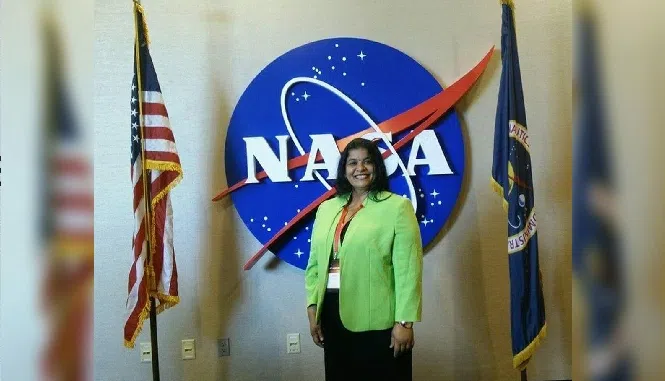
Dr Kesan is an ambassador to National Aeronautics and Space Administration (NASA) space camps and has mentored over 1,500 young astronauts from India to participate in them.
In this interview, Dr Kesan talks about her journey as a woman navigating the world of STEM, how she fought gender bias and how parents can encourage more girls to take up STEM careers.
Q. When did you first become interested in space? Tell us about your journey.
Well, my space journey began much later in life. I took a 16-year sabbatical after I got married. I did many things to keep myself busy, like voiceovers and choreography. But I was beginning to feel that I had to do something more. That was when I met a lady, who gave me an opportunity to go to Miami, US, to attend a travel conference.
It wasn’t easy getting permission from my family to travel. I finally convinced them to let me go, just six hours before the flight! Somehow I got to Miami, and that’s where I saw a presentation by NASA. My eyes welled up watching it. I interacted with the team, and when I asked them if I could bring children from India for the space camp, they said yes. At that moment, I felt it was destiny. This was the calling that I had been waiting for all these years. So I came back and started Space Kidz India, in a small way, from home.
Space Kidz India started as an education research tourism organization. After traveling to NASA regularly, seeing and touching rockets, I got super motivated, and I decided, “Okay, now we have to design and launch our own satellites!” Everyone thought I was crazy. There were so many ifs and buts, but God was kind enough, and we have been able to launch almost 21 missions to date.
Q. When you were growing up, were you ever dissuaded from pursuing your passions and interests because you were a girl?
I was born in a very conservative Tamil Iyer family. Although we lived in Hyderabad, my parents were very deeply connected to traditional values and ideas. All the women in the family would go to school and then college, and that’s about it. They were not allowed to participate in extracurricular or other activities. But I was a bold and outgoing person. I participated in everything possible. As you can imagine, it was tough.
Once, my school principal had to come home and persuade my parents to let me play in the basketball team because I was a good player. After this, my father became very supportive of me pursuing sports. He also pushed me to join the NCC (National Cadet Corps), and was very excited to see me as an armed forces officer.
Q. In recent years, women worldwide have spoken up about sexism and gender discrimination in STEM fields. Why do you think such a bias exists?
This bias is deeply rooted in our DNA, I would say. It’s ingrained in us right from childhood. At home, too, you see this discrimination. For instance, if there’s a power cut at home, the father and the male child will immediately go to fix the electrical box. Only the men are involved in it. Whereas in the kitchen, the mother and the female child are involved in tasks like cooking and cleaning. So, right from childhood, parents ingrain the idea in children that boys and girls must do only specific tasks.
Also, men are told from an early age that they have to be the breadwinners and that they have to pick well-paid professions to run the family.
So, they are pushed to pursue tech subjects. Women are taught to accept whatever the man is bringing home and adjust. They are not given an opportunity to explore careers.
Traditions and cultures have evolved now, and many female students have started studying core engineering subjects. But when you compare the percentage of women and men in engineering colleges or in STEM fields, there’s a considerable gender gap. The accepted notion is that women can’t handle STEM careers— for instance, women can’t take up mechanical engineering because they can’t handle the shop floor!
Women have also accepted such notions to an extent. This is why you see most of them in professions like banking and teaching. If we close our eyes and imagine a teacher, a woman’s image will come up. Who is a nurse? Again, we visualize a woman.
But when we think of a pilot or an officer in the armed forces, it’s a man. Even when we say scientists, people think of male scientists. They don’t talk of women scientists. However, women have made significant contributions to science, including space science.
Katherine Johnson helped Neil Armstrong and others go to the moon, but she was black and a woman, so everything was against her. She became an unsung hero.
Q. Like you said, we see more boys enter STEM fields than girls. When and how do you think this bias begins?
The bias starts at home. And as children grow up and go to school, the bias strengthens. As soon as a girl child is born, parents and society want her to become a doctor. When a male child is born, he is branded as an engineer—this is how things have been in our society for years now.
Parents and schools encourage girls to participate in science competitions but only until high school, because they do good projects, they have artistic designs, and they can talk well. When you compare a boy and a girl in Class 9, you’ll see the girl presenting much better than the boy. Because of this, the knowledge component of girls is ignored; only their presentation skills get attention.
Moreover, parents and teachers do not encourage girls to take an interest in technology. Girls are instead told that they will get married and have children, and that managing the family will be difficult if they get into tech jobs. They are told that their family is their priority and that they should pick a profession that will allow them to focus on that and leave the hard stuff to men. That’s why girls drop out of STEM from high school.
There’s a larger number of girls who take up medicine. However, many women who have studied medicine stay at home, taking care of their families. This is because doctors have to be on call at night. If there are any emergency cases at night, then they would have to rush to the hospital, and this doesn't go well with their families.
If a woman is out late at night, she gets a bad reputation, or risks her safety. And if she is married, she'd be blamed for not taking care of her family. But no one says these things to men, who play an equal role in parenting. It’s always considered women’s responsibility to raise children.
We need to understand that women cannot flourish in their careers without a sound support system, both at home and in society.
Q. Have you faced gender bias in your career? How did you overcome these hurdles?
The biggest challenge I faced was my education because I came from a commerce background. I entered a field that was a man’s space. So, it was very easy for everyone to brush me aside and not take me seriously (“She doesn’t know the subject”). It wasn’t easy initially.
But with my background in NCC and sports, I never gave up. When I fell, I stood up. Whenever people spoke ill of me, I didn’t let that affect me.
I put up a bold face, though I cried when I returned home. But then I would stand in front of the mirror and say to myself how ugly I looked when I cried. I would pat myself on the back and say, “I’m doing something good. It’s okay even if I don’t have an aerospace engineering background. I will learn, I will study and understand the subject as much as possible. I’m an entrepreneur who has taken that first bold step; I’m the first Indian woman to do it.” “Come on, I can do it” — this was my attitude. And this attitude has taken me a long way. And I work with children. If I break, they will break completely, they will not make that first step. I was also aware that I was an inspiration to many women and girls. That motivated me to try harder. I told myself that I would do it, no matter how difficult it was. And by the grace of God, that attitude has made me who I’m today.
Q. As parents, how can we overcome gender bias and inspire the next generation of women in science?
You have to give equal opportunities to both boys and girls. Tell them that a boy can cry and a girl can be strong. Teach them that, right from the beginning. Parents are the first teachers—how you bring your children up is their first lesson. Then comes school. Don’t tell them that this is a man’s job or a woman’s job. Don’t make that differentiation. Encourage girls to take an interest in STEM. They have patience, perseverance, and are very good at multitasking—all of which will serve them well in STEM fields. Only the lack of confidence stops them from venturing out. We need to help them build their confidence and give them the support they need to pursue their interests.
Boys need to be taught how to respect women and how to stand by them. This learning has to start from childhood. If you don’t start learning certain things from the ages of 2 and 3, you’ll never learn them in life.
I believe that the way a man views and treats his wife depends on the way he views and treats his mother or sister. If his mother is a strong woman, he knows how to treat his wife, stand by her, and encourage her.
So, it’s very, very important that we teach our sons various skills, right from cooking and cleaning vessels, to mopping, and tell them that these are not “women’s jobs.” You have to raise them to know how to take care of their family and home.
With the support of men in their lives, women can do wonders. For example, take Marie Curie and her husband. Pierre Curie stood by her, and she won two Nobel prizes (in physics and in chemistry)!
Q. What skills will help girls build a career in science?
I believe that confidence is the most important thing. The rest will come with education. When it comes to technology, you’re always learning and putting it into practice. So, even if you fail the first time or the second time, at least by the 100th time, you’ll be successful. But confidence is one thing that cannot be taught. It has to come from within. People will try to pull you down for various reasons. If you’re not confident enough to get yourself up there, you’ll not make it. Be bold and brave to face the world.
Q. If you had to give a message to girls and women in STEM, what would that be?
Go with your inner instincts. Ask the universe what you were born for, and you’ll get beautiful answers. And if the answer is that you were born to be a scientist or an engineer, forget the rest of the world. Believe in yourself, march forward like a warrior, wage war and conquer the world.
Enhance your child's cognitive skills and scientific thinking skills with The Dot Me and My World program for kindergarten. It provides a solid foundation in science through sensory explorations and engaging experiments.




























Comments
Edit
Comment Flag
Cancel Update