
Breastfeeding for new mothers: Newborn Baby Feeding Schedule By Age (0 to 5 Months)
V Saravana Kumar
If you have a newborn, feeding the little one needs meticulous planning. We have outlined a detailed newborn feeding schedule and all you need to know about breastfeeding

Feeding a newborn is both an exciting experience and a slightly scary one for a mother. At the same time, it is a great way to bond and gives both the mother and the child a feeling of absolute bliss. But at times, breastfeeding a baby might turn out to be quite a challenge for young parents - they would not know when to feed the baby or how much to feed them. This is where a baby feeding schedule or a baby feeding chart is of great help.
Babies in the age group of 0 to 5 months are fed exclusively with breastmilk. However, a proper feeding schedule needs to be followed to make sure that the baby is neither underfed nor overfed. Keeping to a newborn feeding schedule and subsequently following a baby feeding schedule by age promotes a hassle-free baby-feeding experience. This way, nursing mothers are not only able to manage their breastfeeding schedules but also ensure that their precious little ones are adequately fed.
If you are also a new mother, then, together, let's take a look at what you need to know about feeding your newborn.
Importance of breastfeeding
Breast milk is considered the best food for a newborn baby. In fact, experts recommend that babies should be breastfed for as long as possible. A statement released by the WHO titled, 'Exclusive breastfeeding for six months best for babies everywhere', advises mothers to exclusively breastfeed babies for the first six months, and even continue for two years or beyond. Breast milk is unique baby food, as it contains all the nutrients that a newborn needs, including lactose, protein (whey and casein), vitamins and fat. These are all easily digestible and don't cause any gastrointestinal irritation to babies.
Benefits of breast milk
Breast milk offers numerous benefits to a baby. Here are a few of them:
- It provides optimal nutrition to the baby, as breast milk has the right amount of carbohydrates, vitamins, proteins and fats.
- It contains vital antibodies, such as Immunoglobulin A, that help a baby fight various bacterial and viral infections, including infections of the respiratory tract and gut.
- It promotes the growth of beneficial gut bacteria.
- It may minimise the risk of the common cold, allergies, diabetes and childhood leukaemia.
- While ensuring that a baby gains sufficient weight, it prevents childhood obesity.
- It regulates a baby's appetite.
- It is known to facilitate a baby's brain development, resulting in a higher IQ, and reducing the risk of behavioural problems and learning disabilities.
With so much goodness in it, breast milk should be the only choice of food for a baby under six months of age.
Breastfeeding schedule and chart
To make breastfeeding effective, a mother should follow an optimal timetable to feed the baby. We present here a month-wise breastfeeding schedule starting from newborns and going up to 5-month-old babies, which one can follow according to the baby's age.
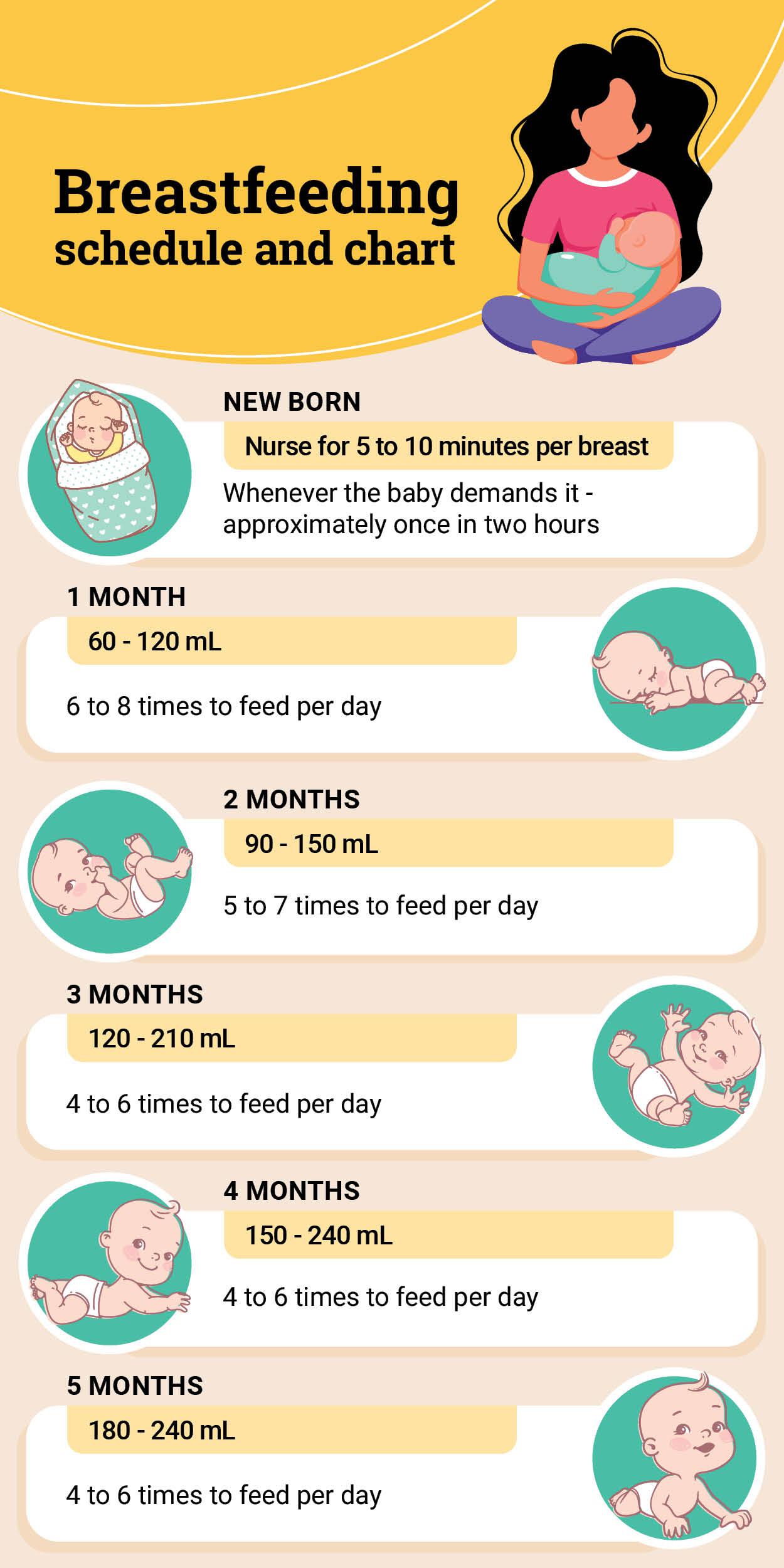
Note: The quantities recommended are only approximate values. As a rule of thumb, feed your baby whenever they indicate they are hungry.
Signs of a hungry baby
A question that most new parents ask is, "How would I know that my baby is hungry?" Your baby knows quite a few ways of telling you that they are hungry. Apart from crying, your baby might:
- open their mouth and stick out their tongue
- pucker their lips as if they are sucking
- move their head sideways
- place their hands or fists in their mouth
- rub against their mother's breasts
Tips for breastfeeding
Every new mother would love to make the whole breastfeeding experience an enjoyable one. Here are some useful breastfeeding tips:
- A comfortable posture is important during breastfeeding. You can either lie on your side with your baby facing you, or sit in a reclining position and hold your baby in your arms.
- Free yourself of any kind of stress while breastfeeding your little one. Try to relax, because your little one will be able to sense your nervousness or tension, and might not latch on to the breast properly. Choose an environment that makes you feel calm. Before starting to nurse your baby, take a few slow, deep breaths.
- The way you position your baby is crucial. Their position should be such that their mouth is at the same level as your nipple. Keep their chin pressed against your breast so that their nostrils are not blocked and they are able to breathe freely.
- Regular nursing can make the delicate skin of your breasts dry or cracked, which might make breastfeeding painful. To avoid this, pat your breasts dry using a soft cloth after every feeding session. You can also wash them with clean water and expose them to air occasionally.
- New breastfeeding mothers might have questions about the amount of milk they secrete, and wonder if it will be enough for the baby. Don't worry. Your body is capable of producing enough milk to meet your child's requirements. So, under usual circumstances, you would never run out of milk.
- Nurse your baby as often as possible to avoid engorgement. If this happens despite regular feeding, try to manually express the milk while standing under a shower. This will increase the milk flow and relieve your pain.
- It is very important for you and your baby that you keep yourself well-hydrated. Drink as much water as you can. Importantly, make it a rule to drink a glass of water whenever you are nursing your baby.
- Your little one is the best judge of when they need to be fed. So, don't force-feed them; look out for the signs mentioned above that indicate they are hungry.
Make sure you follow the breastfeeding schedule perfectly so that your little one gets all the goodness that breast milk has to offer. More importantly, bask in the joyful bonding that breastfeeding gives - to you and your baby.
Baby's water requirement
Your baby gets all the water they require from the breastmilk. So, there is no need to give them water separately, unless they have diarrhoea or you think they are in danger of dehydration. In such cases, all you need to do is feed them 1 cup of water a day, in small portions at regular intervals.
Formula food for babies
Breast milk has no equal when it comes to providing nutrition and immunity. However, some mothers cannot breastfeed their babies for various reasons, such as when they are sick, have insufficient lactation or have to get back to work after maternity leave.
In such a scenario, the only substitute that comes close to breastmilk is formula milk, also known as baby formula or infant formula.
Formula milk is manufactured using purified cow's milk, whey, casein, a blend of vegetable oils, and lactose. These ingredients provide the required amount of protein, fat, vitamins, minerals and carbohydrate to the babies. It comes in both ready-to-feed liquid form, and as dry powder which can be mixed with water. Lactose-free formula milk is available for babies who have lactose intolerance. The feeding quantity and frequency of formula feeds are the same as those of breast milk.
To recapitulate, breast milk is the perfect food for your bundle of joy. Formula feeds can be used if, for some reason, breastfeeding isn't possible. Feeding on demand is the right way to go initially. As the baby grows from 0 to 5 months, a food timetable can be introduced and followed.
We hope our practical tips and schedules for feeding your baby would have cleared your doubts and make breastfeeding moments a time for bonding and joy.



























Comments
Edit
Comment Flag
Cancel Update