
Mathemagic Part 3: Simplifying Complex Math Through Fun Puzzles And Games!
Visram Ramachandran
In Part 3 of our 'Mathemagic' series, we unlock the power of puzzles and games to help your child understand ‘complex’ math elements in the simplest manner

We take the excitement higher with some more interesting puzzles. In Part 3, we introduce your child to the intriguing Fibonacci sequence, and we get them to solve challenging math riddles and have fun with a card game involving integers.
Fibonacci
Numbers can always be arranged based on some underlying logic and they have a way of arranging themselves beautifully! Fibonacci sequences are one of the most famous arrangements, formulated by Fibonacci, a very talented Italian mathematician. A Fibonacci sequence is one where every number in the sequence (except the first two) is the sum of the previous two numbers in the sequence.
One of the simplest Fibonacci sequences starts with 0 and 1: 0 1 1 2 3 5 8 11 19 ….
Here's another example: 4 6 10 16 26 42 ….
Fibonacci sequences have a wide range of applications, including computer programming, music, and nature. They are also used by the most popular stock and commodity analysts and traders to understand complex chart patterns. It is a great idea to introduce your child to this concept early, and in a simple manner. Now, pick any two numbers and build your own Fibonacci sequence!
| Did you know? Fibonacci was responsible for popularising the Indo-Arabic numeral system (the Indian decimal numeral system developed by Indian mathematicians) in the western countries. |
Here are some more cool number patterns. Complete them.
Magic with 8 1 X 8 + 1 = 9 12 X 8 + 2 = 98 123 X 8 + 3 = 987 …………………… …………………… …………………… …………………… …………………… 123456789 X 8 + 9 = 987654321 |
Magic with 9 1 X 9 + 2 = 11 12 X 9 + 3 = 111 123 X 9 + 4 = 1111 …………………… …………………… …………………… …………………… 123456789 X 9 + 10 = 1111111111 |
Magic with 1 1 X 1 = 1 11 X 11 = 121 111 X 111 = 12321 …………………… …………………… …………………… …………………… …………………… 111111111 X 111111111 = 12345678987654321 |
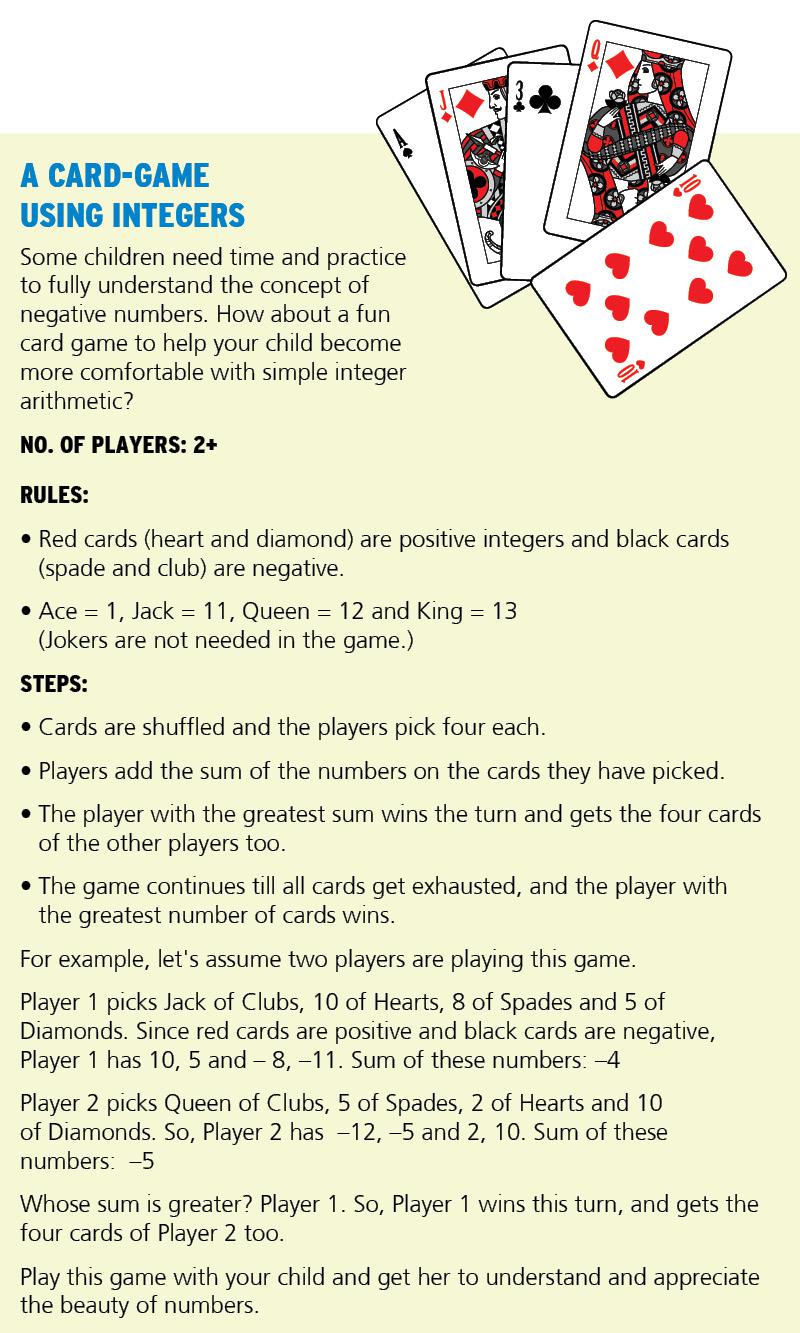
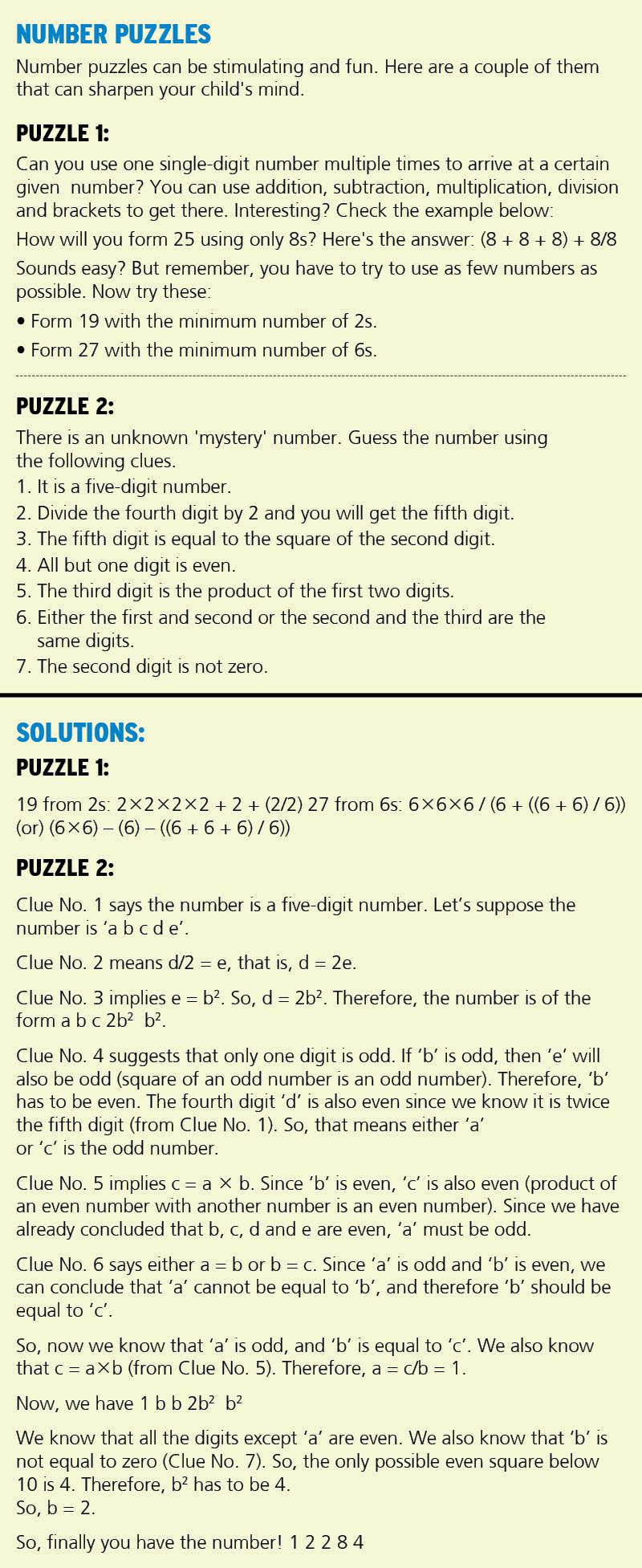
We hope the puzzles gave your child an adrenaline rush! If your child finds it difficult to solve the puzzles, explain the solution to them and encourage them to try solving the puzzles on their own again.
Visram Ramachandran is a vice president in an investment bank and a connoisseur of mathematics.
Also Read:
Make math learning fun for children



























Comments
Edit
Comment Flag
Cancel Update