
Why It's Important For Your Child To Learn The Mother Tongue and tips to promote its use
Saakshi Kapoor Kumar
author parentcircle author parentcircle author parentcircle author parentcircle author parentcircle author parentcircle author parentcircle author parentcircle author parentcircle
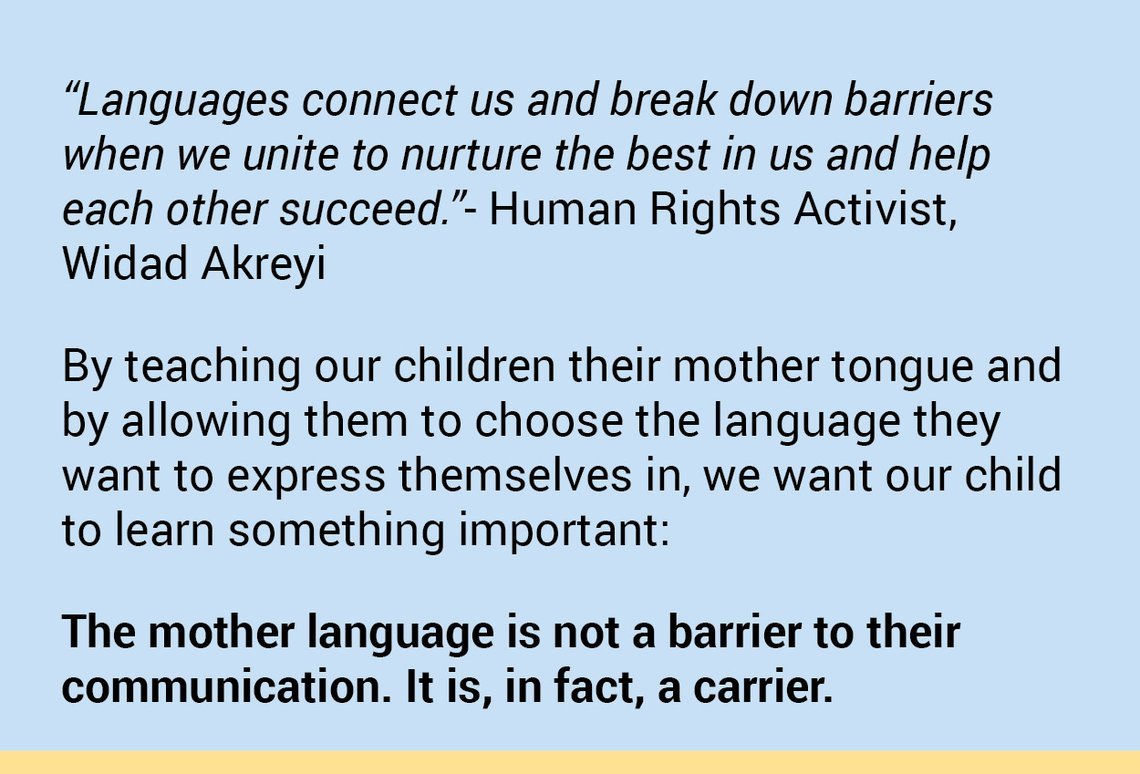
On International Mother Language Day, let's celebrate our mother tongue. Find out what you can do to encourage your child to learn and speak her mother tongue

Seema was looking forward to enrolling her daughter in preschool, but she was very nervous. Her 2.5-year-old daughter, Nitya, knew only her mother tongue. Seema was afraid this would hamper her daughter's performance in preschool where English was the language of learning. She began talking to her daughter more and more in English. But as days drew closer to the start of the academic year, she realized that Nitya was still more comfortable communicating in her mother tongue. Seema was concerned but forcing her child to speak only in English made it stressful for both mother and daughter. Once Nitya started school, it took her a few months to get comfortable with English. Slowly, as she became more and more comfortable speaking in English, she was able to easily switch between the two languages. Her learning was not hampered and in fact, Nitya began to communicate clearly in both the languages.
Do you know that every year, February 21 is celebrated as International Mother Language Day? The United Nations Educational, Scientific and Cultural Organization (UNESCO) has been celebrating this day for about two decades to promote multilingualism and preserve linguistic diversity.
The theme of this year's International Mother Language Day is, "Fostering multilingualism for inclusion in education and society," and UNESCO is urging policymakers to impart education, especially in the early years, in the child's mother language.
But why is the mother tongue important?
In a world that is experiencing rapid globalization, one may ask: Why does a child need to know their mother tongue? Well, for one, it's a well-researched fact that multilingualism has positive effects on a child's cognitive development and academic performance. Research by Baker and Cummins in 2000, published in Multilingual Matters, found that learning the mother tongue can help a child build a strong foundation for further language development. So, when the parents at home encourage the use of the mother tongue on a daily basis, they help their child develop a deeper understanding of how to use sounds and language to express himself verbally and communicate effectively.
You're probably wondering how learning one's mother tongue will impact the learning of another language once your child enters preschool. Let's find out.
One thing leads to another
Have you ever wondered how children learn to translate from one language to another without being explicitly taught? This is because the transfer across languages can be extremely smooth and easy for children who have been exposed to multiple languages right from an early age. So, a child can carry his mother language to school and bring another one back home, just like Nitya did. This is true even for children whose mother and father speak different languages. Simply put, all the languages a child is exposed to nurture each other. For the child's brain, the two (or sometimes more) languages are interdependent.
Benefits of learning the mother tongue:
1. Brain Development
- According to research, when children begin school with a strong foundation in their mother tongue, they build solid literacy abilities in the other languages taught at school.
- When children are exposed to learning multiple languages, the areas of the brain related to language and language acquisition show significant growth.
- .Parenting expert Linda Halgunseth in her article 'How Children Learn a Second Language' says, "There are many cognitive benefits for young children who are simultaneously (rather than sequentially) exposed to more than one language. For example, they have greater neural activity and denser tissue in the areas of the brain related to memory, attention, and language than monolingual learners."
2. Identity
"If you talk to a man in a language he understands, that goes to his head. If you talk to him in his language, that goes to his heart."
- Nelson Mandela
- When your child speaks in her mother tongue and someone responds in the same language, it's not just the brain and the tongue at play, it's also the heart. When such a connection is formed, it builds confidence in your child to express herself freely.
- For years, psychologists have believed that language plays an important role in strengthening the bond between a child and the parent or caregiver. Go back to your own childhood. Think about how many times your parents or grandparents used your mother tongue as an expression of love. Those special words and colloquial terms-they are heirlooms of sorts, valuables that need to be passed on to your child. The mother tongue helps your child connect and identify with the family.
- As we become global citizens, learning our mother tongue will help us retain our socio-cultural identity. In fact, many argue that the role of the mother language is even more significant today to preserve one's cultural identity, when people are migrating and living in other parts of the world that are culturally different. Knowing and conversing in your mother tongue is a sign of respect to the culture you belong to.
3. Diversity and Inclusion
- With our cities becoming a melting pot of different cultures, our children are more likely to encounter people who speak different languages. If our children realize that their mother tongue is just as important as any other language spoken by their friends, they will appreciate the uniqueness of their own language as well as that of others. The key is to encourage your child to accept and respect these differences. It's about helping your child understand that there's unity in diversity, or better still, empathy in diversity. It is the need of the hour.
- When children grow up speaking their mother tongue, they are likely to form a bond with a group of people who speak the same language. They feel connected and accepted as part of a special, unique community.
Tips to promote the use of mother tongue
Now that we have discussed why learning the mother tongue (or father tongue!) is important for your child, here are three ways you can encourage your child's love for their mother tongue at home:
1. Converse often in the mother tongue
This seems like a given. However, speaking in your mother tongue should not be restricted to your home. Encourage your child to converse in her mother tongue with others outside your home. When she hears you converse in your mother tongue with others around you, besides just family, she will feel more confident and prouder about knowing her mother tongue.
Many parents expect their child to speak in English as soon as they step outside their home. But this doesn't benefit the child. Your child's language abilities are still a work in progress and with such expectations, she's likely to get confused, not by the languages (because children are better at learning languages than adults), but by your insistence that she should speak one language at home and another outside. Trust that with time, your child will figure out which language is to be spoken in which situation. Until then, allow her to express herself in the way she feels most comfortable.
2. Introduce your culture, not just the language
This can be a challenge, especially for those living in nuclear families and in metropolitan cities. Here are few simple ways to introduce your culture to your child through your mother tongue:
- Narrate folk tales in your mother tongue (or better still, have grandparents do this!).
- Listen to the folk songs in your language, and sing and dance together.
- Pull out old childhood pictures and share stories about them in your language.
- Point to things around you at home, in the grocery store, or on an outing to the park, the beach, zoo or elsewhere. Tell your child the names of the different things in your language.
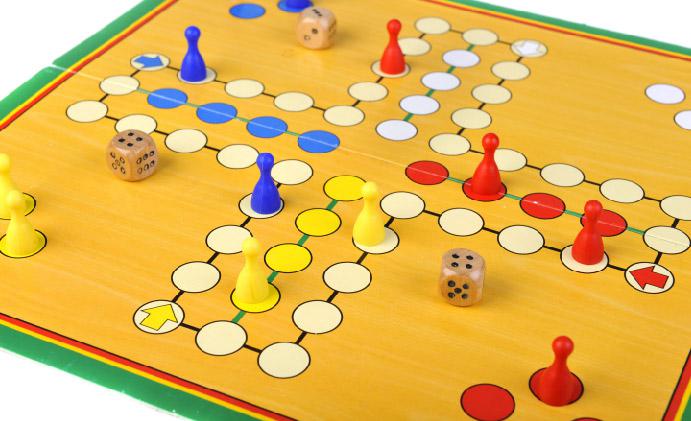
- Play childhood games from your culture to introduce your child to various action verbs and special vocabulary.
- When you use your mother tongue as the means of communication to plan and celebrate festivals and special functions at home, your child picks up the nuances of your mother tongue and the uniqueness of your culture.
- Cook recipes unique to your culture, and talk to your child about what makes a particular dish special. Gradually, your child will become familiar with the vocabulary of food-he'll learn the ingredient names and descriptive words to describe food in your culture.
3. Take her to your native town
As children love learning more about their families, there's nothing better than a visit to the town you grew up in.
- All parents visit their hometown. However, there's a difference between visiting and living. Try to live like the local people do. Wear the clothes they wear, have your child talk to others in the mother tongue and eat the local food.
- Children whose grandparents are city dwellers need not feel left out. Hunt for cultural spots, places of worship and monuments near the city. Instead of the weekly mall visit, visit one of these cultural spots. When your child feels connected to her culture, she'll feel more connected to the language and will proudly converse in it.
What if each parent speaks a different mother tongue?
In today's world, there are many multiracial families, where each parent comes from a different culture and each one speaks a different language. Studies show that when children are younger than 7 years of age, their brains process all languages in a similar manner. When a child is exposed to different languages at an early age, she's able to understand the finer nuances of the language, such as the sounds and accents, the grammar and sentence structure. Later, as she grows, it becomes more difficult to master a language. So, early exposure to multiple languages helps your child master not one but many languages.
So, if your child is growing up in a household where multiple languages are spoken, expose her to all the different languages-mom can speak to the child in one language, dad in another, and maybe grandma in yet another language.
Wondering if your child will be confused? Initially, your child may show signs of slower language development as she tries to process the different sounds and languages she hears and what they are communicating to her. She'll probably mix up the different languages in one sentence as she speaks to you. That is wonderful. Her brain is beginning to make connections and distinctions between the different languages she's hearing around her. Soon, she'll be fluent in all the languages and will figure out how to switch between them as she talks to different people at home. And yes, you guessed it. She will be better than you in speaking your partner's mother tongue!
Another hidden benefit of knowing the mother tongue is that it can actually become a code language for your child. As your child grows, you will hear her happiness, her sadness, her secrets and even the occasional "Please don't embarrass me!" in your mother tongue. But the best thing you'll ever say or hear, in your own language, is, "I love you." Go say it to your child now and remember to use your mother tongue!
In a nutshell
- Learning the mother tongue can be highly beneficial for your child-it boosts brain development, builds cultural identity and provides a sense of security through acceptance within a special community of native language speakers.
- More and more education policymakers are rooting for education in the first language, at least in the early school years.
- Help your child gain fluency in your mother tongue by talking to her in your language during the early childhood years. Let her see you taking pride in speaking to others in your own language.
What you can do right away
- Converse with your child in the mother tongue more often, both at home and outside.
- Look up folk stories and songs in the mother language and narrate them to your child.
- Help your child find 10 words they love in their first language. Help him teach these 10 words to others who don't know, and ask him to learn 10 words from a friend's mother tongue.
- As your child grows, give him enough exposure to the mother language through movies, books, videos and of course, grandparents.
Support your child’s English language acquisition skills with our specialized language and communication program for pre-primary children. The program helps build your child’s confidence in language fluency.

























Comments
Edit
Comment Flag
Cancel Update