
Attachment parenting and breastfeeding. Why breastfeeding is important
Aarti C Rajaratnam
author parentcircle author parentcircle author parentcircle author parentcircle author parentcircle author parentcircle
Breastfeeding isn't only about nourishing the child but is also an important component of attachment parenting. Read on to know more
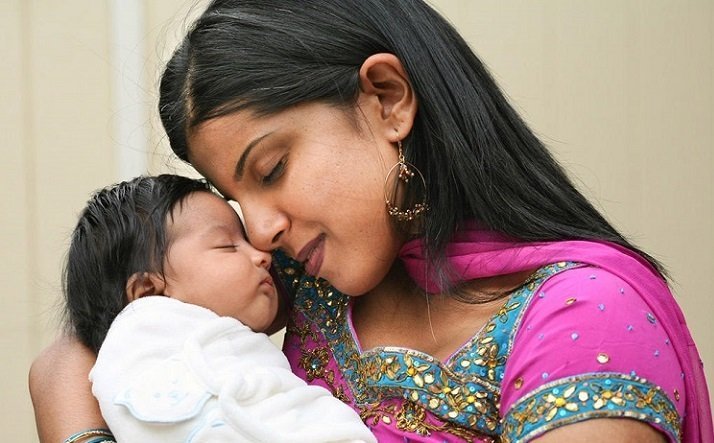
The term 'Attachment Parenting' was coined by the American pediatrician William Sears. The concept of attachment parenting is influenced largely by the attachment theory. The idea is to be sensitive and responsive to the needs of a child to help them feel securely attached to the parent. Attachment parenting, unlike other parenting practices, stresses treating children with as much dignity, love, and respect as that afforded to an adult. It is guided by the following eight principles:
- Prepare for pregnancy, birth and parenting
- Feed with love and respect
- Respond with sensitivity
- Use a nurturing touch
- Sleep is physically and emotionally safe
- Provide consistent and loving care
- Practice positive discipline
- Strive for balance in both personal and family life
Mother's milk is one of the primary needs of an infant and breastfeeding is the healthiest infant-feeding choice. The physiological changes brought about by breastfeeding enhance maternal responsiveness and have several positive outcomes. Breastfeeding plays an important role in teaching infants that parents will listen to their cues and respond to their needs. This creates a sense of trust and security in the baby and helps develop secure attachment. The attachment parenting principle of 'Feeding with Love and Respect' is facilitated greatly by breastfeeding. It helps in developing a deep bond between the infant and the mother.
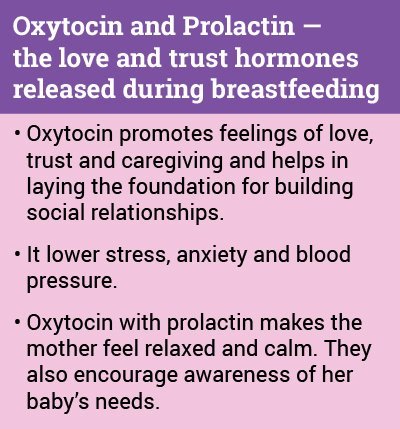
Oxytocin and Prolactin - the love and trust hormones released during breastfeeding
• Oxytocin promotes feelings of love, trust, and caregiving and helps in laying the foundation for building social relationships.
• It lower stress, anxiety, and blood pressure.
• Oxytocin with prolactin makes the mother feel relaxed and calm. They also encourage awareness of her baby's needs.
The skin-to-skin contact in breastfeeding increases awareness of each other. As a result, the baby feels nurtured all the time. Being close to a responsive mother helps the growing child become aware of their emotions and develop emotion-regulation skills. These skills are the two most important components of early childhood development and, lead to emotional intelligence later in life.
Breastfeeding and attachment parenting
- Breastfeeding is the primary exercise used in attachment parenting to help the mother learn 'baby reading'. The mother keenly observes the baby's cues and body language to understand what they mean and to respond in a timely and effective manner.
- Breastfeeding helps the mother 'know' her baby. The mother begins to understand the meaning of every sound made by the baby. In India, mothers and elders usually assume that every 'cry' indicates the need for a feed. This leads to the habit of emotional eating because the baby learns to associate distress with food.
- Feeding is considered an essential component of attachment and bonding, particularly in attachment parenting. The mother respects the child's need for a feed and responds to it - thus, treating them as an equal in the mother-child relationship. This makes the baby feel emotionally safe and become more aware of affection through touch.
- No request for a feed is ever turned down by the mother.
- There is no pressure to wean the baby at a particular time. Breastfeeding is associated with providing nourishment as well as strengthening the mother-child bond. This contributes to the overall well-being of the baby.
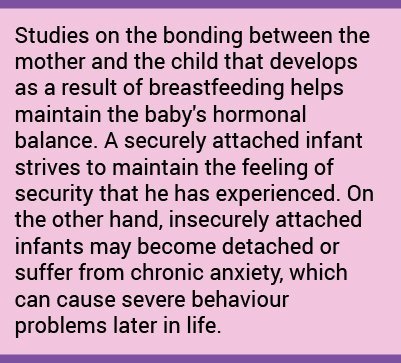
Studies on the bonding between the mother and the child that develops as a result of breastfeeding helps maintain the baby's hormonal balance. A securely attached infant strives to maintain the feeling of security that they have experienced. On the other hand, insecurely attached infants may become detached or suffer from chronic anxiety, which can cause severe behaviour problems later in life.
How breastfeeding benefits the child
The feeling of secure attachment which develops through breastfeeding and the mother's response to the child's needs helps build an infant's trust in the mother. Research shows that this helps in better:
- physical growth
- emotional growth and adjustment, intimacy, empathy and love
- communication between parent and child, resulting in enhanced language development
- organizational skills
How breastfeeding benefits the mother
When the mother is more attuned to her child's needs, she is better able to communicate with and later, discipline her child. She becomes more aware of her child's competencies and preferences as the little one grows.
The relationship between the mother and the child encourages mutual sensitivity, trust, connectedness and flexibility - all of which bring out the best in each other. Watch the following video to learn more about bonding and breastfeeding.
More breastfeeding stories we love
Diet chart: We bring you the top 7 essential nutrients for breastfeeding moms
Breastfeeding myths and facts that every mother should know
The many benefits of breastfeeding for both the mother and child























Comments
Edit
Comment Flag
Cancel Update