
How To Choose The Right Age Appropriate Toy For Your Child
Virginia Jacob
Can toys be more than just fun and games for kids? If chosen wisely, even a simple and low-cost kids toys can help your child experience, explore, discover and grow, says India's favorite toy maker. Find out how.
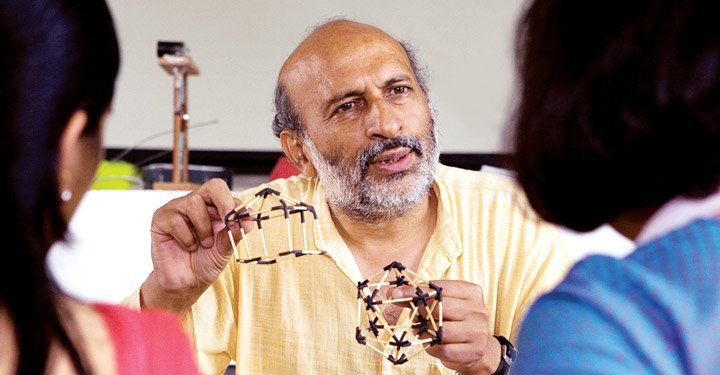
Toys are magical. They have the power to mesmerize a child, engage her senses, spark her imagination and make learning super fun. Who better to shed more light on this than the famous toy maker, Arvind Gupta, who uses everyday materials to create handmade toys.
In an exclusive conversation with ParentCircle, the Padmashri awardee emphasizes that toys provide rich experiential learning in children. What's more, he also gives parents tips on how to choose the right toy.
What role do toys play in shaping a child's mental, emotional and physical growth?
Play is very serious business, said a very senior psychiatrist. Children who do not play are unhappy and remain so, even after they grow up.
Before children learn to understand, they need to experience, which they do by seeing, touching, hearing, tasting, smelling, choosing, arranging and putting things together, and taking things apart.
Children gain experience of the real world by playing and experimenting with different kinds of materials, and learning to manipulate them. Our hands, brain and heart are integrated. So, what children do with their hands helps them learn. But what happens in schools is that children learn through mere recitation. They do not indulge in any learning activity. Therefore, we must try and give our children a rich experiential base. That's where toys help.
Through toys, especially self-made ones, children can learn about the properties of different kinds of materials. It is a great and inexpensive way of learning. When children document what they have learnt in words or in the form of drawings, it leads to better learning. What they document is something they have experienced.
In a market flooded with all sorts of toys, how does a parent make the right choice, especially considering toys are expensive and not necessarily durable?
Children wish to discover how things work. Therefore, they should be given stuff that is available around them. In fact, even pots and pans in the kitchen fascinate children and they love playing with them!
However, a lot of parents don't understand this. They often buy expensive toys but do not allow their children to play with them, fearing they might break them. As a result, children end up playing with the box in which the toy was packed in and not the toy.
Also, as parents, we must make a variety of low-cost, readily available materials accessible to children. These include sand, water and clay. Remember, when children are young, parents can decide on the choice of toys. But when they grow up, it will be best to let children make that decision.
When it comes to choosing toys relevant for specific age groups, it is unscientific. Over the years, people have been trying hard to categorize toys for different age groups. It doesn't work. The best toys transgress all age groups. Everyone can enjoy them.
Do you think Indian schools are doing enough to promote practical learning?
Unfortunately, the Indian system is based on obsolete thinking, where memorizing and absorbing a few facts are more important than comprehending.
An attempt has been made by the government of India to nurture children's creativity. Few years back the government launched Atal Tinkering Labs in 500 schools to allow children to explore their creativity by using ordinary materials to make extraordinary things. A good start!
Toy making is such an interesting choice of career! What inspired you to pursue it?
In the mid-1970s, I was a part of the Hoshangabad Science Teaching Programme (HSTP), which aimed at making science fun for children in village schools. We used very simple, low-cost and locally available materials to revitalize the learning of science. We then realized that toys would dovetail beautifully into this kind of pedagogy. Making toys will be a great hands-on activity.
Children will enjoy making toys and learn science in the process.
Traditional Indian toys are often made with materials that are discarded. Such toys impart the very important lesson of recycle and reuse to children.
We called these science experiments "Toys from Trash". So, that's how it all began.
Toys from Trash. Very interesting. Do you think DIY activities and make-your-own-toys are better than readymade ones?
DIY toys are any day better than factory-made, mass-produced toys! More than fifty-two million children across the globe have viewed our videos on how to make toys from trash on www.arvindguptatoys.com. Also, buy nothing but common inexpensive materials and help your children make their own toys. This is the best gift parents can give children.
Give children materials such as straws, tubes, sheets of paper and cards. In the process of making toys, children learn skills like cutting, pasting and assembling different materials. If a toy doesn't turn out as it should, children will understand that they should work harder to make it better. The best parents are those who tell their children, I don't know it myself. Lets do it together. This instils a great deal of confidence in children.
Your message to the ParentCircle community.
Parents should never think that nurturing children is the sole responsibility of schools and the government. They have a stake in their children that no teacher or government has. So, parents must spend as much time as possible with their children.
If possible, parents should compromise on their income for the sake of spending more time with their children. More than all the riches, children value the time they spend with their parents the most.
Awards and recognition
- Distinguished Mathematics Teacher Award by the Association of Mathematics Teachers of India (AMTI) (2016)
- 50 Most Talented Social Innovators Award, World CSR Day (2015)
- The Indira Gandhi Prize for Popularization of Science conferred by the Indian National Science Academy (INSA) (2008)
- The Outstanding Science Teacher Prize by the C N R Rao Education Foundation (2010)
























Comments
Jayanthan Feb 12, 2021
Edit
Comment Flag
Cancel Update