
The Fascinating ‘Mathemagic at Home’ Series – Part 1: Unveiling More Math Wonders!
Visram Ramachandran
Does your child run away every time you talk about maths? It's time to make maths what it really should be - FUN. Our new series, 'Mathemagic,' is tailor-made to make math learning a fun experience.

"Without mathematics, there's nothing you can do. Everything around you is mathematics. Everything around you is numbers."
- Shakuntala Devi
Some children take to maths like fish take to water. But the truth is many children struggle with it. In many ways, the education system has lost its way when it comes to teaching maths. What should be a super-fun subject has become mere formulas and theorems. Well, you can change that. You can make mathematics enjoyable for your child by helping them find beauty in the subject. We present a brand-new series on how mathematics can become 'Mathemagic.' In this series, we look at fun puzzles, sequences, and games that can help your child appreciate the subject and realize that it is not just about 'incomprehensible' theorems and definitions. Without any further ado, let's get started!
Playing Bus!
Let's start with a simple game to instinctively develop basic counting and progression skills - 'Bus!' This can be played by any number of participants. Here, players take turns and call out consecutive numbers, but when they reach multiples of 5, they call out 'Bus' instead of saying the number. Here's the sequence: 1 - 2 - 3 - 4 - Bus! - 6 - 7 - 8 - 9 - Bus! ....The participant is 'out' if she says the multiple of five instead of 'Bus.'
But let's challenge ourselves with a slightly more stimulating form of the game. Three numbers are decided at the start of the game. Let's call them the Inceptor, Increment and Mask. The Inceptor is the starting number. Player 2 adds the Increment number to the Inceptor and says the sum. The next player adds the Increment number to the previous sum and says the new sum, and so on. Every time the sum happens to be a multiple of the Mask (chosen unanimously at the start of the game), the player should say 'Bus!' and NOT say the sum. The participant is 'out' if they say the sum instead of 'Bus!'
If the 'theory' confused you, look at the 'practical' example below. Let's say the Inceptor is 8, the Increment is 3 and the Mask is 5. The sequence goes as follows:
8 - 11 - 14 - 17 - Bus! - 23 - 26 - 29 - 32 - Bus! - 38 - 41 - 44 - 47 - Bus! - 53 ...
Try playing this fast, and it will be great fun to catch participants miss shouting 'Bus!'
You can also make it more challenging by picking two masks, say, 4 and 5.
8 - 11 - 14 - 17 - Bus! - 23 - 26 - 29 - Bus! - Bus! - 38 - 41 - Bus! - 47 - Bus! - 53 ...
Tower of Hanoi
This age-old classic problem was invented by French mathematician Edouard Lucas in 1883. The Tower of Hanoi is an interesting puzzle with several discs and three rods. The discs need to be inserted into one of the three rods.
The discs are initially stacked on Rod 1 in order of size, with the smallest at the top. The goal is to move the entire stack of discs to another rod. You must try to achieve this within the smallest number of moves. But wait, there are some rules:
- You can only move one disc at a time - remove it from its stack and place it in another. Only then can you touch the next disc.
- A disc cannot be placed on top of a smaller disc.
Try it out! You can also build your own 'Tower of Hanoi' using cardboard and paper straws. Start with a small number of discs, say three. How many moves did you need to shift your stack of three discs from one rod to another?
Answer: The smallest number of moves needed to move the stack from one pole to another is 2^n - 1, where n is the number of discs. This means that for three discs, you should be able to move the stack in 23 - 1 moves, that is, 7 moves. Did you manage that?
Mastermind
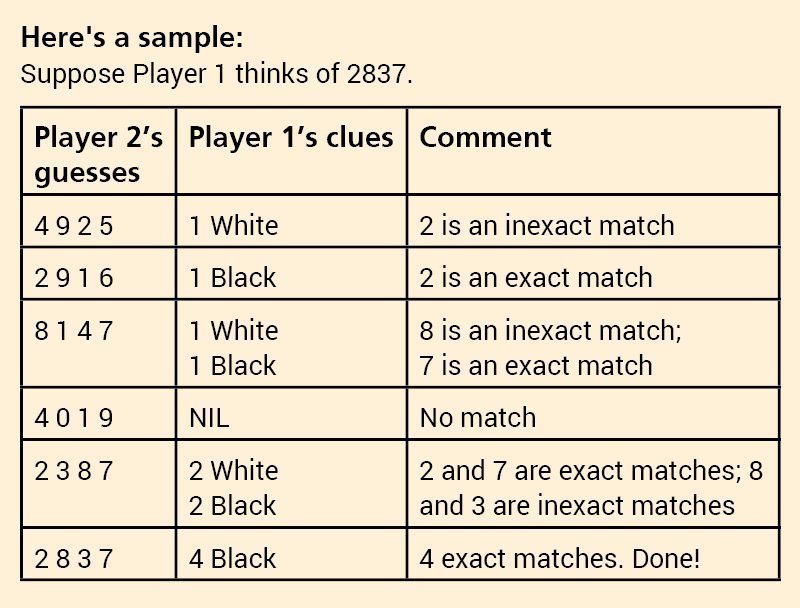
Mastermind is an interesting game that can be played by two people. Player 1 thinks of a four-digit number and gives clues to Player 2, who tries to guess the number in as few guesses as possible.
At each turn, when Player 2 guesses the four-digit number, Player 1 compares the number given by Player 2 with the number he has picked and gives clues:
- how many digits match exactly
- how many match but are in a different position
- how many don't match
You can use colors or anything else to represent the hits. For example, black (exact match) and white (inexact match).
Did you find that refreshing? When your child learns to appreciate the nuances of maths, they will not find the subject intimidating. Rather, they will start enjoying it. Maths develops analytical skills, critical thinking and problem-solving skills, creativity, spatial awareness, logical reasoning, and more. Hope you enjoyed part 1 of our Mathemagic series. Now, go to Part 2 as you continue to fall in love with maths.
Also read:
7 interesting ways to make maths fun for your child
10 tips to overcome the fear of maths
Counting with fingers is good for the brain
About the author:
Visram Ramachandran is vice-president of an investment bank and a connoisseur of mathematics.
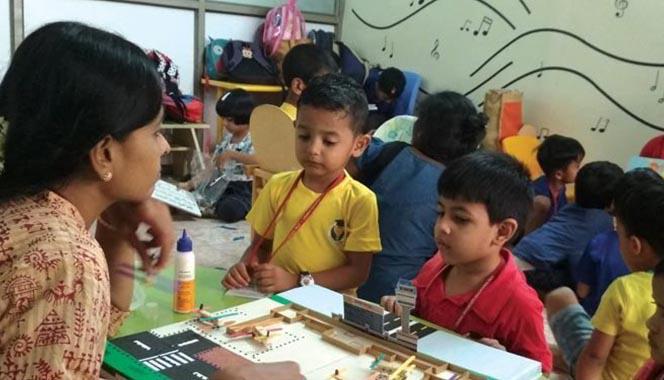
The Dot math program keeps in mind the learning trajectories of children. The lessons are hands-on and activity-based and include age-appropriate worksheets that help build a sturdy foundation in math.




























Comments
Edit
Comment Flag
Cancel Update