
Building And Navigating Friendships In The Digital Age: How Social Media Shapes And Transforms Modern Relationships
Meera Mathews Marrate
Meera Mathews Marrate is a ParentCircle Author has knowledge about parenting.
Social media has taken over the way we interact with people. Read on to learn the implications of your child forming digital friendships.

Maya, a mother of two teenage daughters, is fine if her children use social media to connect with friends, as long as it is within limits. She says, as a modern-day parent, you need to understand that children are fundamentally wired for socialization. Social media gives them that perfect platform.
Maya's good friend Navin, father to a teenager, firmly believes that friendships should be formed based on quality time spent together. According to Navin, being physically present for important life experiences is what really matters.
Navin and Maya may be next-door neighbors and good friends, but they're worlds apart when it comes to their thoughts on friendship. Well, this is the new-age reality. Whether you support Team Virtual or Team Real, it is undeniable that the nature of friendship is constantly evolving. But has the essence of friendship changed due to this evolution?
Timeless friendships
When the young and the old talk about what they expect from a friend, and invariably, all conversations lead to the same three expectations:
- Someone to talk to
- Somebody to depend on
- Someone to have fun with
Over the years, most experts have agreed that true friendship can be developed only through many face-to-face interactions. Looking back, before the advent of social media, there was a certain charm in the way friends used to communicate and bond, which further strengthened relationships.
- Before texting, it was a global norm in schools for students to pass notes with amusing anecdotes and funny observations covertly.
- After meeting a new friend over summer vacations, you kept in touch through letters.
- You knew where your friends lived, so it was perfectly normal to drop in unannounced. In other words, it was fun to gate-crash.
- Long conversations over the phone with your bestie were the best part of the day.
- You waited all year to send and receive birthday cards. And most of them became keepsakes.
Connected cocooning: Friendships on social media
A decade or two ago, meeting new friends, keeping in touch, and maintaining friendships was often very difficult due to geographical limitations or time constraints. Today, social media plays a key role in filling this gap. It helps people stay connected even when separated by distance.
Social media has opened a world of global interaction with the power to change our outlook and the nature of friendship. It's a tempting platform that lets you meet and maintain an extensive network of friends.
Teenagers today are a part of a culture of Connected cocooning a phrase coined by music channel MTV. It describes how the MTV generation is constantly wired to a network of digital devices, or more precisely, social media platforms.
Based on two surveys conducted by Pew Research in 2015 in the US, teens are increasingly going online to make friends. A majority (57 percent) have met at least one new friend online, while 29 percent said they have met at least five friends that way. However, most of these friendships remain online; only 20 percent of teens have met an online friend in person.
The report further adds that most digital friendships are made through social media and online gameplay. Teens use texting in their day-to-day interactions. For boys, chatting and hanging out together while playing video games is crucial to developing and maintaining friendships. Social media introduces teens to new friends and keeps them connected to existing friends. It connects them to their friend's lives and feelings and offers them support during challenging times.
Easy way out?
Multiple studies over the years show that individuals participate in virtual interactions because it is less stressful emotionally. It is easier to say things that would be difficult to say face-to-face. For example, when two friends are in a fight, it is easier to cut off their relationship through a text than do so in person.
According to Indhu Rebecca, a psychology educator who works with teens, Social media tends to dilute relationships and exacerbate issues unnecessarily. This is especially true for teenagers, considering they spend the most time on social media. Making friends has never been easier. Click on a blue button and your friend's, friend's friend becomes your "FB BFF!!", Silly, isn't it? However, for a teenager, the number of likes for a FB post or the number of 'Friends' following them on Instagram is a matter of pride and status. They take it as evidence of their popularity, reflecting on how in and happening they are.
As 17-year-old Vidhya Ram says, I chat with my online friends for hours. But when we pass each other in the school hallway, we don't even exchange a glance.
Parents and teachers should be tuned in to their child's virtual life and open to conversations about it. It is important to impress upon the child the need to steer clear of the dangers posed by social media. It is equally important not to sound preachy (teenagers hate that!).
A 2013 study by Dr. Sam Roberts, a senior lecturer at the University of Chester in the UK, found that face-to-face people were 50 percent more likely to laugh and considered themselves significantly happier. In the words of Dr. Roberts, Quality, not quantity, of communication is most important for keeping friends for life.
Parent talk
Those were the days...
Rita, the mother of 15-year-old Ashwin, vividly remembers her personal experiences with her friends during her childhood. My mother had to drag me back every evening from the playground. I refused to leave my friends. Ironically, there are times I threaten to physically remove the iPad from my son's hand when he spends too much time on the Net. I guess he refuses to leave his friends as well.
Safety first
Anu, the mother of 15-year-old Adwaita, says, Back in my teenage years, my parents used to talk to me about how I should be careful of befriending strangers and be aware of my surroundings. Although times have changed, whether it's for online or offline friendship, two words Safety First still holds true.
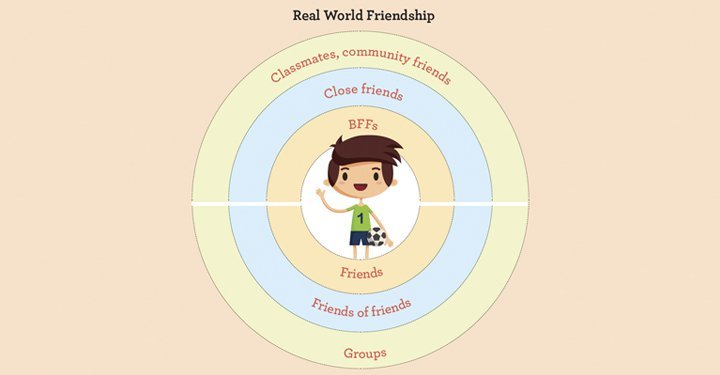
Friendships in the real world
Pros
- Sense of belonging: Having a closely-knit group of friends can make your child feel important and valued and not judged.
- Together with a smile: Hanging out with friends, laughing, chatting, and playing together creates happy times and memories for your teen.
- Support system: Your teen's friends are there to help him with everyday issues be it school work, problems with peers or even, close personal issues. They keep him grounded and motivated.
- Influence: Your teen's friends are a great influence in her life. Spending time with her friends will help your child understand herself better, her likes and dislikes, how to handle situations, and the people she connects with best.
The challenges
- Communication can be difficult in the case of distance and separation.
- Meeting up often requires a lot of planning, especially if friends move to different colleges and cities.
- You need to invest the time to strengthen the friendship.
Virtual friendships
Pros
- Connect with the world: Social media has no geographical limits. Your teen can connect with people having similar interests from different countries.
- Comfort factor: If your teen has social anxiety, social media will help build his confidence and develop his communication skills. Online friends will encourage him to say what he really feels and thinks.
- Sense of belonging: The feeling of belonging to a network of friends and peers enhances your teen's self-belief. It creates a comfortable environment where your child can interact with friends without feeling pressured. When her friend's message, Follow her or Like a photo, your child feels appreciated and loved.
- An effective outlet: Texting and chatting online with friends your child knows in person can be an effective medium for him to express disappointments, frustrations, and fears. The additional support he receives from peers online can help him overcome stressful experiences.
- Keeping up with friends: Social media is a great way for your teen to know what's happening in her friends' lives and to offer encouragement and support to each other.
The challenges
- There is a lack of physical interaction.
- There is an increased risk of misunderstandings because online interactions do not involve a tone or body language.
- Conversations online are not spontaneous. Teens think and respond, and this can increase social anxiety.
- Teenagers write to a screen in online interactions. It is easy to dehumanize the people your teen is interacting with, and your teen could end up writing something he would never say in person.
- Teens deal with real-life problems with friends by texting rather than solving these issues in person for fear of dealing with hurt emotions.
- The number of 'Followers' and 'Likes' begins to define your child's self-esteem and status. Sometimes, teens will remove posts if they do not get enough 'Likes'.
- When friends only post about the good in their lives, others assume their lives are perfect. Teenagers begin to compare and feel their lives are less interesting.
- One can easily be cat-fished (talking to someone using a false identity).
- Your teen can become addicted to his devices because of the need to always stay connected with the outside world and friends.
- Social media is a highly opinionated environment. It can make your child dejected if opinions do not go his way.
- Teens can feel socially excluded if they are not invited to join certain online groups, or when they find out about events posted on social media they are not invited to.
- Getting bullied online by peers can take a toll on their emotional well-being.
Teen talk
An interesting world
13-year-old Advait loves the way social media keeps him in the loop and connects him to people with similar interests. He says, I love basketball and joined an online group of young basketball lovers. I made some great friends there. We discuss matches, favorite players, etc. I feel that I am part of something bigger than myself. I feel a sense of belonging when connected to a community of friends and peers.
No communication gap
11-year-old Vikas feels social media has helped him to open up. He says that chatting with friends online helps me feel comfortable as I feel less awkward and anxious.
Stress buster
14-year-old Pia says that looking at photos and updates of friends online helps me understand them better and allows me to peek into their lives. It opens up lines of communication and understanding. When I feel stressed, I vent online to my friends and it helps me feel less frustrated.
Besties in action
15-year-old Rehaan says, I love the fact that I share funny and sad moments with my friends, be it winning a match or doing poorly in an exam. I've made some good friends this way. I was never into reading, but my best friend is an avid reader. Recently, I accompanied him to a library and randomly picked up a book to kill time. To my surprise, I enjoyed it. Now, we go together to rent books.
My friend, my strength
13-year-old Arya says, If I want to talk to my friend, all I need to do is call him. I don't have to wait for him to come online. Knowing that my friends will be with me if I face any trouble gives me strength and makes me happy. I met my best friend in second grade. I love the fact that we know everything about each other.
Top 5 apps/websites popular among teens
Facebook allows users to connect with friends, family, and other people they know, share photos and videos, send messages, and get updates.
What parents need to know:
- By default, the Facebook settings are set to public, not private. You'll need to reset the privacy settings manually.
- Anyone can send your child a 'Friend' request. Changing the privacy settings can help you filter unwanted 'Friend' requests.
- Only for users above 13 years. Parental consent is required for children below 18 years.
WhatsApp allows users to send text messages, audio messages, videos, and photos for free.
What parents need to know:
- Only for users above 13 years. Parental consent is required for children below 18 years.
- After you install the app, it automatically connects to other WhatsApp members in your contact list.
Twitter is a microblogging site that lets users post brief messages called 'Tweets'. You can also Follow other users' activities.
What parents need to know:
- The 'Tweets' are public by default. The privacy can be changed in the account settings to 'protected Tweets'.
- There is no minimum age requirement to sign up. Parental consent is required for children below 13 years.
Snapchat is an image messaging app to share pictures and videos which can be viewed for a short amount of time.
What parents need to know:
- Only for users above 13 years. Parental consent is required for children below 18 years.
- In this messaging app, once an image is viewed, it is deleted. However, teens need to be careful and not share inappropriate pictures.
Instagram allows users to capture, edit, and share photos, videos, and messages with friends and family.
What parents need to know:
- Photos are public by default unless privacy settings are changed.
- Instagram Direct has an option that allows users to send Private messages to mutual friends. These pictures don't show up in the public feed.
- Only for users above 13 years. Parental consent is required for children below 18 years.
With so many new ways to talk to people, the world can seem a bit confusing, especially if you aren't up to date with technology. Now, with all this information, you are in a better place to guide your teen when it comes to forming friends digitally and non-digitally.





























Comments
Edit
Comment Flag
Cancel Update