
Cyber Laws: An Exclusive Interview With Cyber Security Expert Debarati Halder
Team ParentCircle
Debarati Halder answers questions related to cybercrimes and laws your teens should know about

Dr Debarati Halder, LLB, LLM, PhD (Law), has been championing for the rights of children and women for many years now. An expert in cyber law, she is the honorary managing director of Centre for Cyber Victim Counselling and is also the founder-secretary of South Asian Society of Criminology and Victimology.
Excerpts from the interview:
Q. What are the dos and don'ts that children should be aware of while using the internet? Are there any guidelines they should follow?
The Information Technology Act 2000, amended in 2008, is a statute that all children who use the internet must know. There are two segments to this act-one discusses the civil penalties and the other is about the criminal offenses. Under the civil penalties section, offenses related to computers such as spreading of computer viruses, denial of access, etc., are discussed.
Unauthorized access is considered both a civil and a criminal offense. Creating any offense with the help of a computer or any offense targeting any particular computer, breaking of the device, creation of fake profiles, etc., are considered crimes. Impersonation of people, impersonation for cheating on the internet, etc., are also considered crimes. Cyberterrorism is a serious offense under the Information Technology Act, for which even the death penalty can be given.
Instances where the victim is forced to reveal their private parts, etc., are considered as voyeurism as well as privacy infringement. If such visuals are shown to someone, it can be considered a criminal activity, both under section 67D and 66E. Voyeurism is addressed under section 354C and stalking under section 354D of the Indian Penal Code (IPC)-both are focused on women and girl victims.
Showing rape or sexual assault videos to someone is considered a criminal activity both under the IPC and the Information Technology Act. You must also consider the Protection of Children from Sexual Offenses (POCSO) Act, which clearly mentions that creating any sort of sexual assault video, pornography, or child sexual abuse content using children or children's profiles is considered a criminal activity.
Certain offenses do not have any focused law. For example, revenge porn, bullying, or trolling. But there are other laws which can come together and address this particular issue.
If the perpetrator happens to be a child, they are not going to be excused as these statutes include all persons, including children. The POCSO act is also very clear that whoever does cyber harassment, stalking or the creation or sharing of sexually explicit material must be punished. So, in that case, a child can be a victim and also a perpetrator.
According to the juvenile justice care and protection statute, children are divided into two segments, one is the child who needs care and protection, i.e., the victim and the other the child who is in conflict of law, i.e., the perpetrator.
The act clearly mentions that if a child has committed any offense, they will not be excused. They can be apprehended, and if it is a heinous offense, they may not be given any bail. In such cases, they will be taken to the juvenile justice board and may be kept in the observation home.
Q. How can parents prevent their children from committing cybercrimes?
Parents must provide proper information to their child. They must tell them to be careful and responsible when using the internet, or any social media platform. They shouldn't share any information or content that might harm other children or adults. They must not infringe on the privacy rights of others or create any sort of offensive content.
Parents must also understand that money cannot solve all problems when their child is in conflict with the law. In several cases, we have seen that the bail or the fine has been rejected by the courts. This is because the courts feel that parents are actually supporting their child's criminal activity by paying the fines or sureties. Thus, they have often taken the decision not to leave the child with the parent. The child is instead secured in an observation home, where they go through a correctional system.
No parent would like their children to be detained or to be put in an observation home. We all love our children, so it is our duty not to support children when they are carrying out offensive activities online.
Q. What can parents do if their child is being cyberbullied?
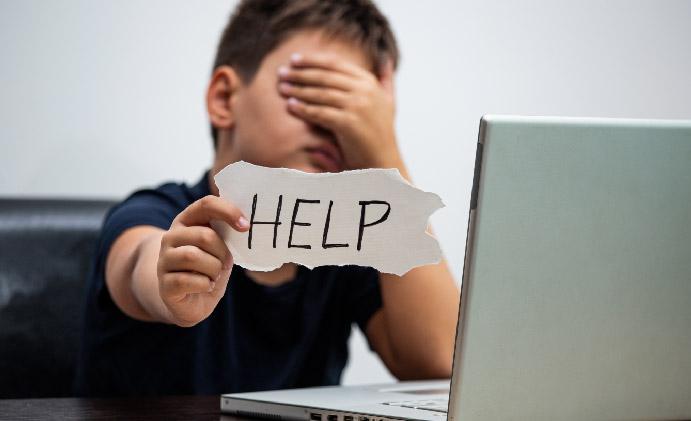
Listen to your child. If they say, "I am being bullied or I feel uncomfortable around certain people," find out what's bothering them. Every web platform has its own reporting mechanism. So, if you see any sort of offensive content, take a screenshot and report that profile. If possible, block that profile. This way, that profile cannot contact your child's profile anymore.
However, the same person can create multiple profiles. So, ask your child not to share any sensitive photographs with anyone as photographs can go from one device to another quickly. Social networking sites like Instagram and Facebook provide a platform where children can choose their trusted friends. There is an option where the profiles can be made private and only trusted friends can be given access to it. Encourage your child to use this feature.
Q. Is age restriction important when it comes to children using the internet?
There is a definite need for age restriction. Legally, a child cannot create an email ID before they turn 13. Parents should be aware of this and ensure that their children do not try to create one with false age proof ... As new-age children are cyber savvy, it is necessary that the government and the concerned websites create some kind of an age-restriction mechanism that prevents younger children from creating or viewing certain content.
Here, I must mention that YouTube actually has a very good age-restriction policy whereby adult content will not be shown to anyone until and unless they verify their age and logs in through their email ID. However, the problem is that there is no foolproof mechanism to implement an age restriction to create an email ID. What if the child creates an email account and then visits those sites?
While age restriction is necessary, it is also important that the child and the parent have a solid relationship where the child can trust the parent and say, "I have seen these things. How can I stop them from popping up on my device?" Parental monitoring is also necessary along with the age-restriction mechanism.
Q. Do teens and parents need to worry about the security of applications, software, or cloud-based storage they use?
Cloud storage is something that has attracted a lot of privacy debates of late. There have been many cases where it has been hacked or data has been leaked from it. I feel that parents and children, to the extent possible, should not use cloud storage. You can consider storing your data on a hard disk. If you are storing data in a cloud, make sure that all safety measures have been taken. Once the data is up, you have to keep an eye on the settings, numbers, pin numbers, etc., and update it accordingly.
There are groups that made money during the lockdown by selling private data to unethical groups. So, we have to be very careful about what we are actually storing in the cloud storage and how we are going to make it more secure.
Q. What steps have been taken by the government to address cyber security issues and to strengthen the cyber security system in the country?
The first thing that the government has done-and I appreciate this-is the monitoring of fake news. Under Section 69 of the Information Technology Act, there is a clear mention that the government can, in certain situations, monitor the communication from one particular profile to another profile or bulk profiles. Under this, the government can block access to certain kinds of content. It can also monitor WhatsApp chats and other app-based chats to prevent circulation of fake news, content that incites communal hatred, etc.
The good thing about this is that even though our privacy is being infringed upon, to a certain extent, the circulation of fake news or content is now being regulated. During the initial period of lockdown, the circulation of fake or harmful news targeting a few families for allegedly spreading the coronavirus was a huge issue.
However, the government cannot monitor everything. Now, there are guidelines given by the National Commission for Women (NCW) and also the National Child Protection regarding cyber security. The United Nations International Children's Emergency Fund (UNICEF) is also preparing a policy guideline to ensure the safety of children while using the internet, which will be shared with all the stakeholders, including schools.
Q. What drives teens to become cybercriminals?
Children who commit cybercrimes feel a sense of achievement. Often, they feel that there is no monitoring authority. Earlier, when they were going to school regularly, they didn't have enough time to be online. But with the pandemic, they are online throughout the day, which is a factor that could lead them to commit cybercrimes.
Parental understanding is another factor that plays a part. Parents sometimes fail to monitor what their child is doing online even though they share the same room. They presume that the child is browsing for some content of their interest or is busy attending online classes. So, taking advantage of this, some young adults indulge in creating or watching harmful content.
Cybercriminals are coming up with mashed-up videos and fake news, too. For instance, after actor Rishi Kapoor's death, several videos were circulating unverified content. While some of these were done by professional perpetrators, others were by people who don't realize that this has a penal consequence.
Another kind of online crime is revenge porn or any other sexually explicit content. In most cases, the perpetrators assume that they can carry out these as the victim won't be able to raise their voice because of fear of blame.
Q. Can you please explain the difference between cybercrime, cyberbullying, and cyber juvenile delinquents?
Cybercrime is not extensively defined anywhere in our laws. Any criminal activity done through devices, software, social media apps, etc. could be termed as cyber-assisted criminal activities. Criminal activities that are done through machines such as hacking and phishing also come under this.
Now, coming to the question of cyberbullying. We must understand that cyberbullying, cyberstalking, and cyber harassment are not the same. Cyberbullying is the creation of harsh or insulting comments, which are posted either in a group, to the person directly, or on a platform where everybody can see it.
Next are the juvenile delinquents. Some children may be committing cybercrimes with or without knowing its consequences. They are called juvenile delinquents who conflict with the law.
Q. If a parent were to find out that their child is involved in any form of cybercrime (either as a victim or even the perpetrator) what should be the immediate action to be taken?
From the parent's perspective, the immediate action should be to counsel the child not to panic first. Ensure that the child does not do any self-harm.
Always remember that if a child has created offensive content, their parents must immediately take note of it and talk to them and ensure that no such content is created in the future. If the victim is also a child, then, they should immediately contact the victim's parent, apologize, and inform them that all offensive content has been taken down. This may reduce the criminal liability of the child as well as the parents.
Debarati Halder is an advocate and honorary Managing Director of Centre for Cyber Victim Counselling. She is also the Founder -Secretary of South Asian Society of Criminology and Victimology.





























Comments
Edit
Comment Flag
Cancel Update