
Games To Foster Problem-solving Skills In Preschoolers. Have You Tried Them Out?
Pallavi Rao Chaturvedi
author parentcircle author parentcircle author parentcircle author parentcircle author parentcircle author parentcircle
Do your children become overwhelmed by problems, big or small? Do problems make them either rebel or withdraw? The simple process of regularly playing some games can train them to be more resilient

In today's high-octane world, even children as young as preschoolers often find themselves unable to cope with demands, both academic and social. The problems could range from perceived expectations regarding academic performance to matters of routine, like finishing a meal within a prescribed time. These issues will only increase with age. The good news is, that children can be equipped in a fun way from very early years to deal with pressures and problems.
These problem-solving games for 3-5-year-olds teach strengths to solve or overcome problems and reinforce positive behavior in a fun way.
Even if your child does not display any signs of distress, it is good to strengthen their critical and creative thinking skills, which are essential for problem-solving and will hold them in good stead later in life.
Problem-solving skills are related to the cognitive skill development of a child. Acquiring these skills in the early stages of life helps a child to build up not only their creative thinking skills but also their critical thinking skills. One great way to do this is to introduce problem-solving activities for preschoolers.
Children develop the ability to deal with problems in stages. When they are about six months old, they start looking for reactions to their actions, learning cause and effect. By the time a child completes their third year, they start relying on their memory to solve problems that they have already handled or have seen adults around them handle.
Research suggests that interactive games can be the best method to inculcate the ability to cope with problems. As fun activities, children easily accept them.
There are a number of activities that can help your child develop or enhance their problem-solving skills. Here are a few examples:
Problem-Solving Games and Activities for 3-5 Years Old
1. Sorting Tub:

This game requires children to pick up objects hidden in a tub of sand, identify similarities with those picked up by others, and form groups based on that similarity.
- How to play: Fill a tub with sand, and hide various objects in it, for example, colored shells or toy animals. Let the children pick out the objects, and join up in groups on the basis of some common factor - say color.
- Learning: Children will learn to identify with others on the basis of commonalities, and develop team spirit. This will enhance their ability to form social groups and be mutually supportive in the face of problems.
2. Skyscraper:

The aim is to build the tallest possible free-standing tower out of blocks. This is similar to Jenga, the game that requires one to pull out already placed blocks and continue to build up a tower.
- How to play: Give your child blocks (preferably wooden) of different sizes, and ask them to stack them up as high as possible.
- Learning: The child will understand the need for planning and patience in order to place the blocks in such a way as to create a sturdy tower. The same skills will be transferred to real-life issues.
3. Tangrams:

These can be used to teach children to think and make changes in their ideas to achieve desired results.
- How to play: A tangram is a Chinese puzzle consisting of seven pieces of different shapes. The pieces can be fitted together to form a variety of complex shapes. Preschoolers can be asked to make basic geometric shapes like a square or a triangle with them.
- Learning: Experiments suggest that visualizing the way these pieces can fit together can boost visual-spatial skills. The sub-text is that this activity boosts a child's ability to step outside their comfort zone and solve problems.
4. The listening game:
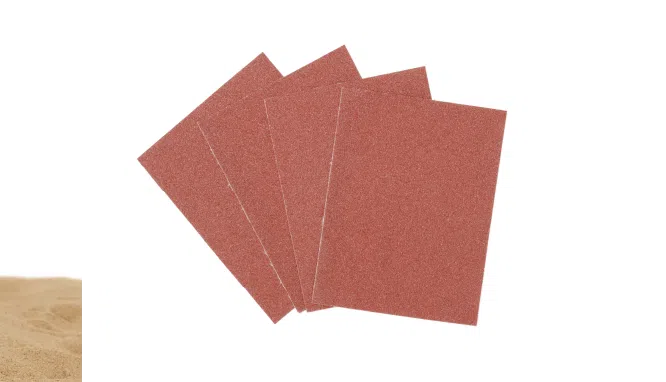
It involves letting the child handle objects of various shapes and textures, and explaining the unique characteristics of those shapes and textures. Spoons, paper, combs, and sandpaper are some of the objects that can be used.
- How to play: Give the objects to the children to handle. Next, ask them to close their eyes and pick an item to match the description you provide.
- Learning: The game helps the child to develop sensory abilities, and boosts his correlation powers, thus reinforcing critical thinking, which is crucial to problem-solving.
5. Simon says:
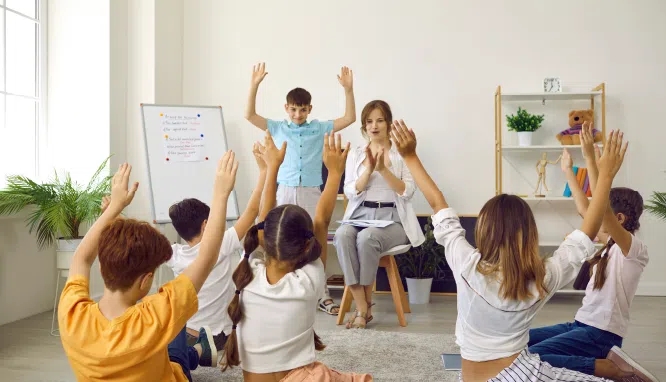
This is a traditional game in which children gather in a circle around one child, who is known as 'Simon'. They have to follow 'Simon's' instructions, but only if the instructions are preceded by the words, 'Simon Says'.
- How to play: Simon calls out actions starting with the phrase, 'Simon says'. Example: "Simon says, Clap your hands," or "Simon says, Tap your feet." Simon can intersperse it with instructions without the prefix, for example, 'wave your hands'. If the children obey instructions without the prefix, they will be out of the game.
- Learning: This activity enhances listening and grasping skills. It helps children learn to differentiate between instructions that are to be obeyed, and those that they should ignore. This is vital for handling pressures later in life.
6. Obstacle race:

In this race, the winning parameters are neither time nor speed but the ability to avoid obstacles.
- How to play: Put a series of different obstacles over a clear stretch of ground, and ask the child to move in different patterns to avoid them.
- Learning: This activity trains children to apply logic to avoid physical hurdles. The knowledge that hurdles can be overcome will give them confidence when they have to face other kinds of hurdles later in life.
Both parents and teachers must acknowledge the importance of instilling problem-solving skills in children from a very young age. Schools can conduct workshops for parents on various games that enhance the social, emotional, and cognitive skills that will build a strong foundation of problem-solving ability in their children.
Our comprehensive pre-primary curriculum nurtures the physical, social, emotional, and cognitive development of children. It offers parent connect, teacher support and professional development, and a continuous progress tracking system. The curriculum is aligned to the learning goals of the National Education Policy (NEP) 2020.





















Comments
Edit
Comment Flag
Cancel Update