
Storytelling for kids: Benefits, recommendations and literary strategies to improve narrative skills in children
S Seshadri
Your child loves listening to stories but do you know the art of storytelling? Read on to learn how to tell a story, the benefits of listening to stories and a few short stories to tell kids.
What is storytelling?
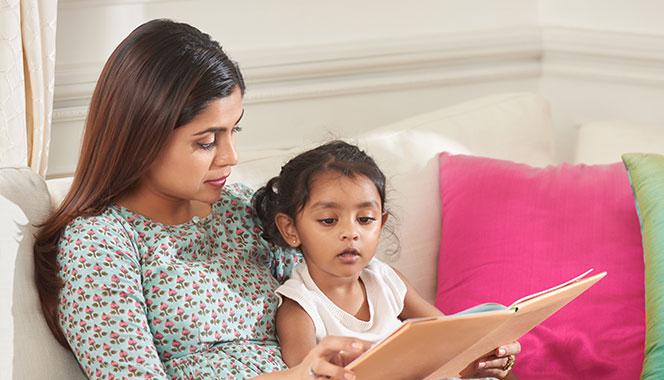
Listening to a story makes a child feel happy and kindles his imagination, especially those studying in kindergarten and preschool. Storytelling is the art of describing an event or a series of events, true or imaginary, in such a way that it keeps the listener engaged.
Values of storytelling
Benefits of storytelling
- Acquaints kids with the best of children's literature.
- Gives rise to curiosity in the minds of children as a story describes the lives of different characters and prevailing cultures.
- Increases a child's knowledge and enriches his vocabulary.
- Helps imbibe ethics.
- Develops listening skills.
- Teaches how to organize and express herself clearly, thus boosting confidence.
How to select a story for your child
Traditionally, grandparents have played the role of storytellers. Most of them tell stories from our Epics or Puranas that impart values to the listeners. And, in the absence of grandparents, mothers take on the role of a storyteller.
Storytelling plays an important part in molding the child's personality and value system. Anyone can be a good storyteller with a little practice and a genuine interest in the characters narrated in the stories.
As a storyteller parent, you can select stories from various sources - especially the Ramayana, Mahabharata, Jataka tales, Panchatantra, Fairytales of Hans Christian Andersen and Grimms' Fairy Tales.
Suitable stories for children of different age groups
Age group - 2 to 5 years: For children of this age group, the stories must be short and to the point. Stories should talk about familiar things that a child can relate to, such as animals, children, home, machines, people, toys, rhymes, humorous and poems, jingles. Typical stories would include 'The Three Little Pigs', 'The Three Bears', 'The Adventures of Little Red Riding Hood', 'Thumbelina' and more.
Age group - 6 to 10 years: Animal tales, stories of children living in other countries, and the ancient and modern fairy tales appeal to this group. Examples of such stories include 'The Elves and the Shoemaker', ' Rumpelstiltskin', 'The Steadfast Tin Soldier', 'Hansel and Gretel', 'The Sleeping Beauty' and 'Jack and the Beanstalk', tales from The Panchatantra and our epics.
Basic storytelling elements
A good storyteller makes sure that a story contains five basic elements: Action, drama, emotional appeal, a strong beginning, and a satisfying conclusion. To have a story with these elements, it may be necessary to rewrite or shorten stories, thus making them suitable for children.
Preparing to tell a story
Some time and effort are required to prepare for a storytelling session, but the effort is rewarding. A typical preparation would run as follows:
- Select an appropriate story.
- Know the story well before narrating it. Read the story the first time to get its flavor, then reread with specific attention towards the plot.
- Read the story once again. This time look for the distinguishing features of the dialogues, the unique quality of the characters, the setting of the story.
- Focus on 'the four': the introduction, the body, the climax, and the conclusion.
- To hold a listener's attention, the introduction should be short.
- The body of the story contains the action, the series of steps that lead to the climax. The storyteller must visualise each of these steps in the story while narrating.
- The climax is the heart of the story, giving meaning to the whole. Whatever impression you wish to make on the child, whatever message has to be passed on to him, has to be emphasized here.
- The conclusion merely ties up the loose ends and does not convey any new idea.
How to tell stories to your child
A few principles related to storytelling:
- Children prefer stories with dialogues.
- A story should have no more than four characters because children find it difficult to follow a tale with several characters.
- Never try to memorize all the dialogues from a story. Only commit to memory the necessary phrases or snapshots of interesting dialogues that lend drama - 'Once upon a time', 'Somebody is sleeping on my bed' and so on.
- Some stories are better read than told. Choose only such stories that lend themselves well for narration.
- Shortening the tale and deleting descriptive passages are acceptable practices.
- By recording a story and listening to it, you can improve your pitch, range and voice volume.
- Use gestures sparingly, as these distract attention from the story and divert the focus onto the storyteller. Facial gestures are enough.
- A dramatic repetition of the story increases the enjoyment of the story and enriches the vocabulary of younger children.
- At times, a child may get distracted. Then, you may ask the child a rhetorical question: "And what do you think happened next?"
The child as a storyteller
Children are imaginative and can come up with their own stories based on events, activities, expeditions, gardening, special days, festivals and so on. They enjoy telling stories that are real or imaginary, stories they have read or listened to, or something they have made up on their own. It is their way of sharing a moment with their friends or audience.
If your child is narrating a story, then listen to it with interest and encourage your child to:
|
What you and your child can do together?
Practice retelling stories
You tell the story first. The story may be retold in a few sentences by your child assuming different roles.
Developing a story
You can begin an imaginary story and introduce a couple of characters and an action plot. At some point, you can stop and ask your child, "Can you go on with the story?" The story can proceed as an activity.
Participating in storytelling
On the subsequent telling of the tale, you can pantomime and make the sound which your child can immediately repeat aloud.
Listen to stories
Many stories are available as audio and videos recording on the internet.
Storytelling resource on the webStory Arts Online: Storytelling activities, lesson plans, bibliographies and links are featured on this excellent website. Also, features a free newsletter. Kids Story Telling Club: This fun site features crafts, activities, and stories. Maintained by Story Craft Publishing. Child Fun: Based on the premise that parenting and teaching children are fun, this site has a wealth of ideas and free props (flannel board and puppet patterns to name a few) for storytelling. |


























Comments
Edit
Comment Flag
Cancel Update