
Benefits of Mixed-Age Learning: How Multi-Age Classrooms Support Holistic Child Development
Aruna Raghuram
While same-age classrooms are the norm, discover the benefits of mixed-age and multi-age classrooms that create rich, inclusive spaces where children grow at their own pace and learn from one another

Seven-year-old Ashish liked reading out stories aloud to his three-year-old sister Anusha. Her eyes would grow big as he came to the thrilling parts. His mother told him this activity had improved his reading skills. Moreover, Anusha was developing listening skills and beginning to grasp ideas faster. As Ashish pointed out the alphabet at times as he read, she was beginning to recognize some herself. She would ask questions that he was usually able to answer. This made him feel good about himself. Anusha had begun to hero-worship her older brother after these reading sessions had begun. Based on the multi-age interaction of these siblings, there could be benefits of mixed-age classes in schools, too.
At home, older children help younger ones pick up new skills, such as tying shoelaces or even learning how to count. This gives them a feeling of responsibility and raises their self-esteem while the younger ones learn faster, egged on by older siblings or cousins.
The practice of mixed-age grouping in schools simply tries to replicate this learning environment in a more formal setting. In a mixed-age group of children, the age range is between one and two years, and sometimes even more. While same-age classrooms are the norm today, experts believe mixed-age groupings may provide learning benefits for both younger and older children, both in the classroom and at play.
What research says
Way back in 1995, a study by Simon Veenman titled Cognitive and Noncognitive Effects of Multigrade and Multi-Age Classes: A Best-Evidence Synthesis found that there is no empirical evidence that student learning suffered in any way in multi-age (mixed-age) classrooms. Students in such classrooms did not learn more or less than students in single-age classes. In fact, students in multi-age classes scored higher on attitudes towards school, personal adjustment, and self-concept than students in single-age classes.
Why should children be grouped only by age?
A child's age is not always an accurate measure of physical, cognitive, emotional, or social development. For instance, a boy can be tall and strong and good at sports but fall behind in mathematics and struggle with languages. Genetic, as well as environmental factors (such as quality of nutrition and childhood experiences), also determine when specific milestones are reached.
Benefits of mixed-age classrooms
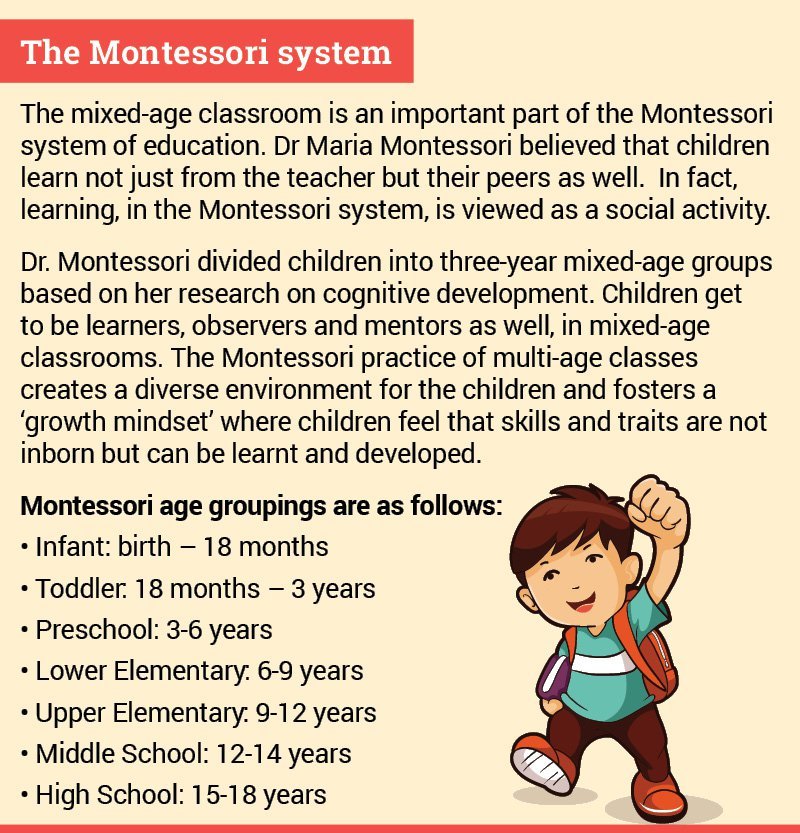
Mixed-age or multi-age classrooms are not just the foundation of the Montessori system of education; they have been adopted by other progressive schools as well. Here are some positives:
1. Child-centered teaching
Each child is viewed as unique. The focus is on the child and their strengths and weaknesses.
2. Learning at their own pace
Children do not get labeled according to their ability as fast or slow learners. They learn at their own pace, with no fear of retention or failure.
3. Social growth
Multi-age classrooms are conducive not just to academic progress but also to relationship building. Children form bonds with a wider variety of children, both in terms of their ages and abilities. Children treat their classmates like family members.
4. Learning experience
Children get into the habit of helping and learning from each other. Older children become mentors to the younger ones, and this improves their understanding of concepts as well as their competence. Some may take on leadership roles in class. Younger children can do things with the help of older children that they would not have been able to do with peers. They get the opportunity to observe and emulate older children. As they appreciate the achievements of older children, they are also motivated to achieve themselves.
5. More cooperation
Children are more likely to cooperate than compete in a multi-age classroom.
6. Building soft skills
Older children learn to be patient and kind as they interact with younger children. In turn, the younger ones learn lessons in collaboration and conflict management.
7. Flexible curriculum
The curriculum is less rigid as compared to traditional schooling. Younger children are exposed to advanced material, and older children have the chance to review material designed for younger children.
The cons - parental concerns
Of course, parents are bound to have reservations about mixed-age classrooms. Parents of younger children may feel that their wards may not be able to cope. Parents of older children may feel their wards may not find the curriculum challenging enough. Parents may wonder whether the teacher is up to the challenging task of handling a mixed-age classroom. Some parents may worry that their child is working in isolation on their own task, and there is insufficient interaction with classmates.
Parents of younger children may not be in favor of older children mentoring their own. They may feel it is better if the teacher does the instructing and guiding. Older children could be unreliable sources of information or poor teachers for the younger ones. Again, parents of older children may feel that if their children spend time guiding younger children, they may be missing out on their education.
What parents need to know
Parents should interact with the school authorities and teachers to put any doubts at rest. Some of the questions they could ask are:
- Why had the school opted for multi-age classrooms? Is it for budgetary reasons, a few number of children in the school, or a conscious educational decision to enhance learning outcomes?
- How was the teacher selected for this challenging task? Did the teacher opt to work with children of different ages?
- Does the teacher feel equipped with teaching materials to work with all the children in the class?
- Has the curriculum been changed to deal with the heterogeneous nature of the class?
- How will the teacher ensure the younger children are given sufficient attention and not be overshadowed by the older, more competent children?
Parents also need to ask themselves what they want from their child's school. Is it primarily academic achievement that they are looking for? Or, are holistic socio-emotional development and a strong friend circle equally important to them?
Benefits of mixed-age play
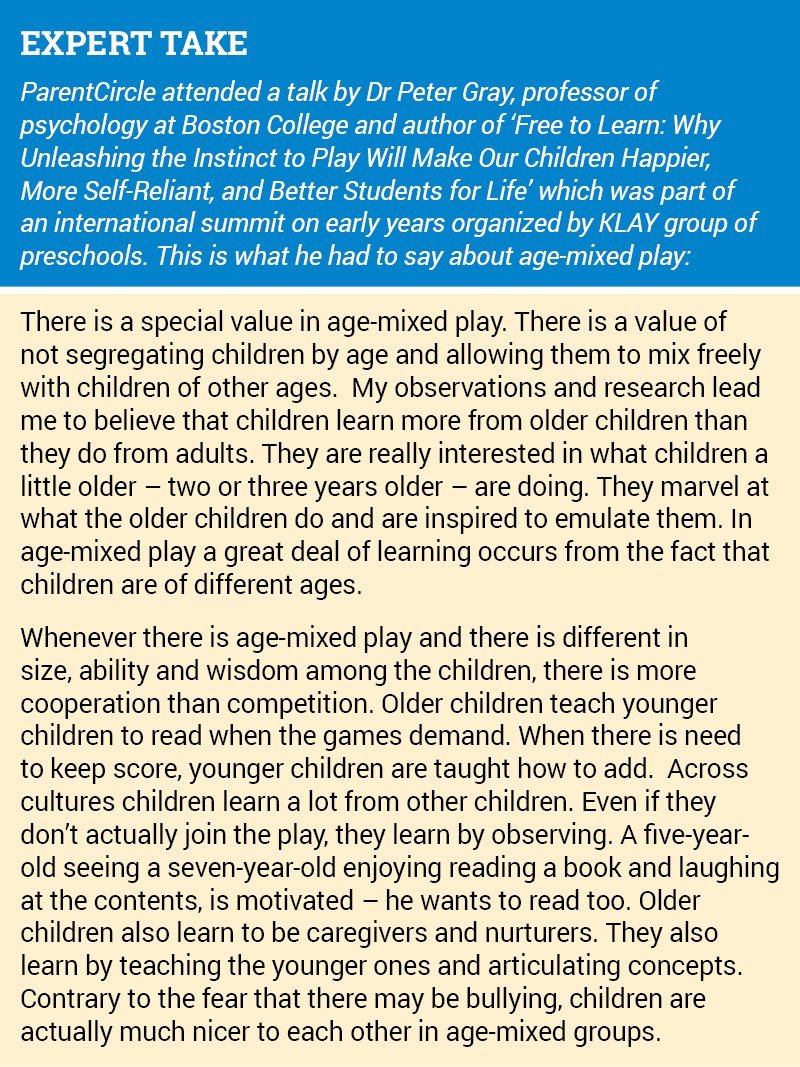
Apart from mixed-age classrooms, mixed-age play also renders benefits. Playing with younger children offers older children the chance to act as leaders, to play teacher, and to develop creativity, empathy, and kindness - soft skills that children need.
In the article 'The Special Value of Children's Age-Mixed Play', evolutionary psychologist Dr Peter Gray says: "Children have far more to learn from playmates who differ from themselves in age and ability than from those who are at their same developmental level." Dr Gray gives two examples:
A game of catch
Two four-year-olds may not be able to play catch the ball too well, as they don't yet know how to throw a ball straight or catch one. However, a four-year-old and a nine-year-old can enjoy playing a game of catch. The older child will throw the ball gently into the hands of the younger one and jump and dive to catch his wild throws.
Playing with cards
Similarly, children under nine cannot play card games too well, as they may not remember the rules and can't strategize effectively. But older children can guide children by telling them to keep track of the cards that are being played, or not to show their cards to others, and other tips.
Dr Gray lists some benefits of mixed-age play:
- Three-year-olds were found to engage in more interactive social play and less parallel play
- The younger ones may acquire skills in reading, writing, and arithmetic through such play
- Age mixing provides younger children with additional sources of care and emotional support
- Mixed-age play fosters creativity in older children as it is less competitive and more creative
"As for the older children, cross-cultural studies have revealed that children demonstrate more kindness and compassion toward children who are three years younger than them than toward children closer to their own age," he says. "Also, experiences like babysitting or tutoring younger children improve their relationships with peers as well."
According to Dr Gray, young children learn from older ones even when they are not interacting with them, by just watching and listening. Their observations both inform them and motivate them to try similar things.
However, parents may have reservations about mixed-age play. Parents of older children may feel that it may not be stimulating or enjoyable for their children to play with younger children. Parents of younger children may fear that their child will not be able to cope with the rough and tumble play or may pick up bad words from the older children. These are genuine concerns, but it seems that the pros outweigh the cons.
Finally, the benefits of mixed-age learning are many. Both at school and at play, children benefit by interacting with children of different ages. While older children benefit as their concepts become stronger while teaching the younger ones, the latter look up to and emulate the older ones, thereby learning from them.
In a nutshell
|
What you could do right away
- If you feel you and your child are not happy with a traditional same-age classroom setup, it is worth it to try something more progressive and different.
- Encourage your child to take part in extracurricular activities where skill progression is important.
- When your child wants to invite their friends over, gently nudge them to invite their siblings too.
- Plan celebrations and family events where adults and children of all ages get together.
This article was featured in the July 27, 2025, edition of The Free Press Journal.





























Comments
Edit
Comment Flag
Cancel Update