
The Benefits Of Laughing Out Loud: Why Humor Is An Effective Tool For Parents
Aruna Raghuram
Parents, take note! Jokes and playfulness win the cooperation of children more easily than threats and demands
- 6.9K
- 1
- 2

Satish is at a toy store. He has just told his four-year-old daughter Nitya that he will get her only one toy. Her little arms are full of toys, and she looks at him balefully. Her expression tells him: "It's time for a tantrum!" Nitya starts screaming and flaying her arms about, dropping all the toys. She throws herself on the floor and wails. Satish looks highly embarrassed (just stops short of apologising to the curious customers around), bundles up his daughter in his arms, and makes a quick getaway.
Meera has been trying for the past half an hour to get her six-year-old son Hari dressed to go to a wedding. He is at his obstinate best. He runs around the room, dodging his mother, who is trying to get him to wear his shirt. It's getting late, and Meera is losing her patience. But instead of yelling at her child, she decides to play along. She starts running around the room with Hari's shirt. "Come and get me!" she chants in a sing-song voice. Hari is surprised by her reaction, enjoys the game, snatches the shirt from her, and puts it on. Job done!
Being a parent is one of the most fulfilling experiences you can have. But you will agree that it is very stressful as well. Imagine having to be responsible for another human being 24x7 for at least 18 years! Whether it is an infant who keeps you awake at night, an obstinate toddler, a full-of-questions preschooler, an argumentative pre-teen, or a defiant teen, children can be a handful.
What can make parenting easier is a dash of humor. Humor brings things into perspective for parents and stops them from taking every hiccup along the way too seriously. It also diffuses tense situations and helps parents connect better with their child.
Let's see how Satish could have handled the stressful situations above differently, with some humor. Perhaps, Satish could have rolled his eyes at his daughter and asked aloud in the store: "Who is making such a ruckus?" He could have then told his daughter in a funny voice: "I am the toy monster. I have come to eat all the toys. Run, children, save your toys." And then, changed the voice back and said, "Let's pay for our toy and run!"
Why is it important to use humor in parenting
By using humor as a natural approach to communication and interaction, parents can 'boost creativity and critical thinking skills, promote values, teach good moral behaviour and civic responsibility, instill trust and confidence, and provide children with a means of coping with sadness, disappointment, and grief,' observes a study. Quite a bucketful of benefits!
Described below are some reasons why humour and laughter are linked to effective parenting:
Laughter is the best medicine: Laughter is good for the physical and mental health of both parents and children. It helps reduce blood pressure, gives your cardiovascular and respiratory systems a good workout, and releases endorphins - the feel-good chemicals in the brain.
An antidote for stress: Sometimes, parents take things too seriously, and this causes them to be anxious and stressed. Children also pick up anxiety and stress cues from parents. Humor and laughter ease parental anxieties. Laughter reduces levels of stress hormones, cortisol, and adrenaline.
Enhances connection: Humor is known to help maintain satisfying interpersonal relationships. Children relate better to parents when they use humor. Humor also helps create fun memories and thereby promotes bonding with children.
Discipline tool: Humor gets the job done and aids in the discipline. Parenting expert and author of Positive Discipline, Jane Nelsen, believes that humor is a key tool in successful discipline as it helps break the negative mood, not just for children but for parents, too.
Humor surprises children: Humor can disarm a toddler who is throwing a tantrum. It can diffuse an impending power struggle between parent and child and make the latter more cooperative. When parents start laughing when children expect them to yell, it confuses children, and they forget what the fight was all about. Parents do not have to shout, nag, and cajole their children endlessly if they have humor in their arsenal.
Changes the outlook: Humor can turn a negative situation into something positive. You are frustrated and ready to throw away the spoon as you try to feed your obstinate infant, who is refusing to open their mouth. If you start singing a silly song to relieve your stress, you are changing the negative situation into something funny and positive.
Laughter can heal relationships: If you have a strained relationship with your teen where angry words are the norm, try to change the dynamics by using humor. Not only will you be able to connect better with your rebellious teen, but laughter will also heal the breach, making both of you forget all the harsh things said earlier.
Humor reduces aggression: By being playful with their children, parents can help them get rid of aggression in healthy ways by roughhousing (play fighting) like having a pillow fight or play wrestling. According to parenting expert and author Laura Markham, roughhousing is essential for children. It helps them manage aggression and builds self-esteem as children experience their physical strength. Also, laughing, which is part of roughhousing, creates more oxytocin, the bonding hormone, which strengthens relationships.
Children develop a sense of humor: You can nurture your child's sense of humor by using humor in various situations and making them laugh. Several studies show that children learn humor from their parents.
Humor promotes learning: Humor is known to boost motivation and memory by its action on the brain's dopamine reward system. Also, parents could help their children remember facts and concepts by using rhymes, puns, jokes, and wordplays.
It builds resilience: Humor helps you cope with the ups and downs of life better. When family members laugh together, they are less likely to experience sadness.
It is important for parents to 'lighten up' in front of their children. Of course, there are situations where humor is not the answer. In these cases, parents may have to bite the bullet and act tough. Also, at times, parents may be just too tired or dealing with other stressors, and it may be too much effort to be playful or funny. In these situations, parents should explain the situation to their children in an age-appropriate manner - they will find their children surprisingly understanding.
I am the one in the family cracking foolish jokes and making my daughters laugh. My teenager tells me that this relaxes her when she is stressed about studies. Nowadays, she is overdoing the exercise/fitness thing. I keep bugging her about it, but in a humorous way. I think that makes it feel less like nagging.
-Bhaskar Dole, father of a pre-teen and a teen
How humor could be used
Here are some suggestions on how parents can use humor while parenting:
Toddlers and pre-schoolers
Act to entertain: You can dress up and talk like your child's favourite cartoon character or superhero to entertain them and make them forget that they are angry or distressed.
Clown around: Talk or walk funnily. Fall and pretend to cry. Toddlers, who often fall themselves, find it very funny when adults do so. For toddlers and preschoolers, distractions like chasing and making stuffed animals talk work well too.
Use puppets and other props: You can put on a funny-looking hat or glasses to make a tearful child smile. You can also animate puppets and stuffed animals, making them walk and talk, to teach your child manners and inculcate other values. By making it funny, you may get through to your child better than a lecture would.
Sing a funny song or play music: You can put on some upbeat music as they are playing with their toys, or sing a catchy toothpaste jingle to egg them on to brush their teeth.
Primary schoolchildren
Play games: Games like pillow fights and play wrestling are not just fun. They make your child feel empowered if you let them win. This puts them in a good mood, and they are likely to cooperate with you.
Soothe anger with love and fun: In her book Listen: Five Tools to Meet Your Everyday Parenting Challenges, author Patty Wipfler suggests 'The lion tamer game'. If your child lashes out in anger at you by hitting you, you can calm them down by saying: "Looks like I have an angry lion on my hands, let me tame her with kisses." You can chase them and shower them with kisses when you catch them. Soon, they will be laughing, and their anger will subside, explains Wipfler. This shows your child you love them even when they are at their nastiest.
Employ novel tactics: If your child is making a fuss about taking medicine, first empathise with them that the medicine tastes yucky. You can then start playing a game where you both compete in making the most disgusting faces and noises.
Author Jane Nelsen gives an innovative example. A mother pretends to read her child's horoscope to find out when she will stop procrastinating and do her chores. Explaining why laughter is beneficial, she says: "You laugh, and then you see things differently; you feel differently, you act differently."
Use a fake voice: Psychologist Dr Larry Cohen, author of Playful Parenting, feels that parents can discipline their children more effectively if they connect with their child with play and humor. Walk into a messy room and ask your child to clean it in a fake voice, he suggests. It is more likely to get the job done than if you give your child a lecture on being tidy.
Pre-teens and teens
Communicate via funny notes: Leave a note for your child reminding them to make their bed: "I am feeling very cold, please put some clothes on me." Or, to feed the dog: "I am hungry, please give me lunch." This would probably work better than commanding them to "make their bed" or "feed the dog".
Watch comedies together: Watching a funny movie or television show as a family and laughing together can create a positive atmosphere in the home.
Share funny parenting stories: You can relate funny incidents from the past to your child about how both of you behaved. Now that they are older, they will be able to see the humor in those incidents. Sharing these inside jokes is a great way to bond. Also, making light of your travails with other parents can help you find humour in situations that had aggravated you earlier.
Laugh at yourself: Parents need to learn to laugh at themselves when they have done something silly. The next time your pre-teen calls you a cheeky name because you have dropped something, don't ask for an apology or punish them with a time-out. Instead, laugh at yourself and say: "I am clumsy, ain't I?" Not only will you both bond over a laugh, but they will respect you for being a 'cool' and 'fun' parent.
How NOT to use Humor
- The humor you use with your child should be healthy. There should be no disparaging remarks, no hurtful teasing, sarcasm, or ridicule (for example, "You're so fat you could roll away to your room"). Also, take into account the age and temperament of your child while using humour. A sensitive child may feel they are being ridiculed even when they aren't. That's why you should not direct humor directly at your child - they may not think it is funny and may get hurt instead.
- Be careful in using tickling as a way to get your young child to laugh. Your child may not be able to communicate that they want you to stop while being tickled (since laughing is an automatic response to being tickled, whether it is enjoyable or not). Also, forcing a child to let you tickle them can send a dangerous message about body autonomy.
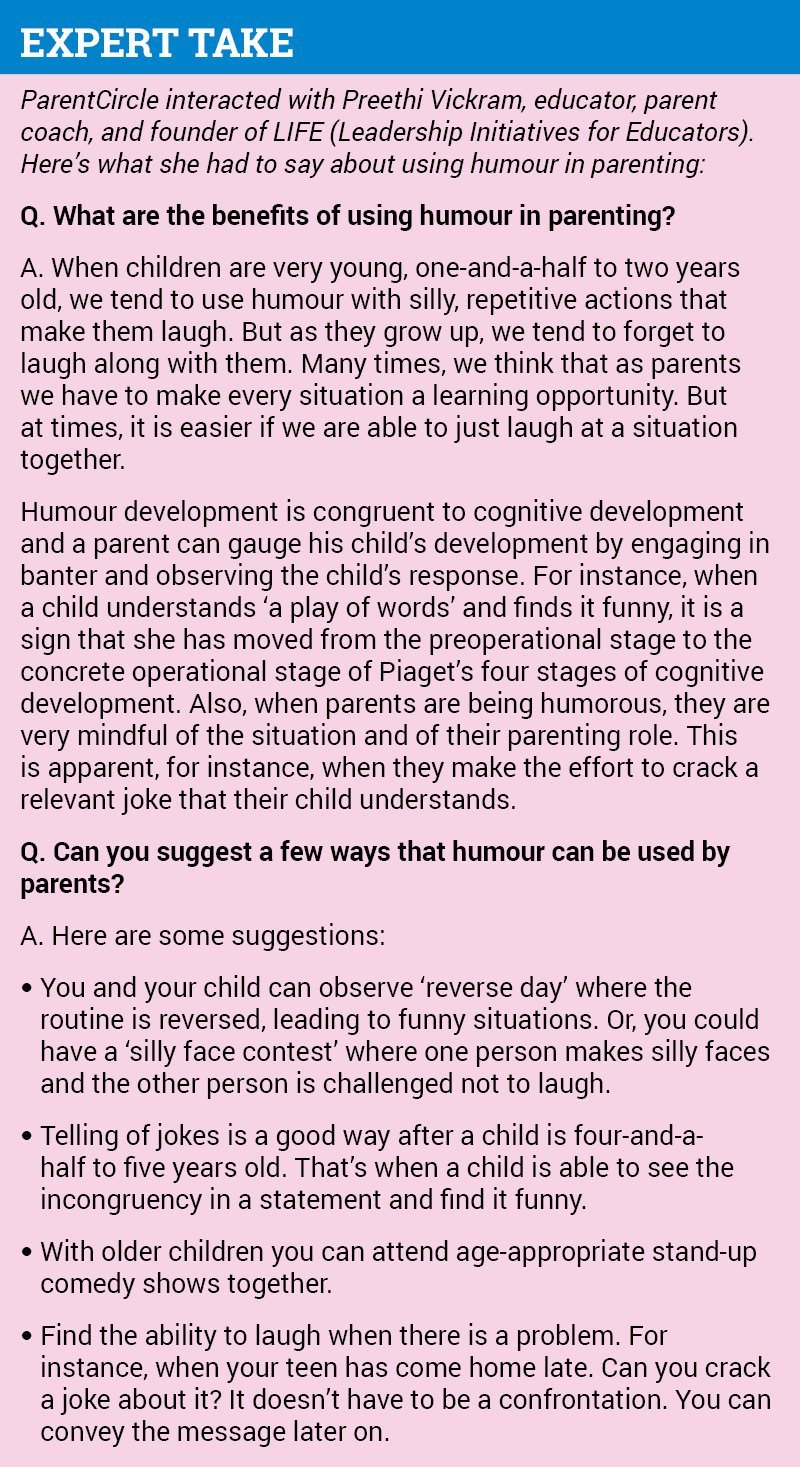
In the daily stresses of parenting, you may forget how to have fun and laugh. You may begin to resent the demanding and sometimes unrewarding job of being a parent. This is when humor comes to the rescue. Not only will it make enforcing discipline easier, but it will also make parenting more enjoyable.
In a nutshell
|
What you could do right away
- When your toddler refuses to eat their vegetables, tell them a funny story to entertain them
- The next time your teen misbehaves, make a humorous comment instead of getting angry
- Make time to bond with your child by sharing jokes and funny stories


























Comments
Stacey Davis Mar 6, 2023
I agree with the points in this article 100%. I’ve raised my boys with as much humor as possible and it helped a lot in difficult life situations. Now, one of my sons is a professional comedian and it makes my momma heart so happy.
-

1Simi Ramesh Jan 22, 2020
-

1Edit
Comment Flag
Cancel Update