
What to Do When Children Get Poor Marks: A Parent’s Guide To Support And Growth
Team ParentCircle
When a child gets poor marks, it can be disappointing for both the child and the parents. In this guide, we explore what to do if your child gets low marks, offer insight into why your child getting less marks isn’t a failure, and explain how parents should respond to low grades with calm, support, and encouragement
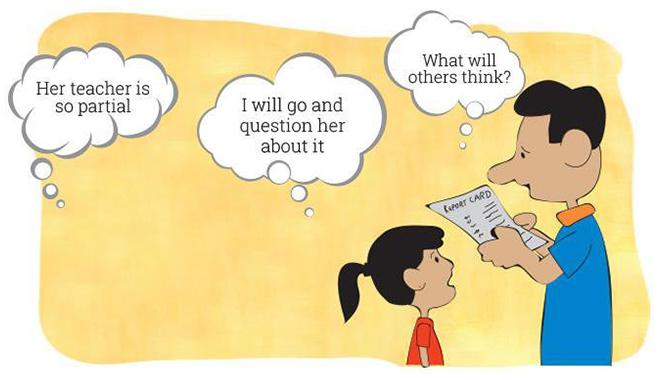
Ten-year-old Seetha's hands shook as she looked at her graded science exam paper. A couple of weeks ago, she had taken the mid-term exam. Her parents had pushed her hard to study. But Seetha found it difficult to focus, thanks to the unrelenting pressure. Now, she was staring at her performance - '70/100' jumped out at her. 'How am I going to face my parents?' was her first thought. They had sent her to tuition classes and made sure she sat alone in her room with snacks and juices without any distraction. They were expecting at least 90 percent from her. Now, they would be disappointed and upset.
It wasn't until after dinner that night, did Seetha gather the courage to show the exam results to her parents. Her doting mother Renu's face fell and her father Hari's face became flushed with anger. Seetha's parents were shocked to see their daughter's poor performance. The extra tuitions, promises of rewards, threats of punishment, and words of advice were all for nothing. As Seetha was fearing the response from her parents, Renu remarked, "We did our part. Seetha worked hard. The teacher doesn't like Seetha, and so, she has not given her good marks." Hari nodded in approval. "Seetha, we know you worked hard. Don't worry. Your mother will talk to your teacher tomorrow to see why she has not given you the marks you deserve. Goodnight my girl and sleep well," said Hari. A 'stunned' Seetha is relieved. She doesn't have to worry about her poor performance anymore.
The next morning, an angry Renu went to meet Seetha's science teacher Mythili. She accused the teacher of partiality, saying "My daughter worked so hard. You are not teaching her properly. Now you are simply deducting her marks. I must talk to the principal about how partial you are." Mythili was taken aback. She knew that no explanation would satisfy Renu. She kept quiet and decided to avoid meeting Seetha's parents again to discuss any issues.
Let's explore Renu and Hari's sequence of 'fixed ideas and thoughts' that leads to feelings of anger and aggressive actions, eventually leading to the 'blame game'.
Thoughts
- I am shocked
- What will everyone say?
- My poor child. This is not fair
- It's the teacher's fault
- Everyone says she is a bad teacher anyway
- She never gives Seetha attention because she never liked her
- My child is being victimized/ignored
- Other children must have copied the answers
- I will go and question the teacher about it
- I must complain to the higher authorities at school
- Other parents should also support me
Feelings/Emotions
- Disappointment
- Anger
- Frustration
- Surprise
- Helplessness
- Despair
- Guilt
- Confusion
- Humiliation
- Worry
- Astonishment
- Shock
- Shame
- Hostility
Actions/Behaviour
- Blames the teacher
- Accuses the school
- Makes excuses for Seetha
- Does not take responsibility for self or the child
- Talks to other parents for support
- Confronts the teacher
- Compares the child's answers with those of other classmates
Now, let's look at a sequence of thoughts and emotions that would put Renu and Hari into a problem-solving mode.
Thoughts
- This is shocking, unexpected
- What went wrong?
- My child must be feeling miserable. I must comfort her
- Is anything bothering my child?
- How can I help my child?
- Let me find out what's going on
- How can the teacher help my child?
- Where can I get help?
- How can I encourage my child?
- It's alright for me to feel bad about what has happened
- What have I been doing so far? Maybe I should change something
Feelings/Emotions
- Hopeful
- Interested
- Accepting
- Open
- Understanding
- Optimistic
- In control
- Confident
- Calm
Actions/Behaviour
- First, analyze the situation and take charge of mixed emotions
- Realizes their responsibility
- Talk to the child about what went wrong
- Helps the child cope with their disappointment and worries
- Ask the child for suggestions
- Motivates the child with encouraging words such as 'let's work on this together'
- Revises own priorities
- Cooperates with the teacher, has purposeful discussions with the child, and the teacher
- Supervises and assists the child with studies
- Helps the child plan tasks
- Ensures the child gets healthy food and appropriate sleep
- Encourages play and relaxation
- Improves the study environment at home
- Gets regular feedback from the teacher
Let's see what happens when Renu and Hari perceive the same situation to solve the problem.
When Seetha showed her graded science paper to her parents, they were initially shocked and disappointed to see their daughter's poor performance. "Seetha," exclaimed her father, "We know you worked hard. We know you are disappointed. Yes, we expected you to do better, too. But let's try to understand what went wrong." Renu chipped in, "Yes, Seetha. First, look through your answer sheet and see if you made careless mistakes or if you didn't understand something. Let's see what kind of help you may need to do better next time. Why don't you talk to your teacher to understand what went wrong? Ask her for help so that you can do better next time. If necessary, I too can come and talk to your teacher to see what help you may need." Hearing this, Seetha heaved a sigh of relief and decided to put in the necessary effort to do better the next time. She knew her parents were truly interested in getting her the necessary help to learn and do well.
When Renu and Hari moved away from a fixed way of thinking to explore new positive ways of thinking, they viewed the same situation differently. This helped them choose an approach that broadened their thinking, steering them towards warm emotions. This, in turn, led to positive problem-solving actions.
Reasons why children lie about exam grades and marks to their parents.




























Comments
Edit
Comment Flag
Cancel Update