
Water Play Activities For Toddlers And Preschoolers
Mina Dilip
Water games for kids are fun and offer a great learning experience. Read on to know from expert Mina Dilip, how you can turn simple water activities for kids into learning opportunities
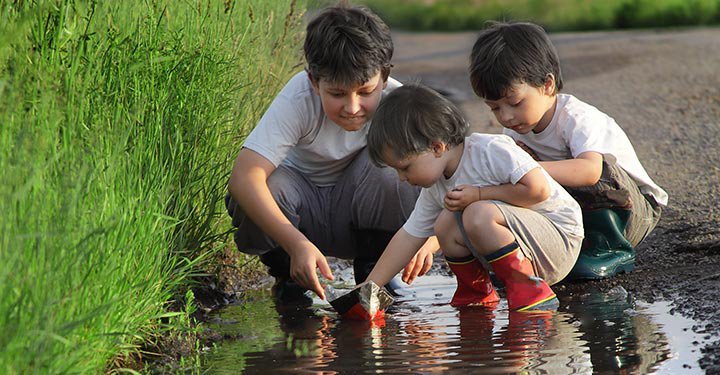
Playing with water can be a wonderfully stimulating sensory experience for 1 to 5-year-old children. Water play for toddlers not only lets your little one release her pent up energy but also helps her enhance her motor skills. Besides, through water play for preschoolers, you can help your child learn a few valuable science concepts too.
If you are looking for some simple, yet developmentally significant water games for kids, read on. This article lists several water activities for kids, grouped together under various headings whose first letters form the acronym 'WATER GAMES'.
Water games for kids
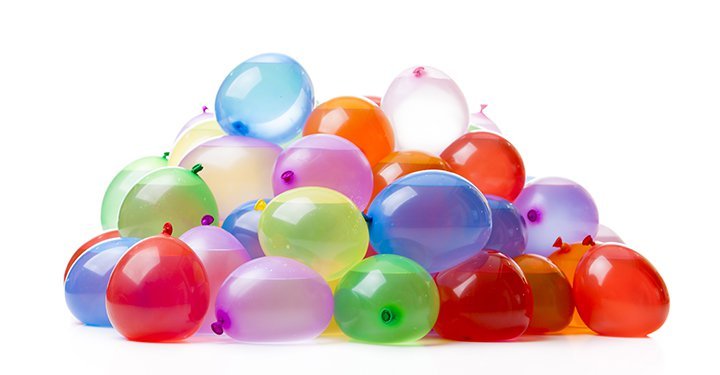
Water balloon attack
Water balloons can be great fun. But, if your toddler or preschooler is playing with water balloons, be around to supervise and keep her safe. Here are two water balloon activities for which all you need are a bunch of balloons and flowing tap water. To minimise the mess and simplify clean-up, you can do these activities outdoors.
- Dodge-balloon: This is a high-energy water balloon game for kids to be played as a group. Fill up a bunch of balloons with water. Then invite the children to toss the balloons at each other, one at a time, just like in the classic game of 'Dodge Ball'. They should try to dodge the balloons coming their way and aim to 'hit' their targets when it is their turn to toss.
- Knock-it-down: This is a classic aim-and-hit water game for kids. Invite your child to use water balloons to take aim and knock down a lightweight target such as a stack of paper cups.
How this helps: Both these games help in developing focus and coordination as your child takes aim and hits either stationary or moving targets. In dodge balloon, avoiding being hit by the incoming water balloon through body movements teaches body awareness and enhances spatial orientation. A highly kinesthetic game, dodge balloon also helps your child release large amounts of energy while playing the game and calm down later.
Artistic water painting
Using water instead of paint, either indoors or outside, is a highly effective, yet inexpensive and fun way to enhance your growing child's motor skills.
- Indoor water painting: All your child needs for this water painting activity are some old newspapers, a paintbrush and a cup of water. Invite your child to dip the brush in water and run it across the newspaper. As the water blots over the paper forming patterns in whatever direction your child moves the brush, you can initiate a conversation about the random images that emerge.
- Outdoor water painting: If you have a big paintbrush/roller (typically used for painting walls), offer it to your child along with a bucket of plain water to dip it in. Have your child dip the brush/roller in the water and then run it across the walls or the floor outdoors. The water will soon dry out, and your child can have a go at it again.
How this helps: Water painting with newspaper helps with fine motor coordination and development of finger dexterity as your child manipulates a small brush using minute strokes. Learning to describe the patterns encourages the development of language skills. Working with a large brush or roller outdoors helps your child gain mastery over gross motor skills and acts as an introduction to science concepts like evaporation.
Teeny tiny versus big bubbles
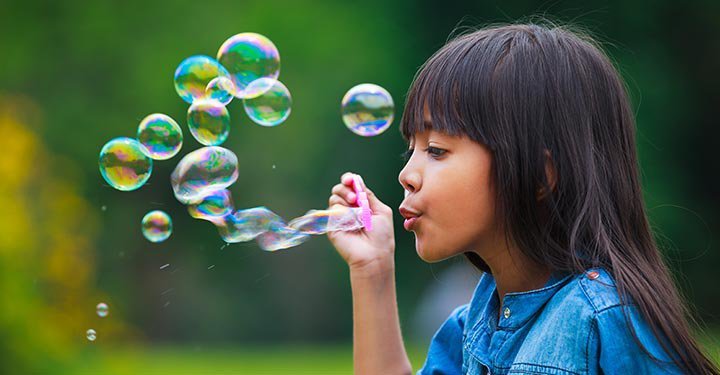
Bubbles never go out of vogue!
- Blowing bubbles: This timeless game can keep your child engaged for hours on end. Invite your child for a game of blowing water bubbles of different sizes. You can also take turns in blowing bubbles. When it is your turn to blow, your child can try catching as many bubbles as he can.
- Dunk-the-mug: A great bath-time game, dunk-the-mug involves dipping an inverted bath mug into a bucket of water and observing what happens. For example, it requires a little effort to submerge the inverted mug or if the mug is tilted slightly when under water, big air bubbles arise from its sides.
How this helps: Watching your child blow bubbles is a tangible way to assess whether he is able to breathe deeply and regulate his breathing. For instance, slow exhalation is essential to create big bubbles. Breath control can make your child feel calmer, and reduce his anxiety and angry outbursts. Also, your child would get to learn science concepts like buoyancy experientially through the dunk-the-mug exercise.
Exciting straw games
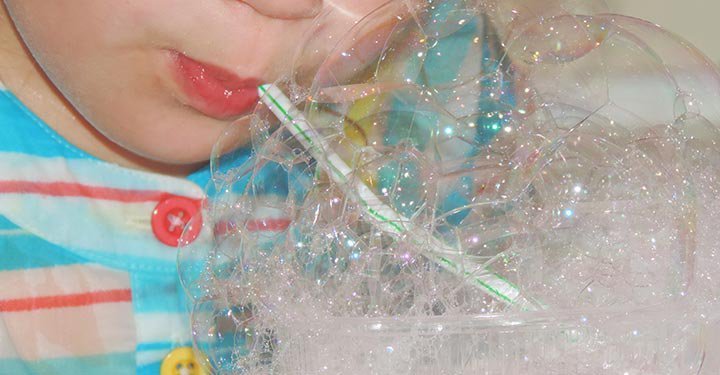
A drinking straw can be an exciting aid in water games for kids. For these games, you will need a glass of water, an empty container and a drinking straw.
- Dip-sip-blow: Invite your child to dip the straw in water, and sip through it gently so that the straw is half full. Now, he should quickly move the straw over to the empty container and blow out the water into it. The goal is to transfer all the water from the glass into the empty container using the straw.
- Straw pipette: Here, the water is transferred from the glass into the container by using the straw like a pipette, with the fingers.
How this helps: These water activities for kids are sensory and experiential in nature. Dip-sip-blow helps with oral sensory development through the sipping and blowing actions using the mouth. Using the straw as a pipette helps in learning science concepts like pressure and air cushioning.
Recreating underwater world
Young children find marine life fascinating and colorful. The following water games for kids capitalise on the natural magnificence of the underwater world by enabling your child to recreate it at home.
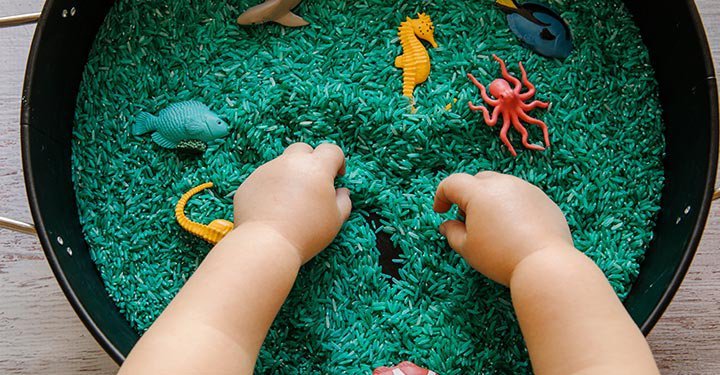
- Ocean-in-a-tray: Give your child a transparent tray filled with water and a few colorful elements like pebbles, artificial plants (even real plants can be used), toy fishes and other miniature marine creatures. Ask her to use all these and her imagination to create an ocean in a tray.
- Float-a-boat: Add an element of origami to the ocean-in-a-tray water activity. Show your child how to make a paper boat to place on the surface of the water in the tray.
How this helps: These games help in developing imagination and creativity. They also enhance your child's aesthetic sense. Moreover, your little one gets to learn about simple science concepts such as floating and sinking as she observes some objects (like pebbles) sinking to the bottom of the tray while others (like the boat) remain afloat.
Garden adventures with water
If you have a garden, introduce your child to outdoor water games in your garden.
- Garden hose shower: A highly tactile kinesthetic experience, this game involves using a garden hose to wash your toddler down. Watch him squeal with delight when he gets to do the same by showering you using the garden hose.
- Talking plants: This is a soothing water activity for kids. Team up with your child to water the plants in the garden. As you do so, encourage your toddler or preschooler to have conversations with each plant in turn.
- Organic perfume factory: If there are flowering plants in your garden, then pick some fragrant flowers. Invite your child to put them in water and enjoy the fragrance.
How this helps: Being close to nature is always healing. These outdoor water games for kids help with bonding as you and your child spend time together in nature. As children talk to plants and pretend that plants are talking back, they become more empathetic and mindful. The organic perfume factory game is an amazing olfactory sensory activity that introduces your child to various new smells and fragrances.
Archaeological adventures
The following water activities involve working with ice. So, please take the necessary precautions related to health and hygiene. These games work better with preschoolers and older children.
- Frozen landscape: Invite your child to create a frozen landscape. She can design it on her own by including whatever elements she chooses. Once she has all the bits and pieces she needs, she places everything in a tray, fills it with water and places the tray containing the landscape in the freezer overnight.
- Dinosaur excavation: To help your child play this exploratory game, pre-freeze a bunch of dinosaur toys in a tray filled with water. Once frozen, invite your child to use simple and safe 'excavation' tools to dig the dinosaurs out.
How this helps: The frozen landscape involves strategising. It develops imagination, helps your child learn planning and organisation, and develops his patience as he waits for the water to freeze. Dinosaur excavation builds focus and attention along with fine motor skills.
Makeshift jal tarang
Fill up half a dozen steel tumblers with varying amounts of water. Give your child a couple of spoons and have him play his very own makeshift jal tarang at home!
How this helps: This is a fun game that enhances auditory processing skills and musical intelligence.
Experiments in the home lab
If you have a water table set up at home, your child can engage in these experiments.
- Water transfer: Give your child the task of transferring water from one container to another using an old syringe (without the needle) or a medicine dropper.
- Watery mixtures: Young children love messy play. Encourage your child to mix various safe materials such as sand, watercolors and household powders (like turmeric or cumin powder) in water and experience the mixtures using multiple senses - by touching, smelling and so on.
How this helps: The water transfer game helps in developing fine motor skills and in improving attention span. A multi-sensory experience of different types of textures has sensory benefits. This can also build your child's curiosity and interest in science concepts like viscosity, liquid suspensions and so on.
Simple water pistol games
Water pistols are inexpensive, yet great fun. Teach your child to refill the pistol on her own. This would encourage independence.
- Target shooting: You can set up a lightweight target such as a stack of balloons or a stack of paper cups, and invite your child to shoot it down.
- Shoot-out: This is a group game, similar to dodge ball. It involves shooting water jets from a water pistol at one another. The goal is to avoid getting wet while trying to drench the other players.
How this helps: Both these games enhance coordination, aim, attention and perseverance. While playing shoot-out, your child also develops body awareness and better spatial orientation.
Tips to set up a water table at home
Choose a location in the house that affords easy clean-up and drainage of water, and set up the water play area. Typically, balconies, wash areas and bathrooms work well. You can either have your carpenter fashion a simple table with a hollow top with waterproofing and flexible drainage, or you can use plastic trays or containers of suitable depth on top of a regular 22 table and fill it up with water.
Young children take to water play very easily. Water games for kids can heal, stimulate and aid in learning. Ensure that you are around to keep your child safe as he or she explores the magical world of water play, and you will be surprised at how rewarding the experience can be.
About the author:
Written by Mina Dilip on 10 November 2020.
Mina Dilip, Child Psychologist, Certified Play Therapist, (PTUK/Leeds Beckett University, UK)
Looking for expert tips and interesting articles on parenting? Subscribe now to our magazine. Connect with us on Facebook | Twitter | Instagram | YouTube
Join our Circles to share, discuss and learn from fellow parents and experts!






















Comments
Edit
Comment Flag
Cancel Update