
Valentine's Day Science Experiments And Activities For Kids That Are Fun And Engaging
Kerina De Floras Felix
author parentcircle author parentcircle author parentcircle author parentcircle author parentcircle author parentcircle author parentcircle author parentcircle author parentcircle author parentcircle author parentcircle author parentcircle
Love is in the air! Add more 'chemistry' to your Valentine's Day celebrations with these fun science experiments for kids.
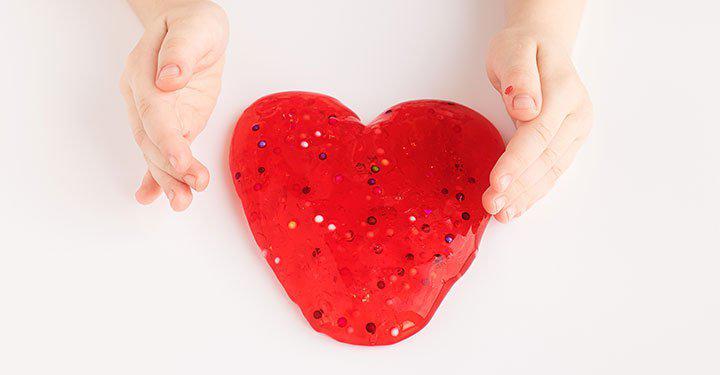
It is that time of year again when roses paint the town red. We are talking about Valentine's Day, of course. Are you wondering how you can celebrate Valentine's Day with the kids? While it can be difficult to explain to the kids what the fuss is about, here is something fun they can do: Valentine's Day science experiments! Yes, you heard us right. Try these cool experiments at home with your child this Valentine's Day. After all, isn't love all about 'chemistry'?
Fizzy hearts
Perfect for Valentine's Day, isn't it? Hearts are fizzing with love, just that this time you use baking soda and vinegar in this case.
What you need
- 3/4 cup baking soda
- 1/2 cup water
- Vinegar
- Food colouring
- Small bowl
- Spoon
- Small heart-shaped moulds
- Plastic dropper
Method
- Ask your child to add a few drops of food colouring of their choice and the baking soda to the water.
- Transfer the liquid into the heart-shaped moulds. Use a silicone mould instead of a plastic one to make removing the heart shapes easier.
- Freeze the mixture overnight.
- Ask your child to pop the baking soda hearts onto a plate. You can arrange the little hearts to form a bigger heart, too, to make it more interesting.
- Add any food colouring to the vinegar.
- Now, using the dropper, ask your child to carefully take a few drops of vinegar and drop them on the heart moulds. Watch and listen to how the hearts fizz when vinegar touches them.
The science behind it
Talk to your child about how acetic acid in vinegar reacts with sodium bicarbonate in baking soda to produce carbon dioxide, which bubbles or fizzes.
Invisible ink
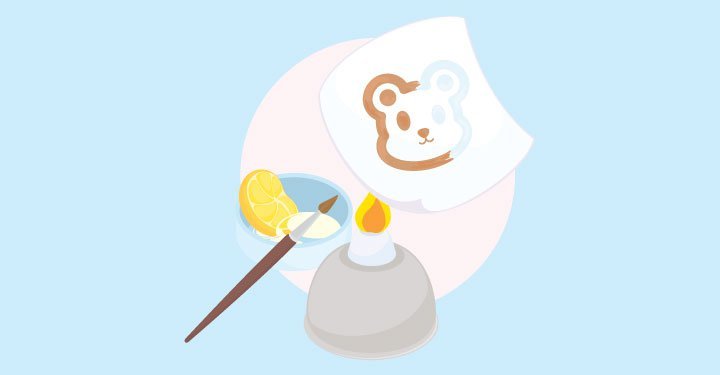
Your child will be very excited with this one. While we all know about the lemon juice trick, did you know that you can write secret messages with crayons, too? Learn both ways here.
What you need
- Half a lemon
- Water
- Spoon
- Bowl
- Paint brush
- White paper
- Oven or stove top
- Crayons
Method
- Ask your child to squeeze out the juice of a lemon into a small bowl.
- Then ask them to dip a paintbrush into the juice and write a message on the paper.
- Leave the sheet to dry
- After it dries, keep it in the oven for a few seconds or hold the paper above a candle flame or stove top. Make sure the flame does not touch the paper.
- The secret message is now revealed!
- On another sheet of paper, ask your child to write another message with a white crayon.
- Now ask them to colour over it with other colours, and watch the secret message appear.
The science behind it
When exposed to heat, lemon juice oxidises and turns brown. This causes the secret message to appear when the lemon juice is heated. In the case of the crayon, the wax prevents colouring over it, revealing the message.
Love potion
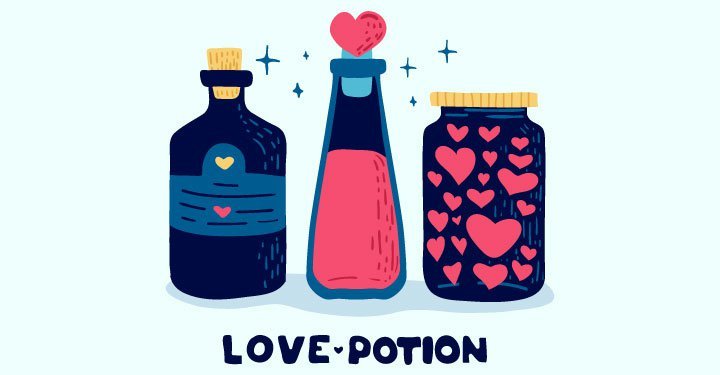
This is a 'Rainbow Jar' experiment with a Valentine's Day twist. Check out how to make a custom love potion at home (no, this is not edible!)
What you need
- A clear, transparent glass bottle
- Corn syrup
- Milk
- Dish soap (pick shades of red or pink)
- Water
- Baby oil
- Rubbing alcohol
- Food coloring (red, pink, purple)
- Dropper or syringe
Method
- Ask your child to pour a little corn syrup into the bottle, then add a little food coloring to it and stir.
- For the second layer, take a little milk and add another food coloring to it. Guide your child to slowly inject milk into the potion bottle from the sides, to avoid mixing with the corn syrup.
- Next, add the dish soap. The trick is to add the layers slowly so that the bottom layers are not disturbed in the process.
- For the next layer, ask your child to pick a colour and add it to some water. Pour this slowly into the bottle.
- Top the layers with baby oil and rubbing alcohol. Cap the bottle after adding all the layers.
- You now have a bottle filled with a beautifully coloured, layered 'love' potion.
The science behind it
Talk to your child about how the different liquids don't mix, even though they are in the same bottle. They are layered owing to their different densities. Show them how thick the corn syrup is, compared to water or milk, to help them understand.
Love magnets
Love attracts, just like magnets. Teach your child how magnets attract, about magnetic fields, and more with this simple experiment.
What you need
- Ceramic donut magnet
- Rectangular ceramic magnets
- 12-inch bamboo skewers
- Magnetic wands (substitute with a pencil with a ceramic disc magnet glued to the end)
- Small rubber bands (substitute with modelling clay or play-dough)
- String
Method
- Cut an 8-inch piece of string, and thread it through the donut magnet. Tie it tightly.
- Connect the ends of the two skewers by overlapping them and wrapping a rubber band (or play-dough) around the joint.
- Repeat the previous step and connect a third skewer to form the triangle base.
- Connect two additional skewers, first to each other, and then to the base, to form one side of a pyramid.
- Before forming a full pyramid with the last skewer, wrap the top connection with the string. The goal is to have the donut magnet hang from the center point of the pyramid, and hang about 1.5 inches from the base.
- Add the last skewer to complete the pyramid shape. Wrap the joint tightly with a rubber band.
- Now try this. Take another magnet and place it under the hanging magnet. Slide it around and watch how your hanging magnet moves along with it. Placing the magnet away from the center can make the hanging magnet seem to be suspended at an angle, defying gravity!
The science behind it
Talk to your child about what makes magnets attract: their strong magnetic field. Teach them about magnetic poles and how similar poles attract, and opposite poles repel each other. Watch this video to know about other experiments you can try with magnets.
Crystal hearts
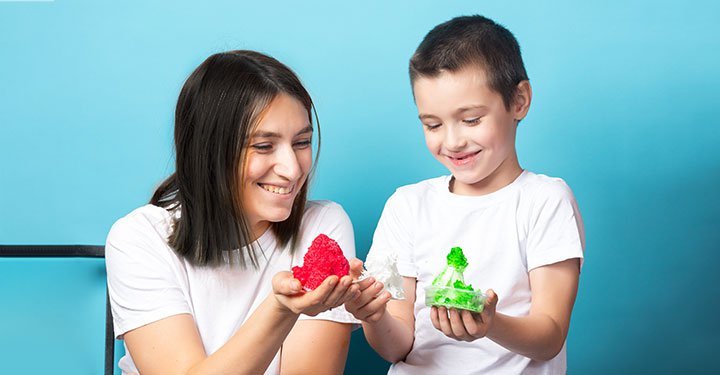
Growing crystals at home is a wonderful science experience for kids, so we urge you to try this Valentine-inspired one this time. Help your child create a sparkly heart while learning chemistry.
What you need
- Borax
- Glass jars (with a wide mouth)
- Popsicle sticks
- String
- Tape
- Pipe cleaners (springy wire)
Method
- Ask your child to form heart shapes with the pipe cleaners. You can twist two different colours together or entwine two hearts. You can also use any springy wire instead of a pipe cleaner.
- Make sure it is easy to put in and take out the pipe cleaners from the glass jar, even after the crystals have grown.
- Boil some water and fill the jar. Now add borax powder to the hot water. For one cup of water, add 3 to 4 tablespoons of borax powder. Make sure you dissolve it as much as possible in the hot water. You can do this yourself, as handling hot water is risky for small kids.
- Tie the heart-shaped pipe cleaner to a popsicle stick or pencil with a piece of string and immerse it fully in the jar. Keep the popsicle stick across the top of the jar to hold the heart in place.
- Leave the jar undisturbed overnight.
- The next morning, you will see crystals growing over the hearts! Gently lift them out and let them dry on a paper towel.
The science behind it
Talk to your child about how more borax dissolves in hot water, forming a supersaturated solution. When this solution cools, the borax particles emerge from the solution and crystallize easily on any surface they can easily stick onto, in this case, the pipe cleaner.
What a fun way to celebrate Valentine's Day with your kids! We bet you learnt some amazing things along the way, too. So, what are you waiting for? Start planning a 'fizzy' Valentine's Day with your little munchkins now!
Last updated on: February 03, 2026


























Comments
Edit
Comment Flag
Cancel Update