
Thinking of discipling a child for misbehavior? Forget time-outs and try time-ins
Team ParentCircle
ParentCircle empowers parents to raise successful children through holistic parenting.
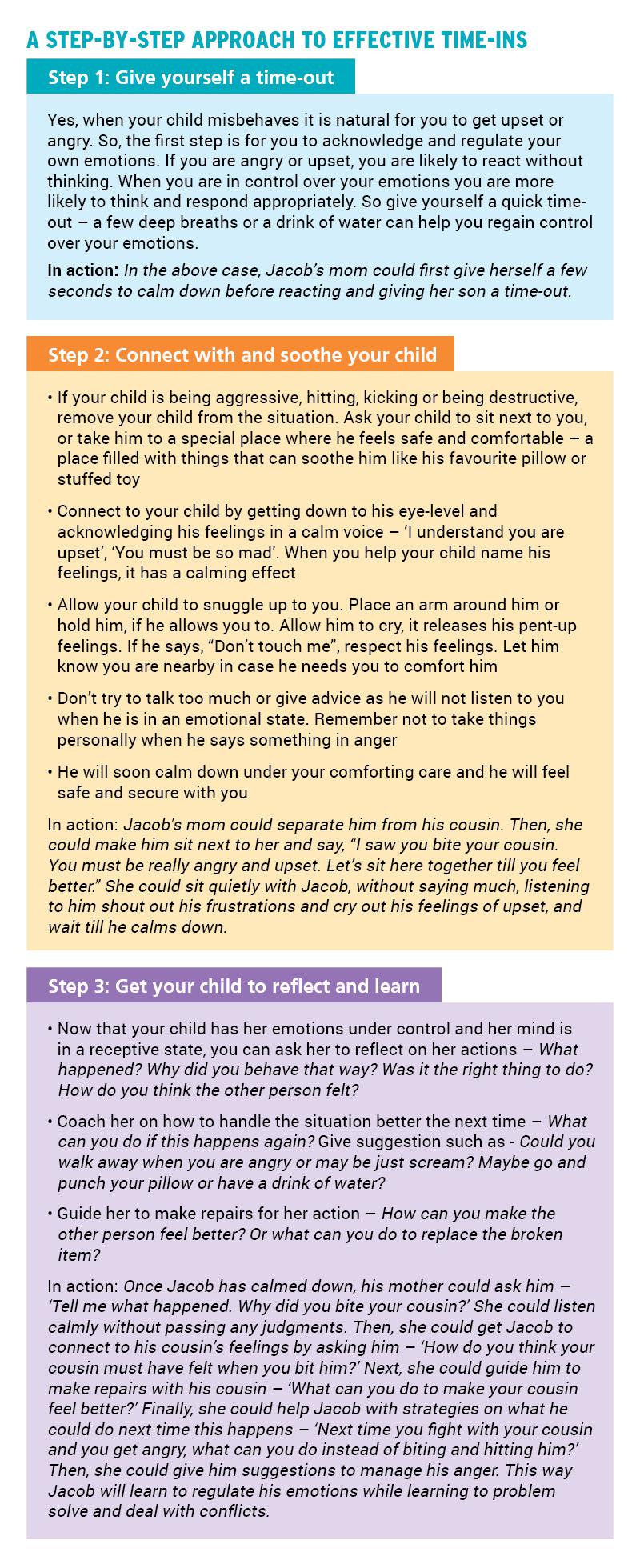
Your preschooler just won’t listen to you. He refuses to get ready for school. You are at your wit’s end, ready to spank him. But, wait! Are there better ways to handle the situation that will strengthen your relationship with your child? Will time-outs and time-in’s work? Read on to find out

He stood outside in the garage with his pants wet, a puddle under his feet, and eyes filled with fear. Just a few minutes earlier, four-year-old Jacob had a fight with his cousin and bit him. His mother, in a voice filled with anger, shouted, “Go stand in the garage for a five-minute time-out and calm down. Think about what you did.” But, instead of thinking about what he had done and calming down, Jacob peed in his pants out of fear and confusion.
Yes, a time-out has been the recommended way for disciplining a child for misbehavior. It is definitely preferred over punishments, yelling and spanking a child. When a child misbehaves, the idea of a time-out is to send the child to a quiet place to allow her to calm down and reflect on what she did. Unfortunately today, time-outs are used too frequently and as a punishment, that its effectiveness is lost.
When the child is given a time-out and sent to another place to think about her behavior, she is probably already struggling to manage her big emotions. This is the time when your child needs your support to help her fight those big emotions to help her calm down. But, instead, when you send your child to sit alone to reflect, she is likely to feel abandoned, rejected, and not loved by you. She is also not in a state of mind to reflect and think, ‘What I did is wrong’. More likely she is thinking, ‘My mom is so mean’, ‘I hate everyone’. In the above situation, Jacob probably felt isolated, was terrified, and unable to manage his emotions. And this caused him to wet his pants.
The appropriate use of time-outsTime-outs were initially designed to help children calm down so they can reflect on and change their behavior as part of a larger parenting strategy. Research supports the efficacy of time-outs when executed correctly. If parents use them appropriately as suggested in the research — infrequently, calmly, with lots of support and connection and positive support — then we are all for that. However, based on our years of experience of working with families, we’ve found that time-outs are often used in a reactive and punitive manner that leaves children feeling more reactive and dysregulated. - Dr. Dan Seigel, author of No-Drama Discipline |
If time-outs are not used properly, then what else can parents do to manage their young children’s behavior effectively? How about trying a time-in?
What is a time-in?
When your child misbehaves, is aggressive or is being defiant, it is often a reflection of a deeper feeling or thought. This child who is overwhelmed with big emotions needs you to first soothe and comfort him during his time of distress before you can address his behavior. Instead of punishing the behavior, you need to get to the root cause behind the behavior and help the child problem-solve.
The idea behind a time-in is similar to that of a time-out – to allow your child to calm down and reflect on his behavior. However, in a time-in, the importance of connecting with your child is emphasized. Another key difference between the two is how we implement a time-out versus a time-in. In a time-in, the first step is for you to remain calm. Then, instead of sending your child to another room or making him sit in a corner by himself, you keep your child near you or in a place where he feels safe, and not isolated or abandoned. Next, you connect with your child to help comfort and calm him down before you get him to reflect on his behavior. This way, you are teaching your child two things - how to regulate his emotions and his behavior; and your child feels loved in spite of his behavior.
FAQ: What are the recommended ages of children when time-ins can be used appropriately and effectively to handle various behaviors? Using time-outs as a tool to discipline is generally recommended when dealing with children under 8 years of age. On the other hand, parents can use time-ins to help children of any age (including teens) regulate their emotions, and learn to deal with situations in a responsible and respectful way. |
 Why are time-in’s effective?
 Why are time-in’s effective?
Time-in is not a punishment. It’s a way of meeting your child's needs so he doesn't have to act out. Specifically, you're giving him the connection that's essential so he can regulate himself. And you're helping him process his big emotions, so he’s ready to problem-solve and repair. - Dr Laura Markham, founder, Ahaparenting.com When your child misbehaves, as a parent, you feel it’s your responsibility to ‘discipline’ your child. However, if you want to nurture self-discipline and self-control in your child, then your goal of ‘discipline’ should be to teach, rather than control and punish. Time-in’s are therefore effective because:
The child learns:
- To regulate her emotions
- How to better behave and deal with situations
It enhances the parent-child relationship, as the child:
- Doesn’t feel rejected or abandoned
- Feels safe and secure knowing his parents understand his feelings
- Builds trust and connection with her parents, so the child wants to cooperate
- Feels loved, in spite of his behavior
More examples of time-outs versus time-ins in action
1. Your three-year-old refuses to eat her vegetables and throws them on the floor in spite of you repeatedly telling her not to do so.
Time-out way – You take away your child’s plate and tell the child in a stern voice to go to her time-out corner for 3 minutes till she learns to behave.
Time-in way – You take away the plate and ask your child to come to sit next to you. You try to keep your voice calm and look her in the eyes as you tell her, “Nina, you have been throwing your vegetables on the floor. I know sweety - vegetables are not your favorite.” Child responds, “I no like vegetables!” You respond, “Yes, I understand. But vegetables are healthy. If you eat it you will become strong. Instead of throwing it on the floor, can we make the veggies yummy for you? You can eat it with your favourite ketchup or cheese sauce.” The child responds, “I like ketchup”.
Here, instead of yelling and power struggles, the mother has given the child the option to eat her vegetables with ketchup. Her child has learned what to do next time she doesn't like her vegetables.
1. You, the father, ask your five-year-old boy to turn off the TV as it is 9 p.m. and way past his bedtime. He ignores you, so you turn off the TV. He starts to scream and cry.
Time-out way – You scream at your child, “Stop that crying now. Go to your room and stay there till you can stop crying and screaming. After you settle down you can go to bed.”
Time-in way – You start to get angry. But, you take a couple of deep breaths to help you calm down before you respond. Then you go over to your child and sit next to him. You tell him, “You want to continue to watch TV right? I know it is disappointing that you have to turn off the TV. But, it’s bedtime now.” You then gently place your arm around your child and let him shout out his disappointment and stop the tears. You wait for him to calm down. Then you tell him, “You know sweetie, it’s way past your bedtime. You must be so tired. Next time, shall I set the alarm to let you know it is time to turn off the TV and time for bed?” Child nods a sleepy “Yes”. You say, “Now, let’s get ready for bed. I will read you a book before you go to sleep. You can select your favorite book.”
Here, we see the father remaining calm and empathizing with the child’s feelings of disappointment. Notice, the father continues to remain firm and doesn't give in to the child’s demands to watch TV. The father stays close to his child and soothes him with a gentle touch. The child feels safe and secure as he lets out his big emotions of probable tiredness, exhaustion and disappointment. This helps calm the child. Then, instead of taking complete control of the bedtime routine, the father allows the child to remain in charge by letting him choose the book he wants to read. It is a win-win for both parent and child that strengthens the parent-child relationship.
So, when your child behaves out of control and you feel out of control, give yourself a timeout and your child a time-in. Turn every little moment of challenge into an opportunity to connect with your child and help him grow into a self-disciplined, independent, and confident person.
In a nutshell:
|
What you can do right away
- Create a cozy corner for your child. Add cushions, stuffed toys and books and make it into space he would love to go to anytime, especially when he is down and wants to be comforted.
- Anytime you feel your anger rise within you, give yourself a timeout. Pause, Think, and then Respond.

























Comments
Edit
Comment Flag
Cancel Update