
Teacher Tales: Uplifting Teacher's Stories Of Changing Lives With Passion And Impact
Sindhu Sivalingam
author parentcircle author parentcircle author parentcircle author parentcircle author parentcircle author parentcircle
It's almost impossible to tell the story of your childhood without mentioning a teacher or a teacher figure. This Teachers' Day (September 5), let's listen to the stories of teachers, by teachers
Why I became a teacher
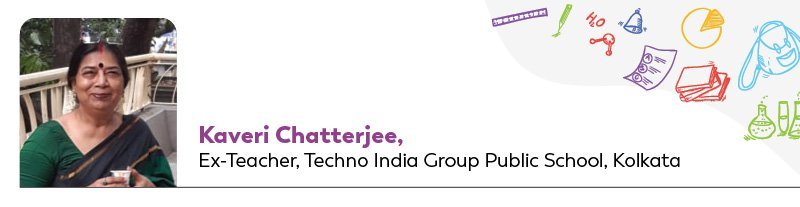
I was raised in a family of educators. My greatest inspiration was my maternal grandfather who was a teacher and later, the headmaster of a school. His passion for helping students in their learning journey left me not only in awe of him but also made me fall in love with the beauty of teaching as a profession. He handled every student with utmost love and care and many of his students stayed with him for years in the same house, as they hailed from far-off places.
Every visit to my grandfather motivated me to pursue teaching as my calling at this juncture of my life, I'm glad I followed my passion.
First day of school
My first day at school is a vivid memory. My coordinator took me to the class: Grade 3. Hearing the student's excited whispers of 'New teacher, new maam' brought a wide smile to my face. Even before I could take my seat, the children gathered around my table and started saying innocent things like how long my hair was. The most beautiful thing was that the children made me their own. It's that personal touch that I still cherish, and it's their innocence that inspires me to continue being a teacher.
Memorable experiences
From a misunderstood boy to a doctor: There is one particular experience that reassured my faith in the role played by teachers in a child's life.
A particular student was perceived as a disruptive child by many of my colleagues because he wouldn't pay attention or would disturb the class. I had noticed his behavior, but I felt that the child had much more to him than what met my eyes. I started interacting with him, asking him about his personal life. Seeing his teacher being nonjudgmental and interested in him, he started being more attentive in my class. I realized that the child had so much to share and offer to the class and being disruptive was his defense mechanism against all the ire he faced. My empathy helped him open up. As he struggled with certain subjects, I decided to stay back after school to guide him with his studies and to listen to him talk. It was such a joyous experience to see a child transform before my eyes within a few months.
Today, he's pursuing medicine and plans to become a surgeon. But he still remembers his old teacher and is in touch with me.
A Mother's Day card for me: Summer vacations in our school would start from the second week of May till about mid-June. This particular year, as we were closing down for the break on a Friday, the children in my class were ecstatic. Amidst all the fun, one little girl came up to me and gave me a beautiful handwritten card, wishing me a Happy Mother's Day! I was overwhelmed with emotions. I held my student closer and kissed her on the forehead. She had lost her parents when she was 3 years old and was being raised by her grandparents. Having found a mother figure in me, she was innocently expressing her affection, and this touched my heart.
Pandemic-related challenges
The most challenging experience has been the shift to the online mode. Before the pandemic, I had a basic knowledge of computers, which would suffice for our work. However, online teaching was a different experience altogether. We were trained to take classes on video-conferencing platforms and taught how to create links. We made mistakes but learned something new with every experience. Moreover, with classes being conducted at home, a teacher's job is no longer restricted to school hours!
Years of teaching have helped me understand that some students need individual attention and soft handling, which becomes difficult online. I was unable to solve the day-to-day issues that children faced and shared with us. Pulling a child closer to soothe them, giving a pat of reassurance, listening to them and giving advice on the many issues adolescents face, or just giving a smile in person—these were no longer possible.
Virtual teaching has made it difficult to replicate the interactive elements of physical classrooms, such as learning from children's experiences and having fun with them. Listening to their stories and viewpoints has reduced them to a great extent. Particularly in social studies, using 3D models, drawing on the board, or acting out have been substituted by videos, interactive simulations, and learning tools. I tried making my classes more interactive by ensuring that my children could express themselves through multiple modes of representation. While some were comfortable unmuting themselves and shouting out an answer, some preferred to send the answer on direct chat and I welcomed it all. I encouraged them to explain little snippets from chapters, which made them feel in charge of their learning and inspired other children.
Understanding that the pandemic has been difficult for the little ones, I made sure that children learned with joy in my classes.
A message to parents
I just want to say that teachers are trying their best to make learning joyful for children. And children are doing an excellent job at coping with the massive transformation. We request you understand that what could be taught more elaborately in the offline set-up needs to be made more crisp and concise for ease of understanding and delivery. We'll keep trying and implementing innovative ways to augment our children's learning, but your support will give us more strength. Also, please listen to everything your child wants to share, as they have limited interactions with friends and others. You're all they have.
Why I became a teacher
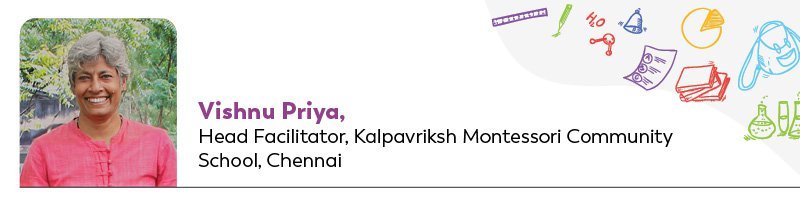
I think I always wanted to work with children but never realized it. When I finished school, I spent some time at my friend's mother's Kindergarten school. It was a nice experience, and I was paid Rs100 for my stint. It was my first teaching experience! But, I went on to become an architect.
After I got married and was pregnant, I stumbled upon Maria Montessoris's book 'Secret of Childhood.' However, I understood very little of it. What I did get from the book was that we could never fully understand a child's world. It stuck with me.
After the birth of my son, I was constantly interested in his world and his experiences. When I put him in a Montessori school my curiosity led me to take up the Montessori course to teach 3 to 6-year-olds. It made me understand a lot about why people and children behave the way they do. But instead of taking up teaching, I went back to my job as an architect.
When my son was reaching the elementary stage, I did the Montessori elementary course. This time, I soaked in the course and did a lot of research and reading.
Two years later, my son's school was looking for a teacher. I saw it as an excellent opportunity to be with children. When I entered the school, I was transported to a different world. Schools keep the aggressive consumerist world outside their corridors. I felt that being a teacher would be far more exciting than being an architect!
So, I stayed with children whose young minds are free from prejudices and who are in tune with nature. Imagine it's going to rain. If you look at the children, you'll see their glowing faces and sparkling eyes, as their senses awaken in anticipation of the rain. This spirit of the children inspired my career change.
First day of school
I was not sure what to expect but I was excited. I observed the teacher in the classroom. She had been my son's teacher. She had that sense of calm in her. She never criticized or offended the little ones. Instead, she would politely say, "I'm sorry, that can't be done." She was very accepting of each child. Usually, the adult in a Montessori environment only watches over the children busy doing their work. Every morning, the children would come, each with a mind of their own. Later in the day when they got restless, she ushered them into group activities or guided them to choose the activities. It made me feel like I was watching a skillful artist at work. I suppose I would have absorbed some of her qualities.
Memorable experiences
Aditi wrote a wobbly L: From my early years as a teacher, one child, Aditi, stands out. Aditi was a persevering learner. She wanted to learn the letters before she was three years old, and soon enough, well ahead of her age, she wanted to write. So, one day after school, I sat with her and asked her what she would like to write. Aditi said, "Leaf." I asked her what was the first sound she heard. She said the sound of the letter 'I'. I asked her to trace the letter and then write it down on paper. Her ''l was all wobbly but if you knew she was writing that letter, you'd be able to say it was what it was!
This reminded me of Maria Montessori's belief that all children have the desire to learn and that they'll naturally explore and learn a language as they grow. All we need to do is create an environment that nurtures their curiosity and guides them when they show their keenness to learn. When the facilitator or an adult connects with the child, education happens naturally, and I continue to aspire for that connection with each child.
Joseph skipped lunch to learn: Later, when I worked for an Anganwadi for a year, I met a little boy named Joseph who lived by a pavement. His father had a pushcart while his mother worked as a domestic help. Joseph would eat at the Anganwadi only. But such was his passion for learning that he would forget his hunger! They would keep calling him Joseph for lunch but he would go on working with his materials. He wouldn't even let me go! One day, he put lots of dots on a paper. I asked him what he had drawn. He said, Kosu (mosquitoes). I asked, "How do you sleep at night? Do you have a net?" He slapped his hands and body with his little palms to show that's how he keeps the mosquitoes away. I wonder where Joseph is now.
Pandemic-related challenges
At the beginning of the pandemic, we waited, hoping it would pass. But soon we realized we had to adapt to the new reality. Our first plan was based on one thought: How must our children be feeling right now? So, we organized a video call and saw how happy the children were to see their teachers and friends!
We wondered what they must be missing and what we could provide over an online platform. The parents were more than willing to help. So, we sent them printables and instructions to make Montessori materials while we started with language activities for our children online. From their early years, Montessori children are encouraged and supported to be independent. Soon with the materials ready, the children began working in separate breakout rooms alongside their friends, just like they would in a school environment. Sometimes we call one or two children to the school to give a demonstration to introduce a new concept. We are managing reasonably well. But I must thank our children for adapting to this change, and our parents for supporting their children.
A message to parents
This is a time for all of us to support our children's education in every way possible. Be patient, the learning will happen. Don't stress yourself out, as your stress is sure to affect your child. It is more important to keep the love for learning alive.
Why I became a teacher
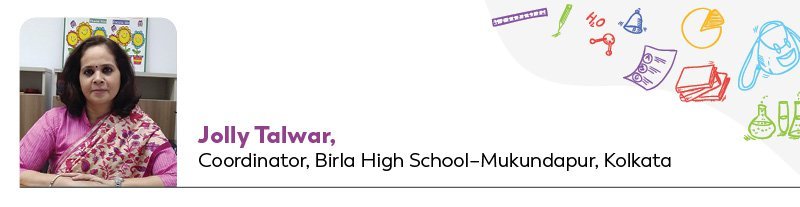
As a child, dangling a stethoscope around my neck, I would often write down prescriptions and rhymes and then explain them to my wide-eyed dolls and sometimes, my younger cousins. I was torn between becoming a doctor and a teacher, but the heart won over the head, and I chose to take care of little hearts rather than look after fragile bodies.
They say parents are our first teachers, and I was taught well. My numerous why, when, and how questions were answered with love and patience. I was encouraged to look at the clouds, run after butterflies, and delve into storybooks. I was allowed to make choices. All these experiences motivated me to become a teacher.
Memorable experiences
Supporting a boy who lost his mother: Many experiences, joyful or otherwise, have sculpted my heart and mind. Can I ever forget the day when I forgot my tiffin and two grubby little hands, full of gooey cake, tried to feed me?
Can I forget the day I fell in class and all thirty pairs of little hands reached out to me and gave me a hug to ease my embarrassment?
There's one incident I want to share, which happened early on in my career. There was a flurry of excitement as it was the last day of school before the summer holidays. Suddenly, I was called to the principal's office. The news I got shook me up. A student's mother had met with an accident and died. I was asked to be with the child till his father came to fetch him. Gaining my composure, I saw the others off while I held on to the little boy. When the father came his only request was, "Maam, will you please be in touch with my son during the holidays?" That day a special bond was created with the child. After middle school, we lost touch but the student, now a strapping young man, makes it a point to wish me on Mother's Day, the day he addresses me as Mom.
Reaching out to a scared child: The nursery session had just begun. The school counselor informed me about a new child who had school phobia. He joined the school but refused to enter my class. Determined to make him mine, I put a desk and chair outside the classroom, just behind the door, where he could hear me and I could see him. I would stand near the door and deliver lessons. Soon, the student's desk inched closer and closer toward the classroom. A month later he just walked into the classroom and sat right under my nose! Two weeks down the line, a tug at my sari made me turn and bend. A sloppy kiss was planted on my cheek. Ah, mine at last! We hugged each other and soon the entire class joined in. Amidst laughter and hugs, I heard the silent sound of trust.
First day of school
"Ma'am, please take care of my child. This is the first time he'll be without me for so long," said a teary-eyed mom. Her trust in me was enormously humbling! It was my first day at school, and I realized that the little hands and hearts had to be held gently yet firmly.
Pandemic-related challenges
Since my school is technology-driven, things were not so difficult for us. The management was quick to train the teachers with the best. Barring the teething problems, my school and teachers took to online teaching like fish to water. From hands-on fun activities to virtual tours, everything was done to keep the morale of the students high.
A message to parents
Even while juggling their professional and personal commitments, the parents supported their children by preparing them for online classes. Hats off to them! Both parents and teachers learned to appreciate each other's efforts. We held on to the child from both ends, understanding that our goal was to give the child a calm, secure environment amidst the chaos.
Jolly Talwar teaches environmental science and conducts storytelling lessons for nursery, KG, and Class 1.






















Comments
Edit
Comment Flag
Cancel Update