
Reward Systems For Kids: How To Use Rewards Effectively Without Creating Dependence
Divya Sainathan
Divya Sainathan is a writer and editor with a special interest in early childhood education.
Wondering if a reward system can help your child build good habits? Learn how to use rewards thoughtfully, choose age-appropriate incentives, and gradually phase them out

Fed up with scattered toys that are never put away where they belong? Up against homework resistance from your all-play-no-work primary schooler? Trying to get your preschooler to finish their meals on their own? Working on a bedtime routine? A reward system could give you the breakthrough you need.
When can rewards help?
Dr Nithya Poornima, clinical psychologist, says, "Whenever you reward a particular act of your child with a smile, more attention, or a sticker, you convey to them that their behavior is acceptable or you want to see more of this behavior."
Rewards can be helpful when a child is learning or practising a specific behaviour, such as putting away toys, brushing their teeth independently, or getting ready on time. However, not every positive behaviour needs a reward. Rewards must be used thoughtfully to encourage a skill or habit that is still developing. Allow children to experience the satisfaction of becoming capable and independent.
In addition to encouraging desired behaviors, a reward can give children clarity and predictability. They know what is expected of them and what they will receive in return. For example, 'When I clear my desk, I'll get a sticker.'
What can you use as a reward?
A reward doesn't just have to be a prize, toy, or a much-liked treat. It could take many forms, some of which will cost you nothing but have a great impact.
Praise and affection can encourage positive behaviour too, but they don't need to be part of a formal reward system. Parents can use specific praise every day without making every positive behaviour feel like a transaction.
Social rewards
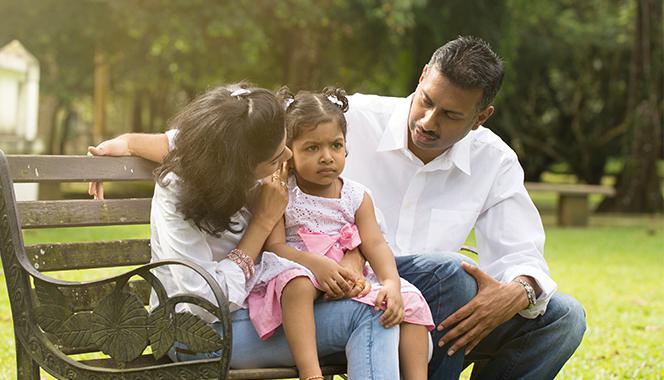
These are personal interactions that your child finds rewarding. When you smile at your child, give them a hug or a high-five, or praise them for something specific they did, they feel good and may be encouraged to repeat the behaviour. - Dr Nithya Poornima
Activity rewards
Your young child cherishes time spent playing with you. Activities such as a park visit and playing a board game together at home can be used as rewards.
Material rewards
Toys, colored pencils, books, or any other object of interest or significance to the child can be used as rewards. While it may not be feasible to give material rewards every time, you can create a sticker or jar system (see box below) to help your child earn these prizes through helpful or acceptable behavior over time.
Avoid using food as a reward or consequence. Children can learn to respond to hunger and fullness cues without associating food with achievement or emotional rewards.
How to make a reward system work
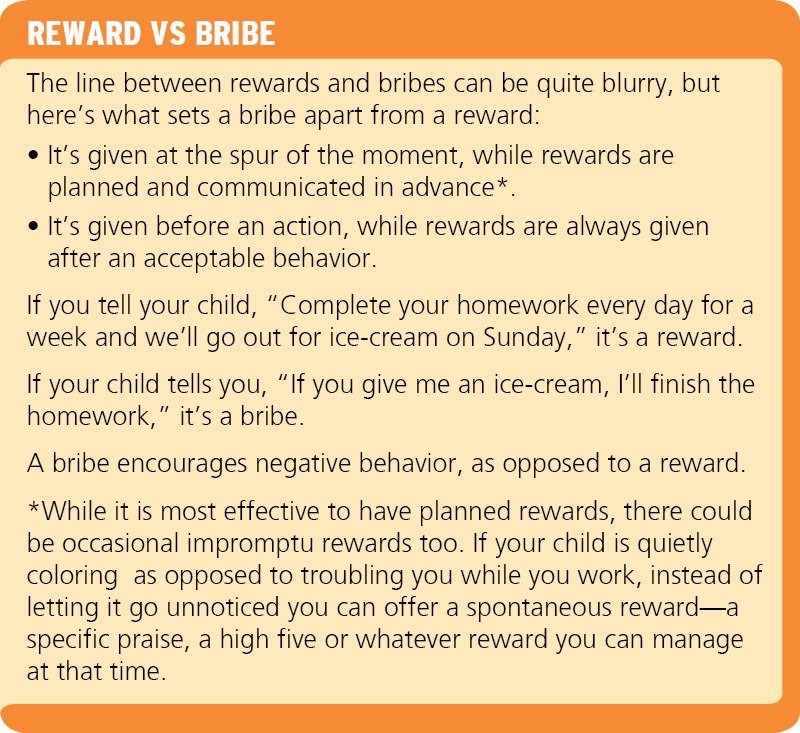
A well-planned reward system can help children practise specific behaviours and build new habits. How do you create a reward system that actually works without bribing your child?
Dr Poornima outlines three principles that can help make a reward system effective:
Contingency
A reward is given only after your child performs a task or behavior that has been agreed upon. For your child to receive the reward, they must first complete the expected task. The expected behaviour should be clear and achievable for the child.
Immediacy
Rewards work best when given immediately after the desired act or behavior. The reward doesn't have to be a chocolate or a new book. It could be a high-five or a hug, given as soon as the task is completed to let your child know you recognize and appreciate their effort.
Consistency
Stay focused on the skill or behaviour you want your child to develop. Each time you reward or appreciate the behaviour, reinforce the same message so your child understands what they are learning and why it matters.
Pair the reward with specific appreciation. Instead of simply saying 'Good job,' tell your child exactly what they did. "You brushed your teeth on your own today. Good for you." "You took care of your teeth!" This helps children connect the positive feedback with the behaviour you want them to repeat.
Getting praise right
|
Dr Poornima urges parents to establish a reward system with a clear idea of the skill or habit they wish to cultivate in their child. Is it self-care, sharing, or helping? Then they should tell their child how the expected behavior will benefit them. Children need to know what behaviour is expected of them and how it will be rewarded.
For example, when you tell your child they will be rewarded with a star for brushing their teeth on their own, what exactly do you expect them to do? Do they need to go to the bathroom, pick up their toothbrush, apply toothpaste, brush, and rinse their mouth independently? Or do they brush their teeth after you take them to the bathroom and hand them their brush?
Be realistic about what your child can do independently. If they do not yet have the skills to complete a task, coach them first rather than using a reward to push them towards an unrealistic expectation.
Common mistakes to avoid
Focusing on too many goals at once
"When you have more targets, your child can feel constantly monitored and scrutinized. They might get fed up when things go beyond their zone of accessibility and say, 'Do whatever you want. I don't want your reward!' Dr Poornima cautions.
She recommends building one habit or behavior at a time. "Start with one behavior. When your child becomes reasonably good at it, support them to become better at it and more independent. Gradually, add one more target behavior, but not more than three to five at a time," says Dr Poornima.
Letting rewards become transactions
A reward should be a tool for practising a behaviour, not a permanent payment for doing it. Help your child understand why the behaviour matters. For example, making their bed helps keep their room neat, while clearing their desk means taking responsibility for their belongings.
Taking back earned rewards
Once your child has earned a reward, don't take it away later because of another behaviour. If the behaviour needs to be repeated, allow them to earn the next reward again.
What should you reward at different ages?
For the reward system to be successful, you need to consider your child's age.
Preschoolers (Ages 3-5)
"For preschoolers, just exploring their abilities can be very rewarding. When they try out things such as walking up and down the stairs or pouring from a cup without spilling, they find them rewarding because of novelty and because they see adults doing these things daily. When we start giving a reward for such tasks, it may deplete your child's motivation," says Dr Poornima.
If your child already enjoys a behaviour or finds satisfaction in mastering it, you may not need to add an external reward. But if you want your mess-maker to develop the skill of tidying up, reward them for packing up their toys or putting away their crayons.
Preschoolers can be rewarded for self-care activities they have trouble doing independently, such as dressing themselves or eating a meal.
Rewards young children may enjoy:
- Parental attention, such as praise, hugs, or high-fives.
- Activities involving play.
- A choice between two rewards, such as a sticker or a special game with you.
- Stars or smiley faces.
- Small toys or objects they've been wanting.
Primary schoolers (Ages 6-8)
Some children may benefit from an incentive while they are learning to manage schoolwork, chores, or other responsibilities:
- Completing their homework (with guidance wherever necessary)
- Watering plants
- Taking care of a pet
- Sorting groceries
- Packing their school bag
- Getting ready on time
Dr Poornima reminds parents that children may still need coaching before they can complete tasks independently. "Coaching is especially important for primary schoolers."
If you choose to use a small monetary reward with an older primary-school child, try linking it to saving or a specific goal rather than encouraging immediate spending.
Primary schoolers find encouragement in:
- Words of appreciation
- A homemade certificate recognizing a specific achievement
- An activity they enjoy doing with you
How to phase out rewards
Dr Poornima suggests that once a behaviour has been established through regular rewards, gradually move from material or activity rewards to social rewards.
Phasing out rewards does not mean phasing out appreciation or connection. Continue to notice your child's efforts and give them positive attention as part of everyday life, not only when they complete a task or display a problem behaviour.
Reward system checklist for parents
- Choose one or two specific achievable behaviours to work on at a time.
- Make sure the behaviour is appropriate for your child's age and ability.
- Explain exactly what your child needs to do to earn the reward.
- Give the reward soon after the desired behaviour.
- Tell your child specifically what they did well.
- Prefer social rewards and shared activities over material rewards when possible.
- Avoid using food as a reward.
- Coach your child when they don't yet have the skills to complete a task independently.
- Gradually reduce external rewards as the behaviour becomes established.
- Continue giving your child positive attention even after the reward system ends.
A reward system can be useful when your child is learning a new behaviour, but it shouldn't be the reason they keep doing it. Use rewards thoughtfully, keep expectations realistic, notice your child's efforts, and gradually shift from external rewards to the satisfaction of becoming more capable and independent.
Dr Nithya Poornima is a clinical psychologist with training from NIMHANS and experience working with children, adolescents, and parents. She focuses on early childhood mental health promotion.
Need more information? Trusted resources:
- CDC: Using rewards to encourage positive behaviour in children
- American Academy of Pediatrics: Guidance on healthy approaches to food and rewards
- Research on rewards and children's intrinsic motivation
Last updated on: August 19, 2026






















Comments
Edit
Comment Flag
Cancel Update