
Multitasking For Moms: Parenting Superpower Or Rookie Mistake In Today’s Digital World
Saakshi Kapoor Kumar
author parentcircle author parentcircle author parentcircle author parentcircle author parentcircle author parentcircle author parentcircle author parentcircle author parentcircle
Most mothers don’t multitask because they want to. They multitask because life demands it. This thoughtful, research-backed piece on multitasking for moms helps you understand why modern motherhood feels so overwhelming today, how technology and expectations have changed the load, and how small, realistic shifts can help you feel more present, calmer, and more in control, without guilt

“Ma, do you think multitasking is harmful to moms in the long run?” I asked my mother as part of my research for this article.
It made sense for me to involve my mother since she is a veteran in both fields, motherhood and multitasking. When my sister and I were growing up, my father was away a lot, sailing in the merchant navy as a captain. This meant that my mother also had to sail through her own storms, navigating motherhood and, without much of a choice, being the captain of the ship called home. For most of her life, she has been a serial multitasker.
“What rubbish!” she snapped before continuing matter-of-factly, “I have done it for years, your grandmother did it too. Do you see anything wrong with us?”
My mother then went on to remind me how her home is spic and span and extremely well organized to date, while my cupboards look like the outcome of a natural calamity. Apart from making me partially regret involving her in my research, her comment did make me think.
Why are researchers questioning multitasking for moms?
Mothers have been multitasking for years. Then why are we debating the impact of multitasking on mothers today?
In fact, multitasking, which means doing more than one thing at a time, seems to be a hot topic of discussion among researchers over the past few years. A landmark study conducted in 2001 by Meyer, Evans and Rubinstein, titled ‘Executive control of cognitive processes in task switching,’ found that multitasking can be counterproductive, even though it may seem like an efficient way of getting things done. Our brain has certain cognitive limits, and multitasking challenges these limits, eventually reducing our productivity and increasing psychological stress. The consensus is that multitasking is not healthy for us.
What multitasking really means for the human brain
But before we delve deeper into that, let’s take a step back. Being the confessed etymology enthusiast I am, I found out that the word multitasking was coined in the 1960s to describe the concurrent execution of tasks by a… computer! And even in that context, this word was misunderstood. A computer isn’t doing various tasks simultaneously. Its processor is actually switching between tasks. While computer processors are designed to do this, our brains aren’t. As if that wasn’t problematic enough, we’ve added technology and gadgets to the mix.
How technology has intensified multitasking in modern motherhood
A real-life snapshot of multitasking in a working mother
Let’s look at a typical evening of a young working mother, Deepa. It’s 7 p.m., and Deepa still has a few work emails to respond to. As she does that on her phone, she is also prepping for dinner. Sitting across the table is her 6-year-old daughter, who needs her help to finish homework. Deepa is also ordering groceries on an app she uses every day. At the door stands a courier delivery person waiting for his payment. Deepa’s family WhatsApp group is receiving messages, and she is eager to read them as well. Phew!
Tell me the truth, dear moms, it sounds just like your evening, right? If you’re nodding in agreement, well, here’s the message from scientists: “Stop multitasking now!” Monotasking, or focusing on one task at a time, is the more efficient way to perform tasks, they say.
Monotasking sounds like an effective way of managing tasks, but is it realistic? We moms multitask as a survival mechanism and aren’t really enjoying it, but monotasking doesn’t seem like a plausible solution because there’s just too much to be done! So let’s go back to my mom’s answer that multitasking is no big deal.
Why multitasking affects today’s mothers differently than earlier generations
Mothers have been multitasking for centuries, but in earlier times:
- Most mothers weren’t working outside the home.
- Joint families were more common, so there were more hands to help out.
- The role of technology in mothers’ lives was negligible, and social media didn’t exist.
And most importantly, even if mothers felt stressed out and overwhelmed with the sheer amount of housework they had to do, along with childcare, they didn’t have a voice. Today, more mothers work and live in nuclear families. They also want to raise their children mindfully and have to depend on technology to get things done. But societal expectations remain largely unchanged from the time of our mothers and grandmothers.
Why multitasking takes a heavier emotional toll on mothers than fathers
Besides, mothers multitask much more than fathers, and they feel more negatively about it. This was revealed in a study conducted by Offer and Schneider, published in the American Sociological Review in 2011. And I am going to try to explain this with another example about Deepa, the same mother whose evening we glimpsed a few paragraphs ago.
Deepa’s inner dialogue
Guilt and the pressure to be a perfect mother
“I need to make sure I get everything done. I want to be the best mother and wife. Just because I am working, I must not ignore my responsibilities.”
Shame and constant self-comparison
“Last week, my daughter didn’t do too well on her test. It must really be my fault. Why can’t I get this right? All the other mothers are doing it!”
Feeling overwhelmed by family expectations
“I need to respond to my mother-in-law’s message, too. She needed help with something, and I haven’t been able to help her.”
Emotional and physical fatigue
“I feel so tired and stressed out all the time.”
Now, let’s turn the spotlight on Deepa’s husband, Govind. He works very hard at the office and enjoys being a hands-on parent. He multitasks too, but more at work and less at home. And when he does multitask at home, he doesn’t feel negative about it. In fact, he may even feel proud of himself for “helping out.” Most of his multitasking-related stress emerges from work, not from home.
Findings from another study by Barbara and Waite, published in 2005, titled ‘Being Together, Working Apart’ by Offer and Schneider, revealed that mothers are more likely to simultaneously engage in “two housework activities or two childcare activities” or a combination of housework and childcare activities, compared with fathers. The study concluded that as mothers are more likely than fathers to multitask at home and in public (shopping, PTA meets, etc.), “multitasking likely takes a heavier toll on mothers’ well-being than on fathers’ well-being.” No wonder Deepa and other mothers around the world are overwhelmed.
How gender roles and unequal workload drive multitasking stress for mothers
Thus, today, multitasking is a real issue for mothers because the gender gap in sharing household and childcare duties contributes to mother stress. This is why we need to address the problem of multitasking.
Five realistic rules to help moms use multitasking to survive and thrive
While every family has its own dynamics and should ideally design their own solutions to any problem, here are some suggested strategies to go from using multitasking to survive to using it to thrive.
You and your partner need to discuss and abide by these five multitasking rules:
Rule 1: Do no more than two tasks at a time
Yes, you’ll still multitask, but it's fine, as research shows your brain can handle two tasks at a time. To manage tasks, use the Eisenhower Decision Matrix, a method that prioritizes based on the importance and urgency of the tasks. According to this method:
- Do the “important and urgent” tasks first
- Next, prioritize the “important but not urgent” tasks
- Delegate the “not important but urgent” tasks. If you can’t delegate them, do them after you’ve finished the tasks in the two categories above.
- Eliminate the “not important and not urgent” tasks and only do them at leisure.
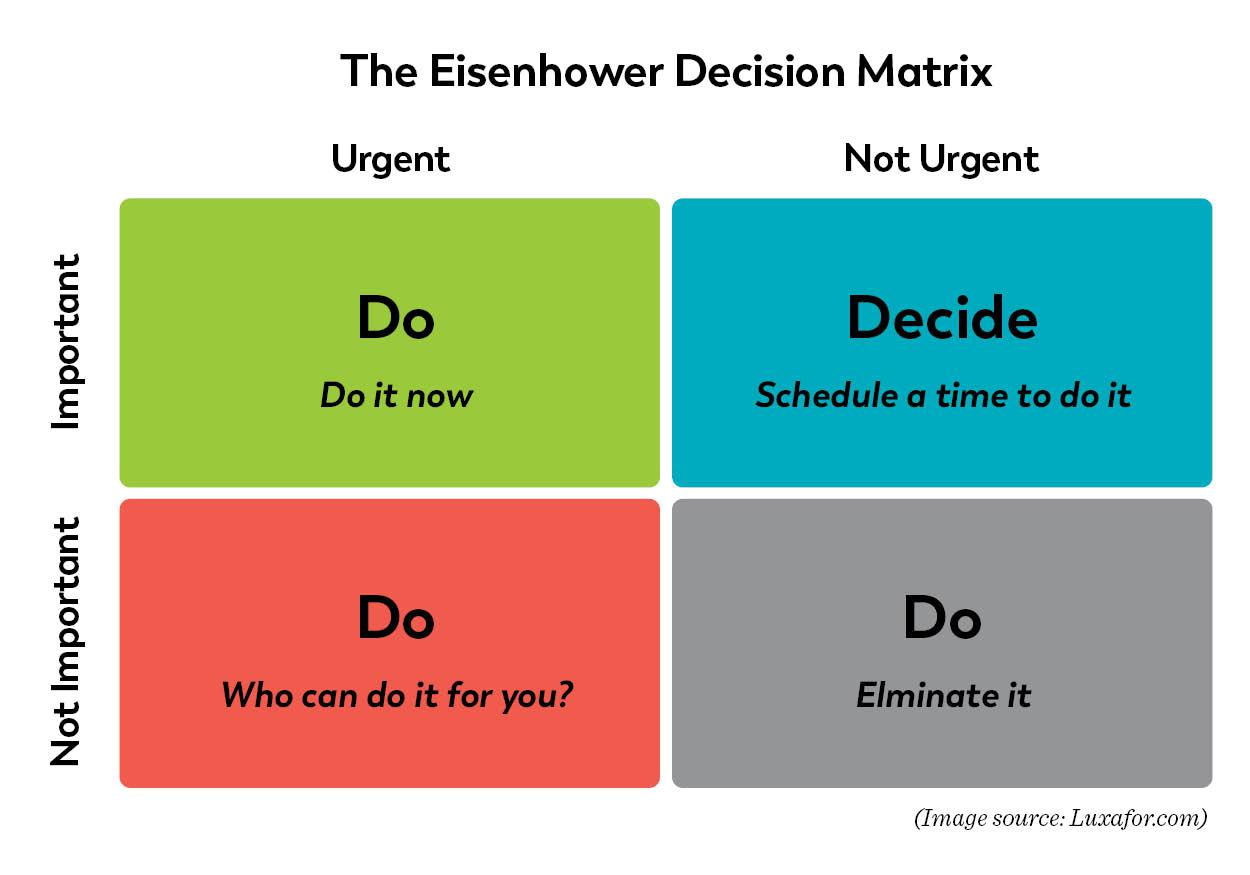
You should ideally be doing these one at a time, but realistically speaking, you’ll probably be doing more than one. However, remember, never more than two.
Suppose you need to do the following:
- Calm your crying child: Important and urgent
- Respond to a work email: Important but not urgent
- Dry the freshly washed clothes in time so they can dry until the sun is out: Not important, but urgent
- Paint your nails: Not important and not urgent
You should first try to calm your crying child, and once they feel better, take them along to dry out the clothes. Spend a couple of minutes just connecting and making eye contact with your child. Let them feel your presence. Once you’ve put the clothes to dry and have had that moment of connection with your child, respond to the email, but your nails will probably have to wait!
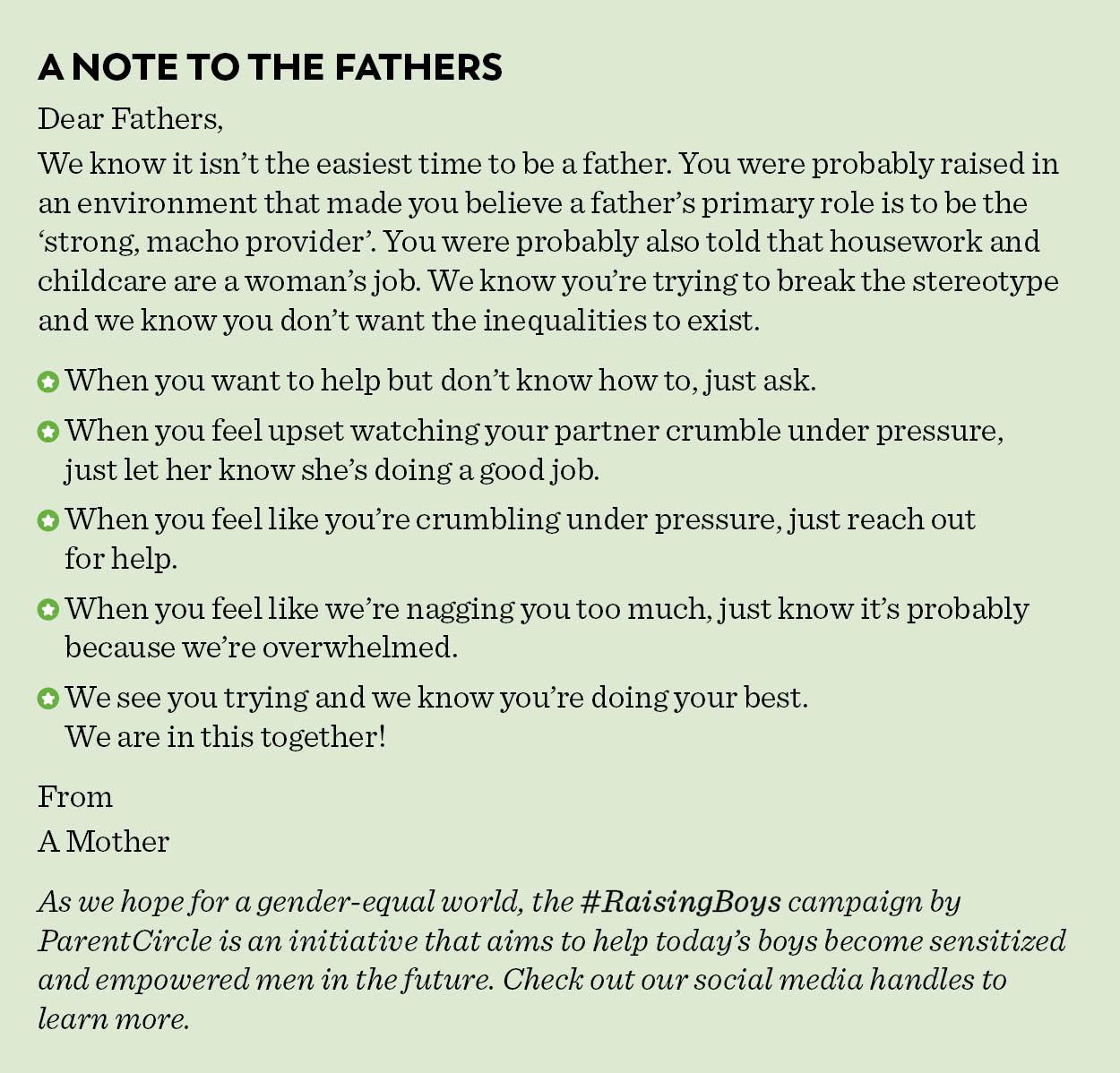
Rule 2: Involve your partner in daily responsibilities
You can only abide by rule #1 if your partner participates in housework and childcare. It helps to have a list of chores and commitments that need attention every week. Discuss and divide tasks.
Trust each other and know that both you and your partner want the best for the family. I remember how I always insisted on making my children their milk because I wanted it to be a certain way. My husband would offer help many times, but I would refuse. Once I began traveling for work, I realized my children preferred the way my husband made the milk, and now he does it regularly. The point is, sometimes, we women hesitate to let our partners do certain things because we feel we’ll do them better. That may not always be true.
Rule 3: Monotask for work-related responsibilities
When it comes to work, productivity should be your goal. Monotasking will enhance your performance and also help you bring less work-related stress home. If you’re working from home, set aside “work-only” time and focus on one task at a time. Of course, this will mean you’ll have to plan your day.
Rule 4: Protect time for your own well-being
Apart from being present with your child and other family members, make time for your own wellness. Whether it’s an exercise routine, taking up a new hobby, practicing mindfulness, or spending time with friends, ensure your schedule has time set aside for you. And here I’d say use multitasking to your benefit. Join an exercise class with a friend. You get to stay healthy while catching up with a pal!
Rule 5: Spend gadget-free time with family and friends
Most of the time when we’re multitasking, a gadget is involved. That’s because we’re using gadgets to do so much. However, this can lead to overstimulation and information overload. It’s important to have time to connect with loved ones without gadgets. Nothing is more valuable than undivided attention from your family and friends. Spend time with your growing child and your aging parents, your goofy sibling, or the oldest friend you have. But when you do so, give and receive presence. The joy of human connection is priceless, and it can be the antidote to stress and fatigue. This is why every year, here at ParentCircle, we celebrate #GadgetFreeHour in November around Children’s Day. The purpose is to rekindle the joy of gadget-free moments with your loved ones.
A hopeful message for mothers navigating multitasking and motherhood
As I end this article, I can’t help but think about how 25 years from now, my children will probably start their families. Technologies such as artificial intelligence (AI) will be more invasive than they are today. However, the challenges of raising a child will most likely not reduce in quantity or intensity. They may amplify. How we manage our lives today will play a crucial role in how our children manage life in the future. I multitask today in the hope that my children receive an important message—becoming a parent doesn’t (and shouldn’t) limit you or stop you from pursuing your dreams and desires. In fact, it can fuel you towards a life of growth, balance, and fulfillment. If we can do it today, they’ll surely be able to do it tomorrow.
Parent checklist: A healthier way to approach multitasking for moms
I consciously limit myself to no more than two tasks at the same time.
I separate work time and home time as much as realistically possible.
I involve my partner in planning and sharing household and childcare work.
I let go of doing everything “my way” and allow others to help in different ways.
I schedule at least one small activity every week only for my well-being.
I practise monotasking for important work-related tasks.
I create daily or weekly gadget-free moments with my family.
I remind myself that feeling overwhelmed does not mean I am failing as a parent.
I model balance for my children, not constant busyness.
Check our articles on raising a responsible child.
Saakshi Kapoor Kumar is a psychologist, educator, and Head of The Dot Learning Experience, a comprehensive early childhood education ecosystem. She works closely with schools and teachers to create joyful, child-centered learning environments and has extensive experience in teacher training, early childhood education, and social-emotional learning.
This article was featured in the March 1, 2026, edition of The Free Press Journal
Last updated on: January 04, 2026





























Comments
Edit
Comment Flag
Cancel Update