
An Interview With Dr. Srivi Kalyan On The Importance Of Introducing Arts To Young Children
Monali Bordoloi
Don’t we all want our children to develop an appreciation for the arts? So, how can we effectively introduce art to young children? We spoke to artist, poet, designer, writer, educator, and environmental activist, Dr Srivi Kalyan, and got some interesting answers
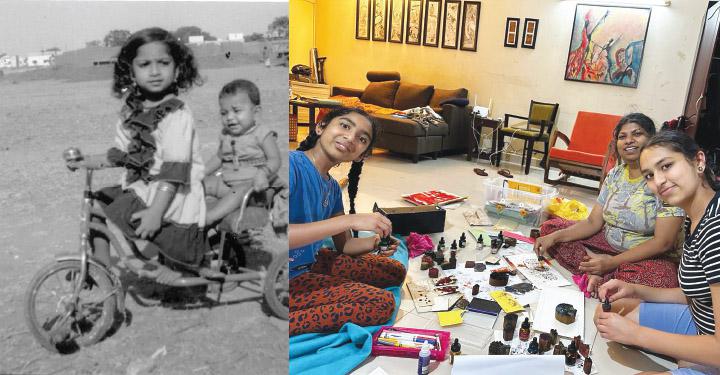
Art comes straight from the heart; it’s all about expressing our thoughts and even our deepest emotions. That is why helping children understand and appreciate art from a young age bodes well for their physical and mental development, says Dr Srivi Kalyan, who has authored and illustrated several children’s books and won awards. She has also worked for some of the leading educational/edutainment organizations like Sesame Street, NCERT, iDiscoveri, Katha, Tulika, Birla Edutech, and Ilango’s Artspace, where she designs books and media for children and young people. She is also involved in conducting workshops; designing environment-related courses, curriculum, and teacher training modules; and interdisciplinary strengthening.
In this interview, Dr Kalyan, who believes no child is too young to be introduced to the world of arts, recounts how her parents were instrumental in developing a love for the arts in her, shares her tips on what we can do to make our children appreciate art, and much more.
You revealed that your childhood shaped your interest in all things artistic. How did this happen? Can you elaborate?
My childhood was a lot about play. We were in Ahmedabad till I was 5. A lot of storytelling happened at home. I come from a fairly poor background; there was nothing much at home, but both my parents encouraged us to draw, read, and write about our experiences. My sister and I used to spend time feeding the goats and camels near our home and going to the zoo—enjoying the outdoors is also a large part of my childhood memory. The result of all these joyous expeditions was that we sisters were mesmerized by all the wonderful things around us, and fascinated by the different ways of expressing those. I believe this defines how I grew up.
Sounds magical just listening to you, but how did your parents instill this sense of wonder in both of you?
My parents complemented each other in the way they brought us up. Even though my father worked long hours, he was very much present in our lives. Every time there was a flower blooming, a bird chirping, or even a frog croaking, my parents would point it out to us. They encouraged us to find the magic in our surroundings and often took us outdoors. Once, my mother and I were traveling by train down south, and I was chattering incessantly. So, she asked me, “Why don’t you observe your sister and the scenery outside and write a poem about it?” At just 5, that’s how I wrote my first poem looking out of a train window.
Later, my parents introduced me to the world of books, especially to the poems of Subramania Bharati and encouraged me to pen down my feelings about those, as well as participate in oratorical competitions. My mother also taught me to document whatever I created, poems or paintings. She showed me how to date those and not just leave those as momentary creations.
The last thing you said, about documenting—that’s quite a unique way to help appreciate every work of art. But how to encourage children to appreciate and create art? To teach them to observe nature, people, and things around them?
Children observe a lot of things when they accompany parents to exhibitions or any artistic place. As they observe the elders looking at and discussing art, they too develop a sense of art appreciation. Nature is the starting point to introduce concepts like shapes, textures, colors to preschoolers; it could even be the potted plants on your balcony, the shapes of tree leaves, or the formation of clouds.
A wondrous way of seeing the world needs to get internalized in children. It may not happen immediately; parents need to repeat it several times before children develop a habit of observing their surroundings mindfully. It’s a time-consuming process, but at the same time a playful and delightful one. It’s important to provide opportunities for multiple engagements with forms, shapes, colors, paintings, sculptures, architectural spaces; it could be simple or complex. Children are able to understand complexities early on. When my niece was around 4–5 years old, I once showed her rhinoceros in various media, as a photograph, as a cartoon, as a sculpture, and as a painting, and then I asked her views on each of these. Such conversations help children to articulate their feelings. Just asking them to start collecting different textures from nature makes them see more in their environment. Or just walk with them and ask them to tell you what they spot on the way. And this can start when they are around 2–3 years old.
So, you’re saying there’s art all around us and parents need to help children discover it.
Yes. Even playground time can be a conversation around forms and shapes around them. Talk to children about the forms that are geometric or organic, or forms that are really huge or really tiny. Ask how an ant is different from a grasshopper, or how many different kinds of ants they can see around them. Art appreciation for children also begins when you say, “Come, let’s look at other life forms around us.” Then the complexities and possibilities of forms begin to arise in a child’s mind.
Introducing diverse art forms and artists could also happen early on, you just have to simplify the language while talking to the child. Children’s books are another fantastic space to open conversations about art appreciation. There are remarkable, beautifully illustrated works, and each children’s book can open a world of aesthetic beauty for them.
So, parents do have the power to encourage their children to appreciate art. Tell us how your parents positively influenced you as you grew up.
I was inspired to be an educator partly because of my parents. They don’t have a background in education, but they are both creative in their own ways. Apart from believing in the power of education, they also wanted us to believe in becoming the best version of ourselves. We were taught to compete with ourselves and not with others. They encouraged us to find our voice and wanted us to be just ourselves from the beginning. There were expectations for us to do well academically, but at the same time, there was freedom for us to explore and find out who we wanted to be. I strongly believe that parents play a key role in shaping their children’s interest in every field, be it in honing an artistic bent of mind or developing scientific know-how. They can introduce the world to the children as a magical place, show them there’s much to enjoy and experience in nature, and then rearticulate that.
What’s the best age to introduce art to children?
Well, my parents gave us colors by the time we (my sister and I) were 2.5–3 years old. A child is ready to explore by the time they’re able to hold and touch things. There’s no right age for it, you can introduce art even to a 6-month-old! Of course, in early childhood, you’re looking for safe materials when it comes to art tools. We have experienced this with my nieces—when they were 4–5 months old, my mother allowed them to play with safe art materials. Even before children use language to express themselves, you can encourage them to express themselves through art. If not actual art tools, they can start with kitchen items, like using natural dyes from vegetables and fruits. Shapes, colors, and textures could be part of their daily routine, it need not be a separate artistic exercise.
Once, my sister and I were painting on huge canvasses for a project, and we gave some colors and paper to my eldest niece to keep her engaged while we worked. She was just 1.5 years old then. She kept looking at the canvasses and was not interested in painting on paper. We thought she was bored and let her be, but suddenly, when we were not looking at her, she rushed to the largest canvas in the room and painted on it with her paintbrush. She was so thrilled to be able to do that! When we asked her what she drew, she tried to explain with her limited language skills that she had recreated a zoo that she had visited recently.
When you say tools of art, apart from the usual paints and crayons, what else can we give a young child so that they grow to love art?
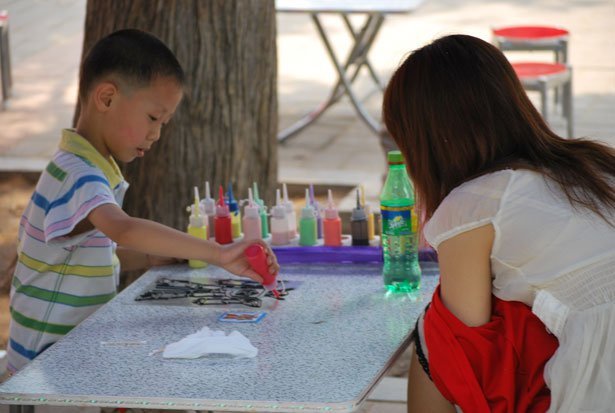
If you want your young one to develop a love for the arts, you need to listen to them, talk to them, engage their imagination, and help them feel acknowledged. Also, make them feel that it’s perfectly okay to express themselves in abstract ways. Children can work with sand—a lot of sand play can be about creating art. You can even ask them to draw different emotions and the imaginative world of their everyday experience on sand. Often, when children are sad or upset, they’re not quite able to articulate their feelings. At such times, art really helps. Singing, dancing, visual arts like painting, or acting—all these art forms come quite early to children, and they’re ready for it as long as we are able to engage and understand that they’re interested in doing that.
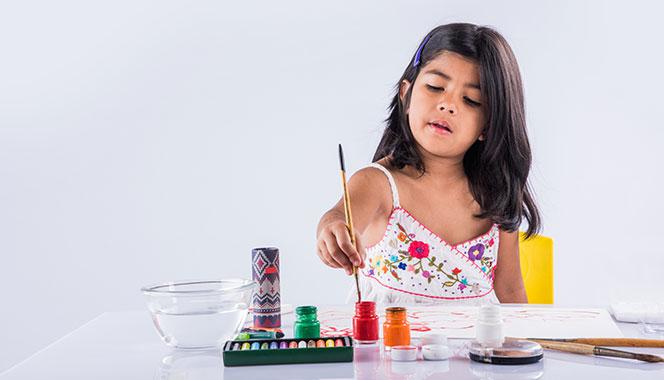
As for materials, nowadays, plenty of safe art materials like huge crayons are available in the market. Just don’t give children anything with a fine/sharp tip, too early. Young children tend to put everything in their mouth, so be careful—in fact, it’s perfectly okay if you give them a beetroot to paint! You can introduce tools like brushes when they are a little older, around 2 years, and you need to guide them and make them understand that brushes could get hurt if you bang them on a hard surface. And parents need not know the art form to introduce it to their children. Today, art activities are available online, so parents can also learn. Lastly, don’t run after perfection. Understand that it’s okay for children to color outside the lines, draw a pig like a cow or a cow like a donkey. There’s no perfection in the world of art.


























Comments
Edit
Comment Flag
Cancel Update