
World Breastfeeding Week: Everything you need to know about storage of breast milk
Dr Madhuri Prabhu
We look at how breast milk can be stored so that a baby need not be deprived of it even if the mother is away at work. Read on for more...
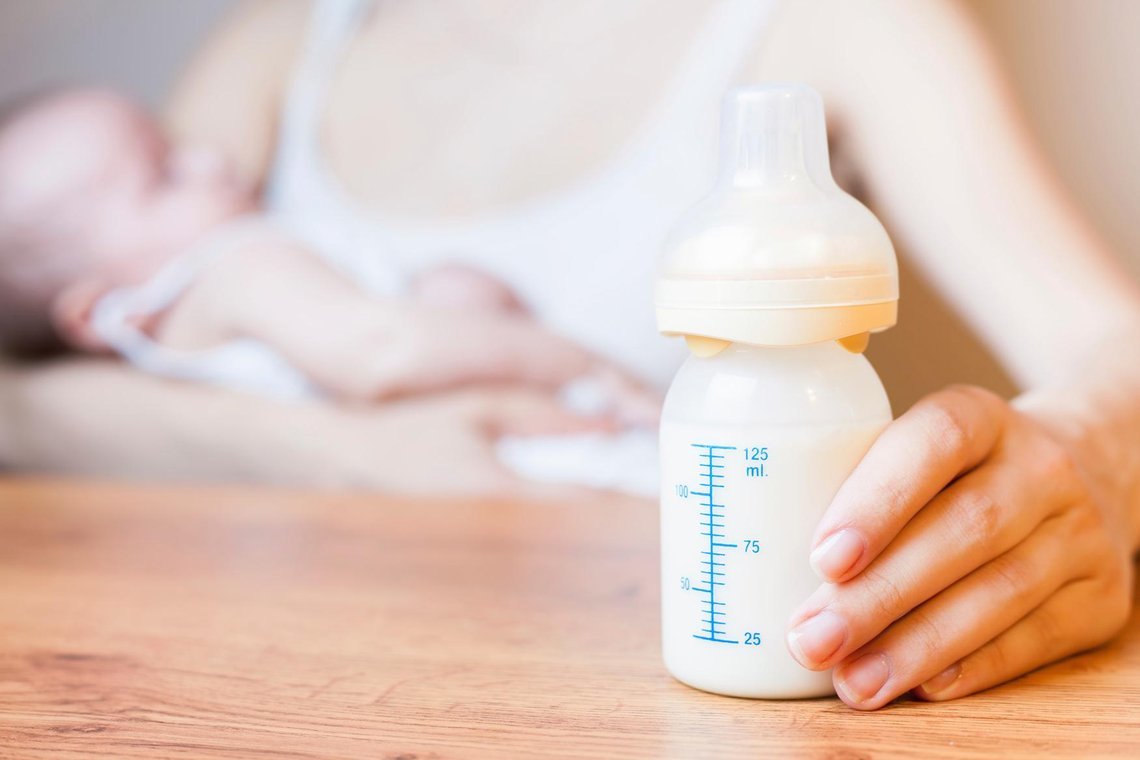
World Breastfeeding Week is celebrated every year from 1 to 7 August to encourage breastfeeding and improve the health of babies.
Mother's milk is considered the best food for babies, and not without reason - it supplies all the nutrients in the right quantities, protects against allergies and infections, is easily digestible and prevents obesity. It is always available at the perfect temperature and is safe. With the number of benefits it offers, it is only right that babies must not be deprived of mother's milk.
But what if the mother has to go to work and is unable to breastfeed the baby? Well, the answer is to express and store mother's milk, and feed the baby whenever required.
Instances when mother's milk needs to be stored
One of the biggest problems faced by new mothers working outside home is how to provide the best nutrition for their babies. For such mothers, expressing and storing mother's milk is a convenient option. It allows them to pursue their career without compromising on the quality and quantity of milk available for their babies.
Preterm babies who are unable to suck and swallow (due to various complications of premature birth) benefit by being fed with expressed mother's milk till they can feed directly from their mothers. Also, babies who have undergone surgeries or are under intensive care can benefit from expressed mother's milk.
New mothers can find breastfeeding taxing, both physically and mentally, because they have to take over soon after childbirth. To give mothers a break from this routine, babies can be fed expressed mother's milk by family members instead of substituting with formula feeds.
In addition to the above, variations in breast anatomy like flat, inverted or sore nipples may also require feeding expressed breast milk.
No matter what the circumstances are, it is important that utmost care is taken while expressing milk.
How to express breast milk
Mother's milk can be expressed by the hands or with a breast pump. Choose a time when you are relaxed to increase the flow of milk.
When expressing by hand, start with massaging the breast gently. Compress the area behind the nipple to spray the milk. Do this by putting your thumb on top and your index finger exactly underneath. Compress rhythmically until the spraying stops. Repeat by changing the direction slightly. With practice, you can do this effectively.
You can also express milk by using a pump. It takes about 15 to 45 minutes to pump both breasts depending on the pump you choose.
Facts to remember before expressing milk
- Hand washing is a must prior to expressing milk
- Always express milk in sterile containers
- Store small quantities in each container (2-4 ounces)
- Stick a label to document the time and date of expressing prior to storage
Once milk is expressed, the next important step is to ensure it is stored under favorable temperature conditions.
Here's what you need to know.
Duration of storage
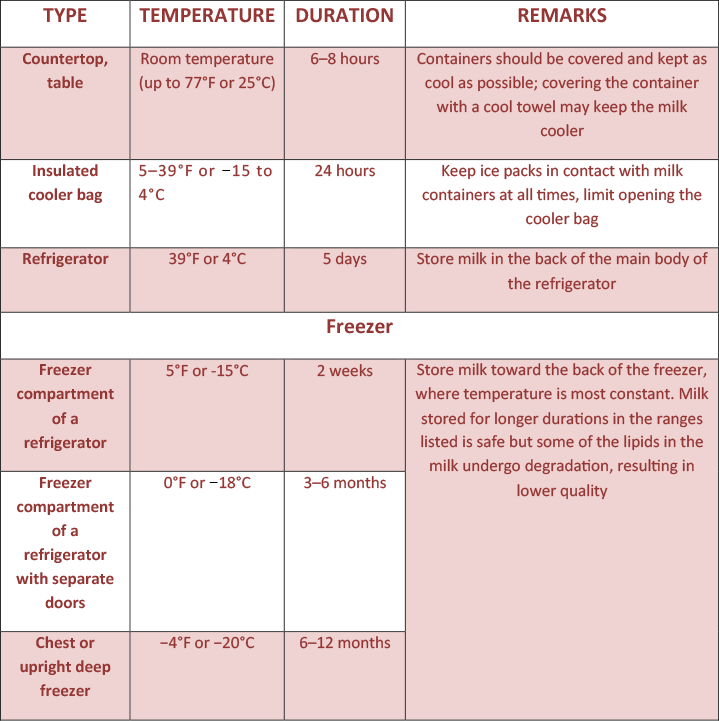
Reference: Academy of Breastfeeding Medicine (2004) Clinical Protocol Number #8: Human Milk Storage Information for Home Use for Healthy Full Term Infants. Princeton Junction, New Jersey
How long should one store breast milk at room temperature?
In countertops and tables, store from 6-8 hours at room temperature up to 77°F or 25°C. Containers should be covered and kept as cool as possible; covering the container with a cool towel may keep the milk cooler.
How long should one keep breast milk in a cooler bag?
In an insulated cooler bag, store at a maximum of 24 hours with room temperature 5°F to 39°F or -15°C to 4°C. Keep ice packs in contact with milk containers at all times, limiting the opening of the cooler bag.
How long can we keep breast milk in the refrigerator?
In a refrigerator, one can store breastmilk for a maximum of 5 days with temperature 39°F or 4°C. Store milk in the back of the main body of the refrigerator.
How long can you keep breast milk in the freezer?
- The freezer compartment of a refrigerator, to store at a maximum of 2 weeks with a temperature 5°F or -15°C
- The freezer compartment of a refrigerator with separate doors, to store at a maximum 3-6 months with a temperature 0°F or -18°C
- Chest or upright deep freezer, to store at a maximum of 6-12 months with a temperature of -4°F or -20°C
In the freezer, store milk toward the back of the freezer, where the temperature is most constant. Milk stored for longer durations in the ranges listed is safe but some of the lipids in the milk undergo degradation, resulting in lower quality.
How to use the expressed milk?
- Do not heat stored milk in a microwave oven
- Always thaw the milk by placing the container in which it is stored in warm water
- Once thawed, use within 4-6 hours
- Do not shake the container vigorously
There is a myth that expressed mother's milk may be harmful to a baby. This is completely false. Mother's milk is the best start a mother can give her baby. Expressing mother's milk and storing it for later use, if done correctly, stands to benefit both the mother and the baby. It also promotes breastfeeding.
For further queries on breastfeeding, and expressing and storing mother's milk, speak to your pediatrician.
The author, Dr Madhuri Prabhu is a pediatrician based in Chennai.






























Comments
Edit
Comment Flag
Cancel Update