
How To Handle Aggressive Behavior In Young Children With Patience And Effective Strategies
Dr Sulata Shenoy
author parentcircle author parentcircle author parentcircle author parentcircle author parentcircle author parentcircle
Learn why young children act aggressively and how to guide them with patience, clear boundaries, and positive strategies to help them express emotions in healthier ways.

Rita is a primary school teacher and the mother of two young children aged 6 and 4 years. At home, she often yells at, and sometimes even hits her children to stop them from fighting. After she breaks up the fight her children often accuse her of favouritism. In school, she handles a boisterous class of first graders, some of whom are prone to aggression. Handling aggressive children throughout the day fills Rita with a sense of guilt, frustration, and helplessness.
Rita's is not a unique case. Emotional-behavioral disorders in children have taken the form of an epidemic. Is it a result of the stressful times we live in? Is it a fallout of the increase in selfish materialism? Are single-parent and nuclear families to blame for this unprecedented rise in behavioral issues in children? While no single factor can be blamed, signs of increasing aggression in children are a result of many psychological and sociological factors. Let's consider some of the following facts:
- The increase in divorce rates in India has led to an increase in the number of single-parent families.
- According to a June 2016 UNICEF global report, 6 of 10 children aged 2-14 years are regularly punished physically by their caregivers.
- Results of a survey published on nobullying.com revealed that 70% of children included in the study were aware of cyberbullying.
- The number of unhappily married parents staying together for the sake of children has increased. Children in such families are often the target of violent outbursts by parents, which leaves them stressed and bewildered.
These facts suggest that dysfunctional patterns of interaction between the child and his environment trigger the development of aggression.
Causes of aggression in children:
- Low self-esteem and negative self-concept
- Adult expectations and being subjected to either severe discipline or a lenient approach
- Difficulties faced at home and outside
- Stressful life events (birth or death of a family member, school-related issues, change of residence, family dislocation or change in family structure)
- Neurological problems such as learning disability, attention deficit hyperactivity disorder or autism
- Illness, prolonged hospitalization, or chronic health conditions
Effects of seeing violence on screen
A study by the National Institute of Mental Health, USA, in 1982, identified the following major effects of seeing violence on television and playing violent video games:
- Children may become less sensitive to the pain and suffering of others.
- Children may be more fearful of the world around them.
- Children may be more likely to behave in aggressive or harmful ways towards others.
Ways to curb aggression in children:
- Parents should act like role models and create a cordial home environment to develop a sense of security in children. Teach children to respect and value themselves and others.
- Don't ridicule children's fears and anxieties. Doing so makes them confused, defiant and aggressive.
- Encourage children to recognize and accept their feelings by engaging them in conversations like, "You look upset. Do you want to talk to me about it?" or "It looks like ... has made you angry. Can we discuss it?" Differentiate feelings from behavior and teach children appropriate behavior to express feelings.
- Teach children to respect objects, others, and themselves. For example, you can say, "This is one of your favorite books, isn't it? If you turn the pages carefully and gently like this, the edges will not get frayed." Praise and reinforce children's ability to nurture and respect their environment.
- Set rules and clearly explain acceptable and unacceptable behavior. Base rules on age-appropriate expectations and convey them in simple words. For example, "You have to play quietly when baby/grandma is sleeping." Fair and firm rules serve as standards and guidelines, and help children deal with their overwhelming feelings.
- Regular outdoor activities like swimming and cycling help children spend excess energy. Unspent energy manifests in the form of aggression.
- Teach children how to get along with others by training them in social skills.
- Never compare a child with his siblings. This breeds jealousy and resentment and gives rise to aggressive behavior.
- Biological factors like hunger, sleep, tiredness, and illness aggravate aggressive behavior. Ensure that you address these issues.
- Enforce discipline with non-physical forms of punishment. Also, use time out and compensatory behavior. Spanking teaches children that certain circumstances justify aggression.
Dos and don'ts for parents:
- Don't get provoked by aggressive behavior. Before reacting, ask yourself, "What can I do to de-escalate the aggression and benefit my child's personality?" What message are you sending them by agreeing to their unreasonable demands? Do you want them to grow up thinking that they can make you give in by acting out?
- Engage with children and teach them skills like negotiation, patience, and strategies that can lead to a win-win situation for all.
- Empower children to face and report aggression from others. Children must be protected from abuse, as child victims of aggression can end up becoming aggressors themselves.
- Exhibit a proactive problem-solving approach to conflicts for your children to learn and understand. Do not complain, grumble, or abuse others in the presence of children. For example, if your domestic help is irregular, do not rave and rant at her when she comes. Instead, sit down with your helper and discuss her performance. Allow her to provide a reasonable explanation and follow it up with appropriate action. Be effective role models for combating aggressive impulses.
- Limit exposure to violent content on TV, video games, or books. Make a list of age-appropriate content and allow your children to choose only from that list.
- Avoid aggressive talk and uttering profanities in front of children, as they tend to remember those images and expressions. This may promote aggressive behavior in children.
- Develop a behavior contract. Draw up a one-week chart to keep track of good behavior. Apart from marking stars on your child's chart, use verbal praise, hugs, pats on the back, and privileges for compliance. Move from external rewards to making your child feel intrinsically rewarded in the long run.
- Help children acknowledge and express negative feelings such as fears or guilt through conversation, play, creative art, and craft work.
- Develop a sense of self-esteem in children. It helps them nurture healthy interpersonal relationships, and take interest and pride in their activities and achievements.
- Parents can help children control their feelings by showing empathy and taking necessary action at the same time. While experiencing strong emotions like aggression, children don't listen to anyone. This is the time to empathize with them. When your child voices aggressive feelings like, "I want to punch him in the face," or "I'll kill him!" or "I hate my teacher," don't express shock and forbid them from expressing their feelings. Such an action can lead the child to repress their feelings. Instead, express concern and say, "I can see that you are very, very upset. Let us talk about what makes you feel this way." This will make your child pour out their feelings. Empathizing with them (not their misbehavior) and working out empowering solutions will bring relief.
What parents should do and say when children display aggression:
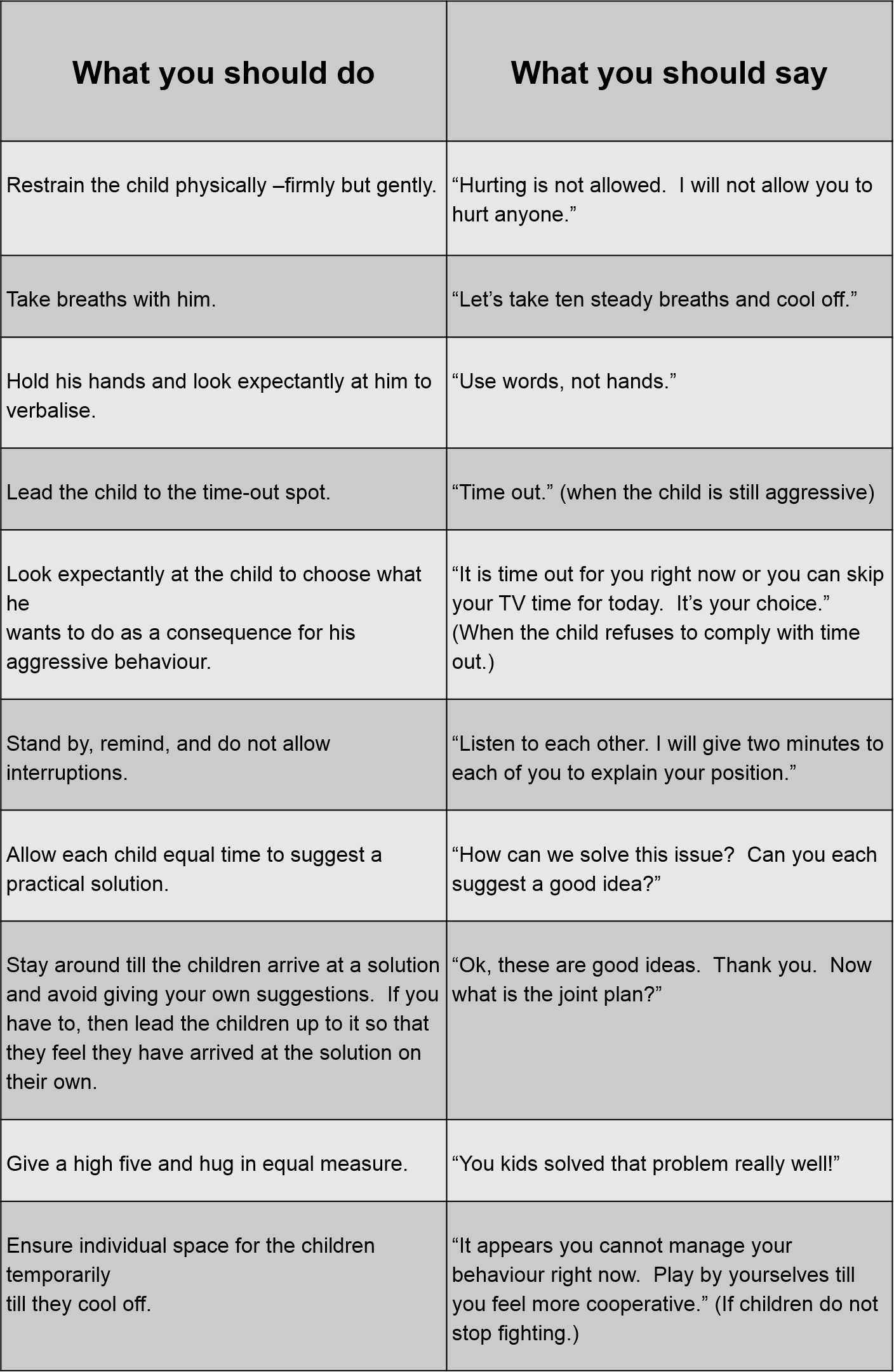
Remember, children are still learning to manage the deluge of forceful feelings. This is because their system of self-control is not fully developed. Also, bear in mind that a relaxed and regular schedule will go a long way in establishing a routine and fostering a sense of security in children. A child who feels competent, safe, and calm is not likely to act out of control. Help your child gain and maintain self-control, which is an important life skill.
Dr Sulata Shenoy is the Director of 'Turning Point', a Centre for Psychological Assessments, Therapies and Counselling, Bengaluru.

























Comments
Hargun Mahi Dec 29, 2022
Thnku mam it's really seems very helpful for me because I am facing the same problem as my ward is not responding me in good ways
Edit
Comment Flag
Cancel Update