
FEATURED
How to Choose the Right Pre-Primary School: A Complete Guide For Parents
Nalina Ramalakshmi
Not sure how to pick the best preschool? Learn what a high-quality pre-primary program looks like, and get a practical checklist for your school visits
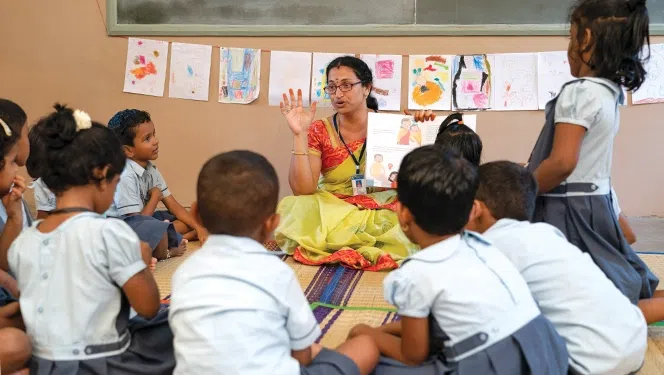
“Two pink lines. I can’t believe it!” Even before the fact that you are pregnant sinks in, your mind is already racing ahead. When should my child start school? Which school should I send my child to? Should I sign up right now?
You may feel overwhelmed when choosing a pre-primary education program from the array of such programs on offer.
Why the early years of education matter more than you think
We all want the best education for our children to ensure their future success. Today, there’s a great deal of discussion about the importance of preschool and early childhood care and education.
The National Education Policy (NEP 2020) recognises the foundational stage, ages 3 to 8, as among the most critical periods in a child's development. The brain grows fastest in these early years, so every experience your child has right now is more crucial than you may realise.
What a high-quality pre-primary program actually looks like
Once you know what a truly high-quality early years program looks like, the decision becomes much clearer.
A high-quality pre-primary program does far more than teach the ABCs and counting to 100. It builds the developmental foundations—emotional, social, physical, and cognitive—upon which all future learning depends.
The four pillars of a high-quality pre-primary program
Here is what to look for, and what to ask on your school visits:
1. Emotional development: Preparing the mind to learn
Emotional readiness is the foundation of all learning. It is the game-changer when it comes to learning. For a tree to grow, we first need to prepare the soil before we plant the seeds. Similarly, for a child to learn, we must first prepare the child’s mind. Only a calm and composed mind is ready to focus and learn. If a child is agitated or emotionally charged, their brain does not function efficiently and effectively.
Creating the right classroom environment
In our experience working with early years educators, the classrooms where children thrive are not the quietest ones. They are the classrooms where a child feels safe expressing their thoughts and feelings: 'I don't know' or 'I need help' or 'I'm feeling sad.' The child can reach out to a teacher at any time because they trust that the teacher:
- Is caring and responsive to the child’s needs.
- Will support them as necessary to help them learn, even when they make mistakes.
- Soothe them when they are hurt.
At home, this sense of security must be reinforced by a strong bond with a parent or caregiver.
Child’s emotional regulation
Regardless of how loving and caring the school or home environment is, on any given day, a child is likely to experience a range of emotions, from happiness to sadness, anger, disappointment, or even scared. During these moments of intense emotions, the child needs to learn to regulate their emotions so they can return to a state of mind that allows them to focus and learn.
Look for programs that actively teach ways to regulate their emotions, such as naming their feelings, using breathing exercises, and developing the resilience to bounce back from difficult moments.
2. Social Development: Learning to be with others
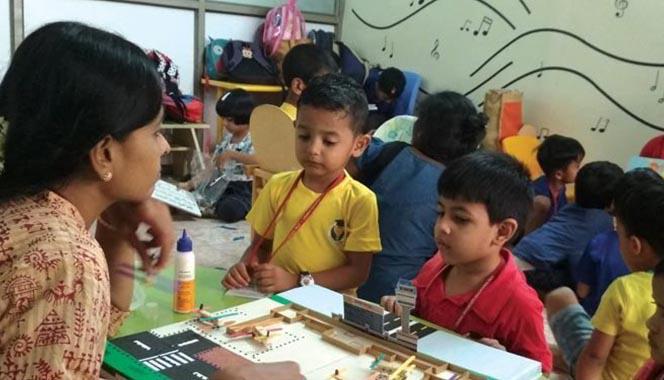
Children starting preschool or kindergarten are leaving the security of their homes and entering a new environment where they will interact with new adults and peers. For many, this will be a new experience.
Yet this is a developmentally appropriate time for it. They are ready to learn to share, help others, work with others, and even negotiate and manage conflicts. So, school becomes an important arena where these young children practice and develop their social skills.
Look for a curriculum that provides regular opportunities for children to work together in pairs and small groups, rather than one where children always work alone.
3. Physical development: Gross motor and fine motor skills
Children in the pre-primary years are developing coordination, balance, and strength. In our work with early-years educators, we consistently find that classrooms where children are allowed to move freely show higher levels of engagement.
Fine motor skills should be developed through pre-writing activities that strengthen finger muscles and hand-eye coordination. So, before children start writing, they must be given pre-writing activities to enhance their fine motor skills.
Look for a curriculum that weaves movement into the entire school day indoors and outdoors, and introduces pre-writing activities well before a child holds a pencil to write.
4. Cognitive development: Learning through play
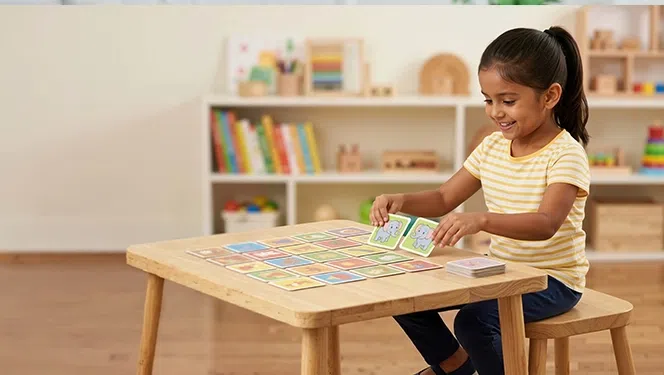
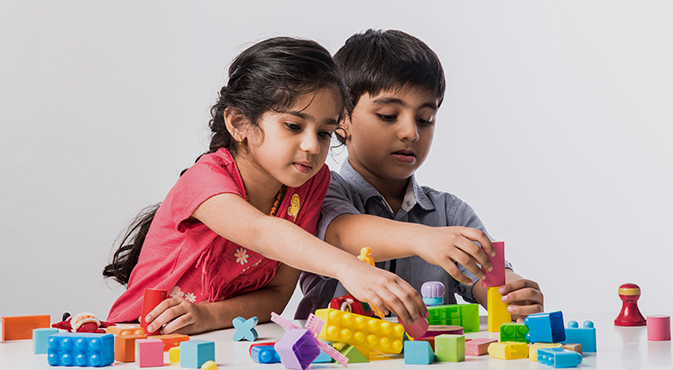
A child this age is full of wonder and so curious about the world around them. They learn best through play.
The pre-primary program should lay a strong foundation in Literacy and Numeracy and develop a child's reading and mathematical reasoning skills, so essential for future academic success.
- Encourages the child’s curiosity and allows them to explore and experiment.
- Engages them through lots of play and hands-on activities, questions, and discussions.
- Encourages creativity, critical thinking, logical reasoning, and problem-solving.
Look for a curriculum that connects learning to real-life experiences and builds strong foundations in early literacy and numeracy, reading, and mathematical reasoning.
Two skills that underpin everything else
Language and communication
A high-quality pre-primary program must provide a language-rich environment in which children are encouraged to ask questions and practise expressing their ideas, which are crucial to developing literacy and cognitive skills.
School readiness and independence
The program must prepare children for formal schooling by developing their abilities to:
- Follow instructions and routines
- Listen in a group
- Wait for their turn
- Raise their hands to get the teacher’s attention
- Do their work independently
Building self-confidence and independence in young children
Equally important is a child's growing self-confidence as they practise washing their hands, packing their bags, putting on their shoes, eating on their own, keeping things away, and completing their tasks.
A practical checklist for your school visitWhen you visit a pre-primary school, look beyond the infrastructure. Here is what actually matters:
|
The questions that matter most are not "When will my child learn to write?" or "Will they count to 100?"
The real question is: Does this program see and support my child as a whole person? That is the program worth choosing.
Planning your child’s early education? Explore our complete guide on How to Choose the Right Preschool for Your Child.
Nalina Ramalakshmi is the Founder-Director of ParentCircle and The Dot Learning Experience, with extensive experience in parenting education and early childhood learning. She pioneered the P.E.A.C.E. process, a five-step parenting framework that helps parents turn challenging moments into opportunities for connection, learning, and growth.
This article was featured in the December 28, 2025, edition of The Free Press Journal
Last updated on: June 10, 2026
Our comprehensive pre-primary curriculum nurtures the physical, social, emotional, and cognitive development of children. It offers parent connect, teacher support and professional development, and a continuous progress tracking system. The curriculum is aligned to the learning goals of the National Education Policy (NEP) 2020.





















Comments
Edit
Comment Flag
Cancel Update