
Balanced Screen Time For Children: How To Build A Healthy Relationship With Tech
Kerina De Floras Felix
author parentcircle author parentcircle author parentcircle author parentcircle author parentcircle author parentcircle author parentcircle author parentcircle author parentcircle author parentcircle author parentcircle author parentcircle
Knowing how to build a healthy relationship with technology can help your child benefit from the digital world without becoming dependent on it. Start early, stay mindful, and guide their screen time with purpose

Your child has discovered devices, and you think it’s all going to go downhill from now on.
How are you going to limit their screen time?
Will they throw a tantrum if you take away the phone?
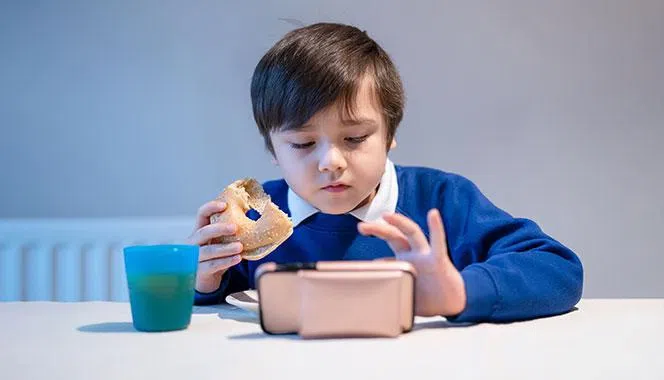
Will they get used to screen time during meals?
But let’s face it, we live in a tech-driven world—one where artificial intelligence (AI) is rapidly evolving, and now mimics human speech, writes code, generates ideas, and has conversations with people. Children need knowledge and experience in the digital world to adapt to emerging technologies.
So, instead of categorizing device usage as entirely harmful, let’s look at how you can understand your child's interest in technology and devices. Also, read about how you can partner with preschools to help your child develop a healthy relationship with technology.
Understanding your child's digital choices
A study published in 2023 in Frontiers in Psychology explored the factors influencing smart device addiction in preschoolers. It found that young children prone to depression and social withdrawal were more likely to be addicted to devices. This was because devices offered an escape from reality, suppressed negative emotions, and provided psychological support, even if it was for a short period of time. The study also found that parents who were better at regulating their emotions were able to reduce their child’s device addiction.
Children of all ages love exploring devices and technology. To help your child achieve balance, it’s important to first understand what they love about the digital world. They are attracted to digital applications, games, and videos. For them, screen time is like a reward or happy time, which helps them escape boredom. From a young age, they learn how to differentiate between ads and videos, too, but they don’t really understand what ads promote. They are eager to learn gaming strategies and techniques, and winning or leveling up gives them a dopamine rush. They are curious to learn about new advancements in technology, and you’ll be amazed at how fast they learn to navigate a new device or application.

Most of the time, your child may choose digital devices over traditional toys. Here’s why:
- Digital gadgets offer a wide range of entertainment that traditional toys or games do not. For example, your preschooler is able to watch videos, interact with others, and play games, all on one device.
- Gadgets are easily accessible today. Smartphones, tablets, laptops, and the like are available at home, providing easy access for your child.
- Devices are portable and easy to use, making them convenient for young children to use wherever they are.
- Online apps and websites give them what they love with targeted content and ads. They offer suggested content based on your child’s interests, making them more attractive.
- Online games always provide room for improvement, without judging scores. For example, they offer options to earn an extra lifeline, put the user with players having similar skills, offer words of encouragement when they level up, and more.
- Most children love interacting with others, and devices help them with just that. Family and friends living across the world are just a video call away.
Technology for learning and development

Remember, screen time isn’t the villain—the content and duration are. Digital technology and healthy screen time can help your preschooler play, learn, and develop skills when balanced with other activities. Let’s take a look at how technology can boost your child's learning curve:
- Improves creativity by helping them think out of the box through activities like drawing using an app, creating videos, or taking photos.
- Enhances digital skills, as your child learns to play or pause videos, skip ads, level up in a game, switch between apps, or even create content.
- Builds problem-solving skills when they play interactive games that let them make decisions based on a given scenario, like choosing an appropriate dress for a character in a game based on the weather.
- Improves social skills when they use messaging or video conferencing apps to interact with family and friends.
Incorporating technology in learning: What schools can do
Apart from home, school is where children indulge in play-based learning and skill development. Introducing preschoolers to technology-based learning, among other learning methods, can set the stage for starting a healthy relationship with technology. Here’s what preschools must keep in mind when incorporating technology into learning.
- Be mindful of the learning resources used in the classroom. Instead of showing them aimless videos of cartoons or short films, you can give them a virtual tour of a museum, and play an activity based on common interest (let them name animals by looking at the shapes of their shadows on a slideshow).
- Keep a mix of online and offline activities. If you’re talking to them about dinosaurs, let them color different dinosaurs on an activity sheet, and then you can play audio files of dinosaur sounds.
- Choose hands-on and interactive activities that keep children moving. For example, you can use interactive whiteboards where they can draw or write, or use a projector to project games on the floor.
- Teachers must be digitally literate and know about online safety. This way, they can talk to children about filters, pop-ups, blocking ads, explicit content, and access to chat features on apps.
- Partner with parents and use apps to keep them informed about their child’s progress, share photos of class events, and show children how to interact with them through video calls.
- Use different apps and tools for learning. Apart from tablets and computers, let children learn about video cameras, projectors, and STEM tools.
Learning Apps For Older ChildrenEducational apps entertain and impart knowledge. Be it building their creativity or developing their fine motor skills, there’s an app out there for everything. Here are a few apps your child may enjoy.1. Khan Academy Kids (Free)Available on: Google Play Store, iOS, and Amazon AppstoreThis fun, interactive app focuses on core learning—early literacy, language, math, and writing, while also building creative and socio-emotional skills. It uses an adaptive learning path, providing customized learning for each child. 2. Moose Math (Free)Available on: Google Play Store, iOS, and Amazon AppstoreThis app introduces children to basic math concepts like numbers and counting through engaging activities. It also includes a report card section where parents and teachers can track the child’s progress. 3. HeyCloudy (Free)Available on: Google Play Store, iOS, and Amazon AppstoreThis storytelling app has a screen-free mode, engaging kids through stories, music, brainteasers, and a lot more. The stories are filled with informative content and can also be accessed in different Indian languages.A Learning App for Young Children1. Daniel Tiger's Grr-ific Feelings (Paid)Available on: Google Play Store, iOS, and Amazon Appstorecan learn, play, and sing about feelings and emotions with Daniel Tiger, their friend and neighbor. This app offers engaging activities to help children identify, name, and express feelings. We recommend that children learn best about emotions and feelings through conversations with their parents, family members, friends, and people. Do not allow an app to replace these vital in-person conversations. Use the app only to support your child's social and emotional learning and ensure that you have conversations about the story. |
Children must engage in physical play, imaginary play, creative play, reading, and socializing for their holistic development. Along with offline activities that keep them active, you may include carefully selected online activities to enrich their learning experiences. Partner with your child’s school to know and discuss the digital learning methods they use and help your child build a healthy relationship with technology.
This article was featured in the July 27, 2025, edition of The Free Press Journal.
Last updated: July 15, 2025





























Comments
Edit
Comment Flag
Cancel Update