
How Technology Can Support And Empower Children With Autism
Team ParentCircle
In this special feature commemorating World Autism Awareness Day on April 2nd, we look at how we can use technology to help children with autism.

Saranya is 10 years old but can only say a few words like water and food. She also has difficulty communicating with hand gestures and facial expressions. Saranya was diagnosed with Autism Spectrum Disorder (ASD) when she was four years old.
Like Saranya, many children with autism find it difficult to communicate effectively. This inability to communicate is one of the most common attributes of autism, and it has a significant impact on the development of social skills, relationships, learning, and quality of life for children with autism.
In a world where technology is enabling better living, is autism able to derive its fruit from innovation? The answer is Yes. In this article, we explore how technology not only helps improve the communicative abilities of autistic children but also makes learning easier and more enjoyable for them. After all, children of today are native speakers of technology, and this applies to children with ASD too. Let's hear it from our experts:
- Krishna Kumari a special educator, with 14 years of experience, presently working as a Project Associate in TARA (Team for Accessibility and Reasonable Accommodation) at Vidyasagar.
- Prasanna Venkatesh Vasudevan is a freelance special educator and art psychotherapist.
- Harini Sriram is an occupational therapist working in an inclusive international school, and a freelance counsellor.
Visual Scheduling Apps
Since autistic children have strong visual memories, these apps can be a great tool for them. Visual scheduling allows an autistic child to view an upcoming activity and have a better understanding of the sequence of activities that will occur. It helps the child feel organized and secure, thereby reducing anxiety and behavioral issues.
Krishna Kumari shares an example. "One of my students, aged about 8, had trouble with closure. That is, without fully completing a task to his satisfaction, he would not be able to move to another activity. So, even when the bell rang or the time was up during a test, he would refuse to stop the activity. There were huge meltdowns and this was a big challenge for us. We tried to address this problem through visual scheduling. We started providing visual schedules of the sequence of the day and supported them with simple verbal reminders to signal an upcoming transition. For example, 'Time for a break now,' 'Put your math away' or 'Go to your English class.' We also provided him with a visual timer so he could see how much time was left for an activity before he would be expected to transition. It slowly began to make a difference for him and helped in smoother transitions.
Using this tool, parents can customize and personalize the visual schedules to suit their child, by adding the child's picture and her teacher's picture, her teacher's voice for instructions, and so on.
Some popular visual scheduling apps include Timo Routine Visual Timer from Morning to Evening, Visual Schedules and Social Stories, and Proloquo2go.
Augmentative and Alternative Communication (AAC)
AAC uses a range of strategies and tools to help children (and other differently-abled people too) who struggle with speech to express their thoughts, needs, wants, and ideas. AAC tools can be simple, low-tech tools like picture boards and symbol charts, from which the child can select words or symbols to communicate their message. AAC can also be a high-tech device that uses batteries or electricity. Examples include speech-generating devices that produce speech when letters, words, or pictures are selected, and speech synthesizers that convert text to speech and then play it out aloud. These tools allow the user to carry on a conversation.
Bhavna Botta, 31, an AAC user, says, "AAC has made a huge impact in my life. It has helped me express myself." Bhavna, though not autistic, was born with athetoid cerebral palsy and cannot walk, talk or write. A commerce graduate and an entrepreneur, she uses Erica, an eye-gazing technology, to communicate with others. This technology tracks her eye movement and types the letters as she glances at them, thus helping her convey her thoughts. Isn't that inspiring? Other well-known AAC users include the great English physicist Stephen Hawking, American broadcaster Roger Ebert, and Irish poet Christopher Nolan.
Some popular AAC apps include Avaz, Jellow, AACORN AAC, Bol, Talk With Me, and Proloquo2go and popular speech-generating devices include GoTalk Now and Quick Talk.
Mobile learning
Using your mobile phone to access learning content can be easy and effective. There are a host of options available, from catchy animations and engaging interactive questions to simulation games and infographics. Music creation apps are also a great option. Recent research by the University of Montreal has shown that engaging in musical activities can help improve social communication in autistic children.
Prasanna Venkatesh shares an example. " I had a student who was around ten years old and was usually very detached from everything. One day, I showed her a music creation app for the first time and let her explore the app on her own. She opened the keyboard and engaged with it beautifully! Most children with autism are fond of music. So, it is a great way to draw them out."
Harini Sriram adds, "I have seen music videos on YouTube that have a calming effect on autistic children. But a word of caution: they are addictive. So, there should be strict limits. Many animated short story videos on YouTube have helped teach my students values and morals."
Some popular examples of mobile apps include GarageBand (music creation app), Amazon Kindle, BYJUS, Khan Academy, Photomath and YouTube.
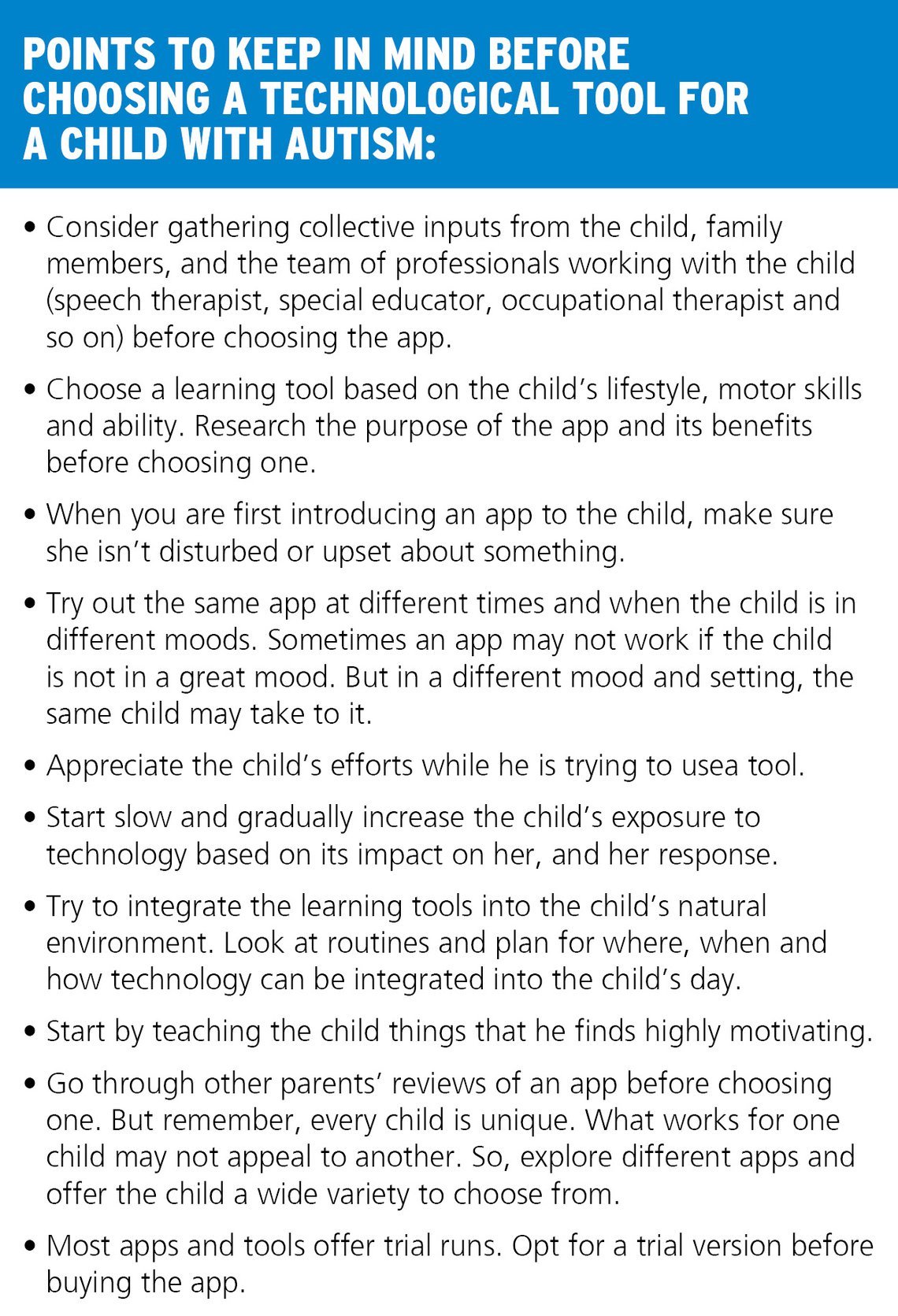
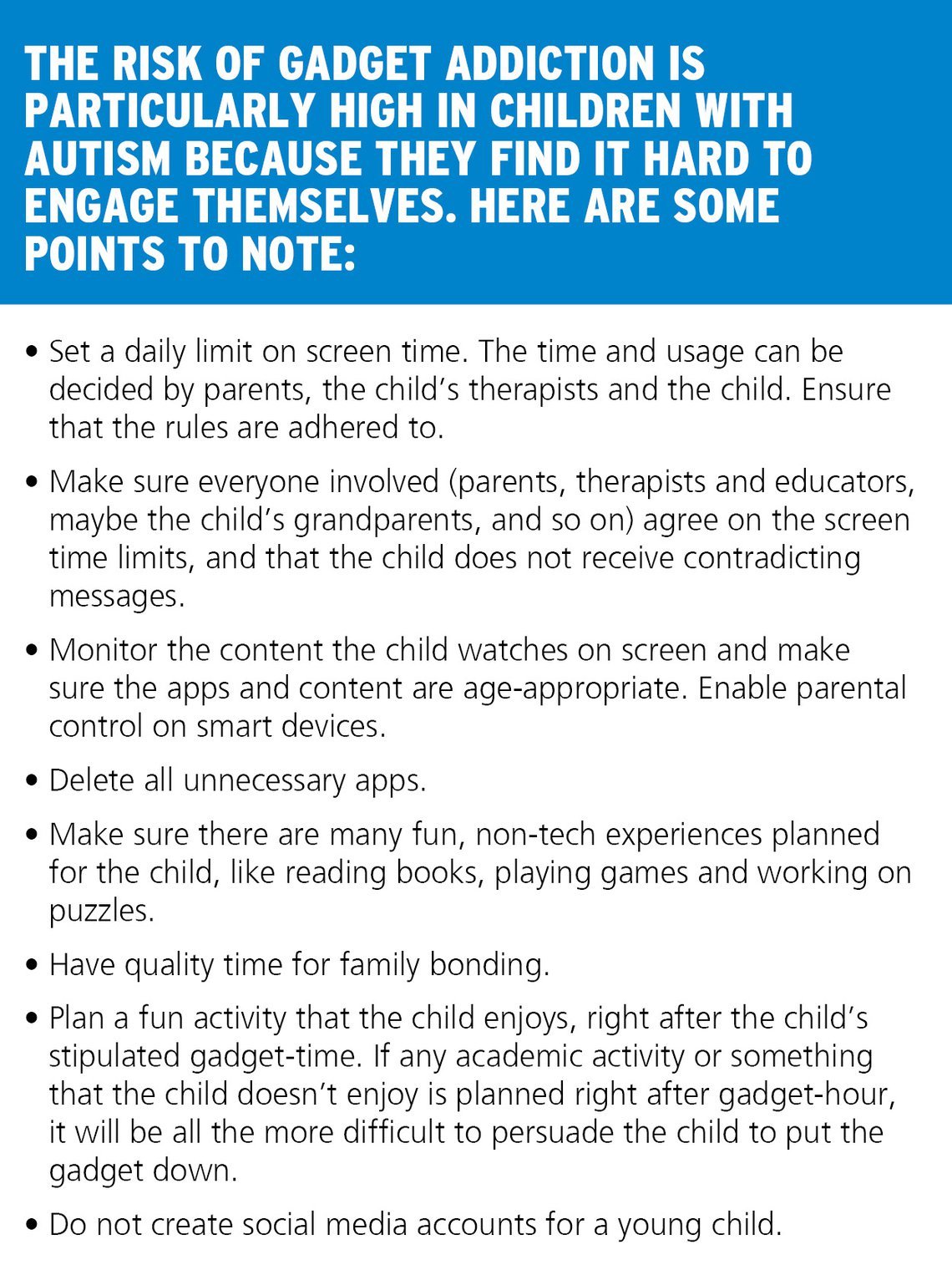
Go ahead and explore everything technology has to offer. If the child does not show any interest in learning technology, keep trying different options without getting demotivated. Be patient and yes, you must remember that technology can give a child with autism a leg up. However, it cannot replace face-to-face interactions, quality time spent with the child, or other traditional ways of learning. So, use technology smartly to help children with autism grow, without it overpowering their lives.


























Comments
Edit
Comment Flag
Cancel Update