
Want to help your child learn the keyboard? Here are some tips that can help
Vani Venugopal
Are you thinking of getting your child to learn the keyboard? Here are a few simple and practical ways by which you can support your child’s musical journey

Most children have an innate sense of music. They can recognize beat and rhythm—even babies respond to them. Research has shown that fostering this musical sense can be hugely beneficial for a child. Music plays a nurturing role in a child’s development, including memory, cognitive development, language, social skills, motor skills, and even math.
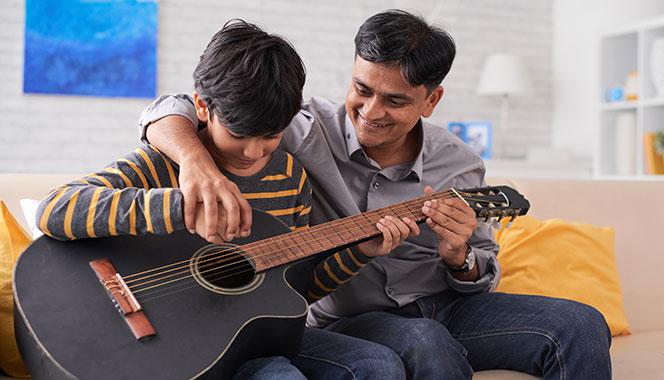
There are many ways parents can introduce children to music. One can begin by singing them lullabies, playing music to them, getting them to sing rhymes and dance to music, and so on. Once they grow older, learning to play an instrument is an excellent way for them to explore and discover music.
Benefits of learning a musical instrument
A 2020 study published in the journal Frontiers in Neuroscience showed that playing a musical instrument can improve attention and memory in children. It can lead to the formation of new neural connections and aid the development of an improved brain structure.
Here are a few other benefits of playing musical instruments:
- Strengthens fine and gross motor skills
- Improves hand-eye coordination
- Lowers stress
- Promotes better memory and cognitive skills
- Fosters an understanding of math
- Enhances attention span, focus and concentration
- Accelerates language development
- Imbibes patience and discipline
- Nurtures social skills
Why keyboard is a good choice
Picking a musical instrument for your child can be difficult. While there are numerous choices and children often have their preferences, it is important to choose an instrument that matches your child’s age and skill.
The keyboard is a great instrument to start with because it forms the basis of most music compositions. It is relatively simple to learn—a child can begin by pressing one key and learning one note at a time. It exposes them to all elements of music such as rhythm, melody and harmony. It is also a great starting point after which they can easily transition to other instruments.
Tips to help learn the keyboard
1. Start at the right age
Children who often love listening to music or dancing to tunes will grow disinterested once they are enrolled in keyboard or piano lessons. This could be because while they might be interested in music, they might not have developed the skill set and physical dexterity to play the instrument. And when it comes to the keyboard, development and dexterity of the fingers are essential. Here are a few things your child should be able to do before beginning keyboard lessons:
- Place five fingers on five different keys at the same time
- Move each finger separately
- Display an interest in music
2. Keep it dynamic and interesting
Children, especially those who are young, have short attention spans. So, if you make them sit for hours in front of the keyboard, they will get bored and frustrated. So here are a few things you can do:
- Keep the learning sessions short, in the duration of 15-30 minutes, depending on their age and attention span
- Take frequent breaks during sessions. Include other musical activities that make them stand up and move around
- Keep it simple. Don’t burden the child with too much information and things to remember, this will overwhelm him and cause him to lose interest
3. Allow some time for unstructured play
Before your child begins to play the keyboard, allow him to just ‘play’ with it. While music lessons are important, unstructured learning can be hugely beneficial. This is an open-ended style of learning where there are no rules, and the child is allowed to explore and discover on his own. Here are a few things you can do:
- Allow the child to play around and discover the instrument and its sounds on his own
- Engage him through stories and games involving the keyboard. This can be simple clapping games or sing-alongs or even games to learn the notes
4. Choosing the right keyboard
It is important to choose a keyboard that is a good fit for your child. With so many types of keyboards available there, it can be overwhelming to make the right choice. Yamaha has a range of child-friendly, easy-to-learn keyboards that would be a great choice for beginners. They are lightweight, easy to carry and come with a bunch of resources that your child can use to learn to play the instrument.
5. Get the posture right
Posture is vital when it comes to playing a keyboard. Here are a few tips to get it right.
- Use a keyboard bench instead of a chair. The bench allows for more flexibility and the child will be able to move more freely while playing the keyboard
- Get your child to sit in the middle of the keyboard near note C. They shouldn’t be too close to the keyboard. Their knees should only be partly under the instrument.
- Ask him to keep his feet flat on the ground and relax his shoulders. It’s important not to keep the body stiff.
- While playing, remind him to keep the fingers in a relaxed C shape. The wrists and forearms should be kept straight.
While these may seem like a lot of rules, once the child starts playing, it will come naturally to him as this is the most comfortable posture to play. He might need some guidance and reminders about posture in the initial stages.
In this journey, support your child’s initial steps into the world of music through Yamaha keyboards. Yamaha also has easy tutorials for learning to play the keyboard. Users of the Yamaha PSS series keyboards will also get free access to these videos on the Yamaha website.
So, there you have it— a few simple and effective tips to help your child’s musical journey along. Give these a try and watch your child begin to love his keyboard!



























Comments
Edit
Comment Flag
Cancel Update