
Design Thinking: It's Not What You Think It Is! It's Even Better!
Divya Ramesh
author parentcircle author parentcircle author parentcircle author parentcircle author parentcircle author parentcircle author parentcircle author parentcircle author parentcircle author parentcircle
Want to help your child think creatively and solve problems with confidence? Design Thinking is a powerful approach that encourages kids to explore, experiment, and innovate. This article guides parents on introducing Design Thinking to their children through fun, hands-on activities that build critical thinking, empathy, and problem-solving skills. Get ready to nurture your child’s creativity in a whole new way!

Before we explore design thinking, here's a quick task for your child. Give them a sheet of paper and a pencil, and ask them to plan a surprise birthday celebration for their grandfather (or any other family member).
Now, let's try to understand what design thinking involves.
What is design thinking?
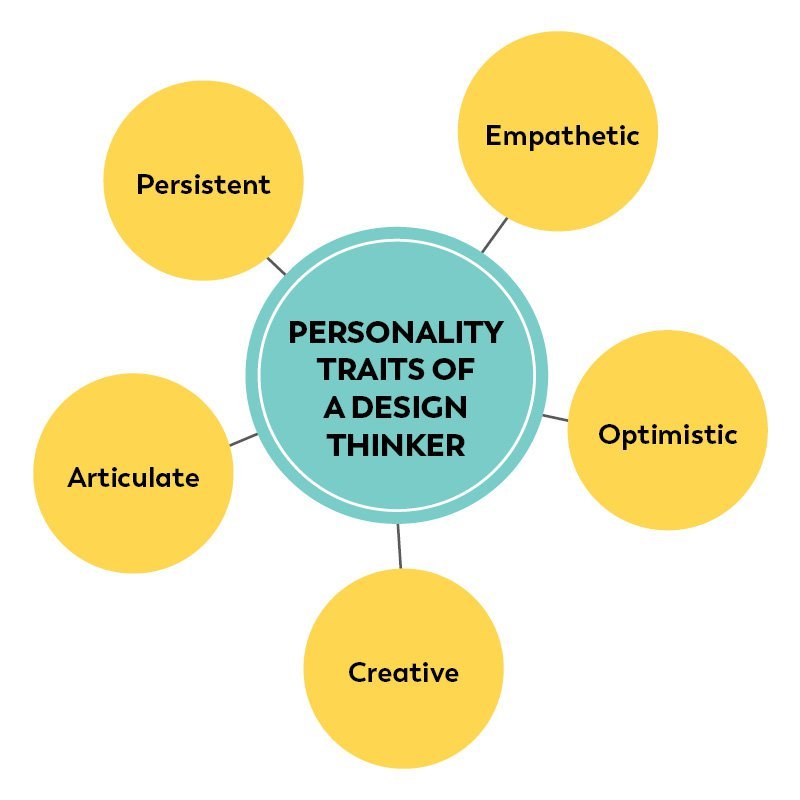
Design thinking is an effective problem-solving technique, useful in everyday situations. However, many people wrongly believe that design thinking is the same as designing and that it's mainly useful for designers.
Dr Pavan Soni, an innovation expert and the author of Design Your Thinking: The Mindsets, Toolsets and Skill Sets for Creative Problem-Solving, explains, "It's a myth that design thinking is about designing. Design thinking is actually about thinking. It's not about thinking what to design, it's about designing your own thinking.
He adds, "Very often when we Indians problem-solve, we use our common sense or listen to our intuition. This isn't the right approach because it's not reliable. But in design thinking, we approach a problem in a very systematic manner. Another distinguishing feature of design thinking is that it involves developing a deep understanding of the needs of the people for whom a product or plan is being designed.
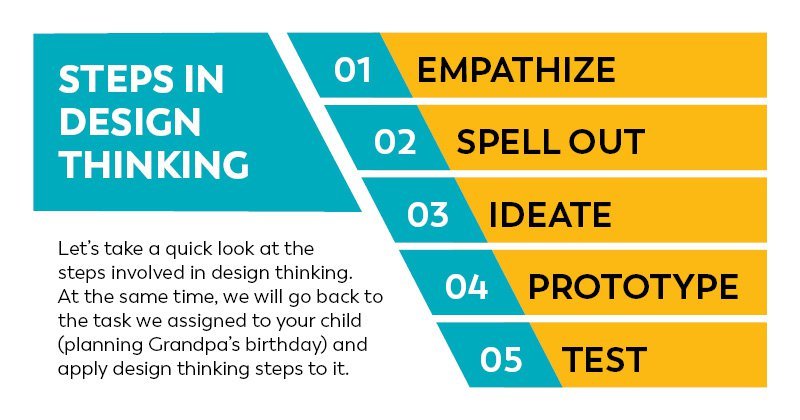
1. Empathize
Talk to people (the users) about their needs for a product and do thorough research on their challenges and expectations.
For Grandpa's birthday
Encourage your child to chat with their grandfather to find out what he would like to do on his birthday. But wait, since this is a surprise, your child has to be very careful about the choice of questions. Here are some good questions to ask:
- What are your hobbies?
- Can you recall some of your most fun experiences or adventures?
- What's on your bucket list?
- Whom do you enjoy spending time with?
- What's your idea of a fun evening?
- What's your favorite dish?
- What makes you happy?
2. Spell out
Collate the information you have gathered from people and clearly define your user's needs and problems.
For Grandpa's birthday
Your child has to put together all the interesting answers from their grandfather and then define what they think Grandpa will enjoy doing on his birthday. For example:
What Grandpa enjoys: Grandpa loves reading mystery books, playing dumb charades and other fun games, visiting temples, and spending time with his grandkids.
The challenge: It may be difficult for Grandpa to travel to faraway temples. It may also not be possible for all his grandkids to visit him on his birthday.
What can be done? How about getting him some mystery books, planning a virtual party with all his grandkids, and visiting a nearby temple?
3. Ideate
Now that you have a clear understanding of user needs and problems, sit down as a group and brainstorm ideas to help the users. Note down all the ideas on sticky notes and display them prominently.
For Grandpa's birthday:
Your child has to invite all family members to a brainstorming session. They can talk to cousins too and get their ideas. Discuss all possible options.
- Virtual dumb charades and cake-cutting with all his grandkids?
- List down the books that he is likely to enjoy. And since he loves games, how about a fun treasure hunt that leads him to the books?
- Which temple would be ideal? Maybe a not-so-crowded temple that's not too far away.
Ask your child to jot down all the ideas.
4. Prototype
Experiment with the different ideas and create miniature versions of what you are envisioning. It could be a 3D model using cardboard or any other material, or it could simply be a pencil sketch of the product or idea that includes every possible detail.
For Grandpa's birthday:
Your child could prepare a pencil sketch of how they imagine Grandpa's birthday is going to be, from morning to night. Ask them to include details of the cake, the rules and movie titles for dumb charades, treasure hunt hiding spots and clues, etc.
5. Test
When your product is in the final stage, test it on the users and get their feedback. Remember, often this is not the final product. Based on user feedback, the product is refined.
For Grandpa's birthday:
Now, your child has to test the plan and review the details of the cake, the gifts, the game rules, and the agenda. They can even improvise the plan.
Ask your child to compare the plan they first created (without applying design-thinking steps) and the current plan. How are they different from each other? Which one is better? Why?
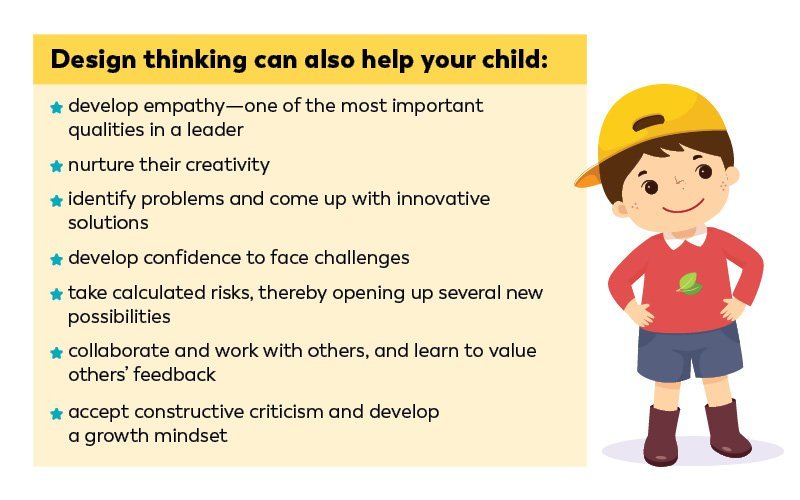
How can design thinking help your child?
Dr Soni explains that three main aspects of design thinking can greatly benefit children.
- Thinking with hands: Design thinking encourages the use of dexterity to express ideas, which is critical for children's development.
- Embracing imperfection: In design thinking, you keep working on a project to improvise it. So, it teaches children what it means to fail. Children learn to achieve perfection over time, by tinkering.
- Visual thinking: Design thinking encourages the use of colors, mind maps and sketches, which improve children's ability to think visually. Visual thinking helps children develop into holistic thinkers.
How to Create an Environment That Nurtures Creativity
Creativity is at the core of design thinking. As a parent, how can you nurture creativity in your child? "Unstructured play is very important for children. How to create meaning out of chaos is something that children need to be allowed to cultivate right from an early age, and parents have a crucial role to play. So, try not to structure your child's day to the last detail," says Dr Soni.
He adds, "Encourage your child to play with a lot of physical objects and use physical objects to express himself, instead of resorting to gadgets.
It can be chalk, paper or any other non-electronic means of expression.
Some more points to keep in mind:
- Show interest in your child's ideas. Encourage them to share their ideas with you, friends and family. Ideas grow when shared.
- Talk to your child about your problems, ideas and plans.
- Involve your child in housework and planning things. Assign responsibilities to them, for example, planning a party, a meal, or a staycation.
- Set up rules together with your child.
- Be easygoing about rules. For example, suppose your child's bedtime is 9 p.m., but they're working on something exciting. Don't rush them to bed the minute the clock strikes 9!
- Let your child take risks. Let them explore. Let them fail.
- Encourage a lot of art projects at home. Art fosters creativity.
- Encourage your child to come out of their comfort zone and try new activities.
- Motivate your child to read, read, read.
- Appreciate your child's creativity.
- And finally, let your child daydream. Daydreaming is not a waste of time!
Activities to Develop Design-Thinking Skills
There are many everyday situations where design thinking can come in handy.
- Preparing Sunday breakfast for the family.
- Designing a reading nook in your house.
- Bringing your family's plastic use to near zero.
- Planning a fun Friday entertainment evening for the family.
- Designing an ideal work-from-home desk.
- Coming up with a family fitness program.
Design thinking can make a world of difference in how you approach and tackle a problem. Let's discourage rote learning among our kids and push them to question, explore, experiment, and have fun. And an important pointer from Dr Soni. "Parents need to embrace design thinking in their activities to inspire their children!"
Divya Ramesh is a freelance writer from Chennai.





















Comments
Edit
Comment Flag
Cancel Update