
FEATURED
Benefits Of Teaching Your Child Their Mother Tongue For Language, Learning And Identity
Divya Sainathan
Divya Sainathan is a writer and editor with a special interest in early childhood education.
Wondering whether your child should learn your mother tongue? Discover how home languages can support learning, identity, family bonds, and belonging.

Should you speak your mother tongue or English at home?
The National Education Policy (NEP) 2020 places strong emphasis on children's home languages and multilingualism. It recommends that, wherever possible, the medium of instruction should be the child's home language, mother tongue, local language, or regional language until at least Grade 5, and preferably until Grade 8 and beyond. It also recommends that, wherever possible, the home or local language should continue to be taught as a language even after the medium of instruction changes. Importantly, NEP 2020 also recognises that in multilingual families, the home language may sometimes vary from the mother tongue or local language. (Education Government of India)
But what does this mean for parents?
Consider a Bengali married to a Telugu-speaking partner, living in Kannada-speaking Bengaluru, and raising an English-speaking middle-schooler. Which language is the child's ‘home language’? And when families use different languages at home, which one should parents prioritise?
For many children today, their mother tongue may not be just one language. The languages spoken at home can all play an important role in creating a child's sense of identity and belonging.

For many urban families, the more immediate question is: Should we speak our mother tongue at home to help our children stay connected to their family and culture, or should we use English more often to prepare them for the future?
But parents do not have to choose one language over another. Children can learn multiple languages, with each language serving different purposes in their lives. The question, then, is not whether English or the mother tongue is more important, but how we can make space for both.
Let's hear from a couple of parents:
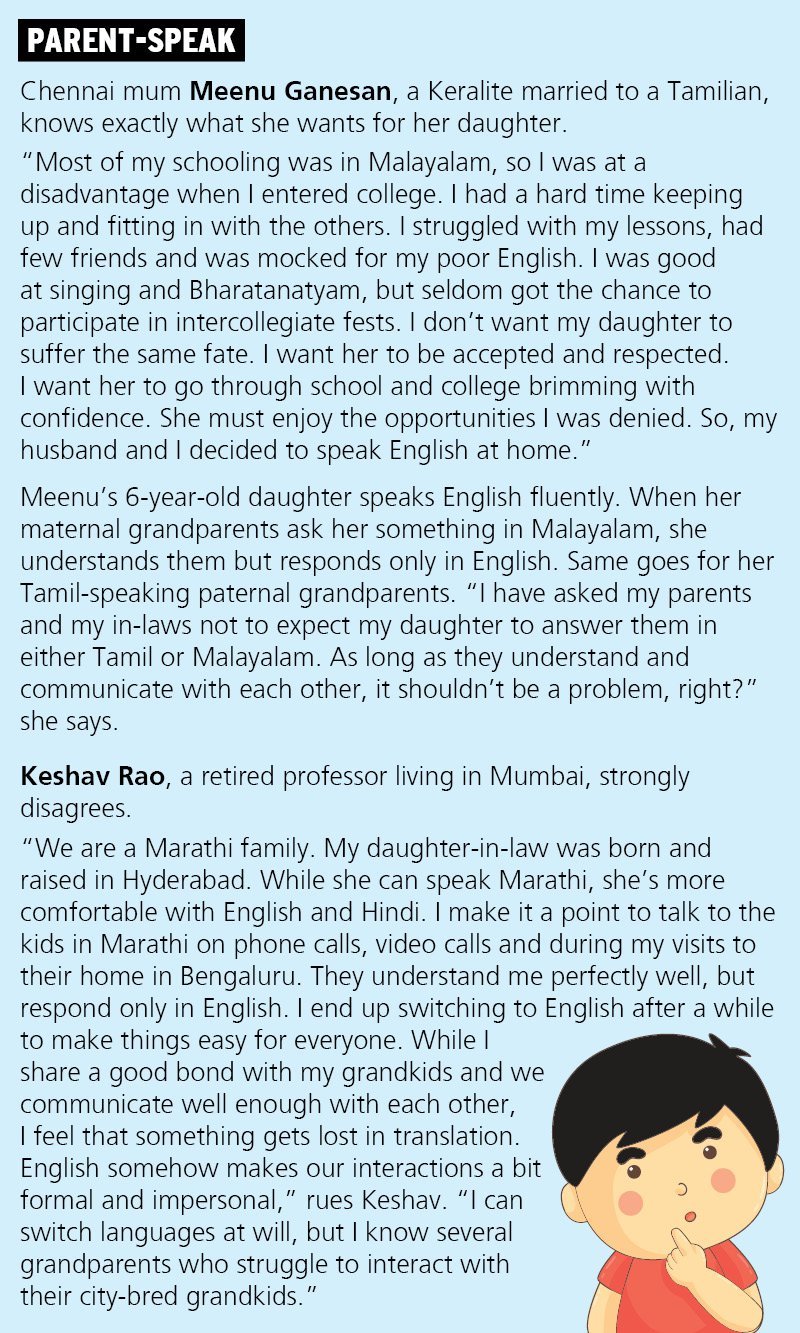
More people are moving out of their home states for work, and families are becoming increasingly nuclear, especially in cities. Language is no longer a barrier to marriage, with English or Hindi serving as the link. Whether it's a deliberate or unconscious choice, whether the drive comes from a parent or a child, there's no denying that urban households are witnessing a shift away from the mother tongue toward the growing use of English and Hindi in everyday life. What are the consequences?
Why preserving home languages matters
Language is so much more than names and labels. It carries stories, knowledge, traditions and ways of seeing the world. According to UNESCO, around 40 per cent of the world's languages are endangered, and, on average, one language disappears every two weeks. When a language disappears, it can take with it cultural knowledge, traditions, and unique ways of understanding the world.
Think of all the maasis, buas, chaachis, tais, and maamis who could be reduced to the generic term 'aunt.' Children who lose touch with a family language may also lose access to some of the stories, traditions, and cultural knowledge passed down through it.
Instead of setting English and native tongues against each other, how about giving each their space and time? Let us look at what children can gain from learning and using more than one language.
What children gain from learning multiple languages
Growing up with more than one language gives children opportunities to communicate with a wider range of people and move between different cultural and social settings.
It can also help them develop an awareness of how languages work and how communication changes depending on the person and situation. These benefits vary from child to child.
Communication and social understanding
Moving between languages teaches children to adjust their communication with different people and in different situations. They learn to pay attention to tone, context, and how others express themselves.
In families where different languages are spoken, children also learn to adapt their communication to ensure they are understood. These experiences can help children develop better communication skills.
Learning additional languages
Children who grow up using more than one language become familiar with how languages work, which could help them learn additional languages.
However, children progress at different rates, and learning multiple languages does not mean that every child will learn a new language in the same way or at the same pace.
Connections with family and community
Knowing a family or regional language can help children communicate with grandparents, relatives and members of their wider community. It also gives them access to stories, songs, traditions and everyday conversations that may not be available to them in another language.
Opportunities for learning and work
While most parents believe that proficiency in English enhances one's job prospects, few realize that knowledge of native languages opens up a wide range of connections and work options in education, healthcare, public services, media, business and community work.
For example:
- A local language can enable journalists to explore more sources of information
- Educators can build reassuring bonds with students
- Doctors can communicate more effectively with patients and their families
- Customer service professionals can convey information clearly to clients.
Further, several regional administrative departments, NGOs and research organizations expect aspirants to be fluent in a particular native language.
Why your home language matters to your child
Encouraging your child to learn and use the language spoken at home can help them:
- Develop a positive self-identity that embraces and cherishes their cultural heritage.
- Forge deep bonds with their family and community.
- Build a foundation for learning. When children have a strong language foundation, they can draw on the vocabulary, concepts, and learning strategies they already know as they learn another language.
- Develop strong language skills: Regular opportunities to hear and use a home language help children build vocabulary and communicate confidently with family members and their community.
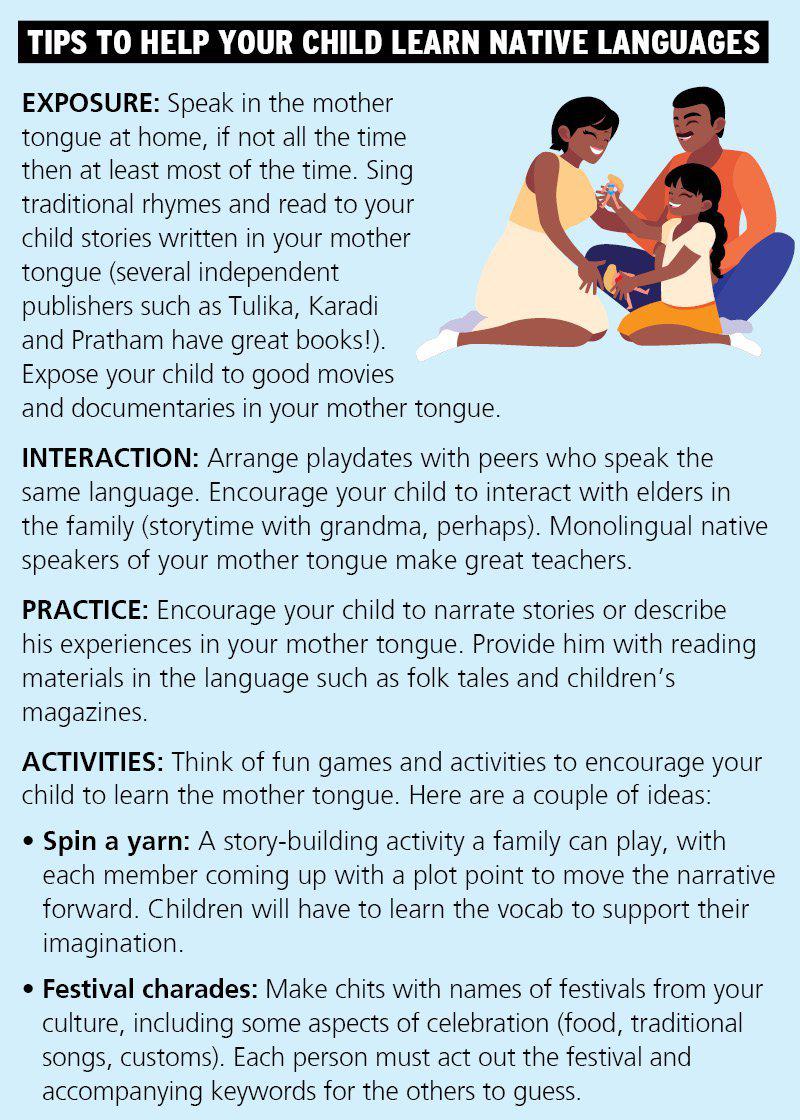
How to keep your home language alive
- Speak the language naturally every day.
- Tell stories, sing songs, and share jokes in the language.
- Let grandparents and relatives interact with the child in the language they are most comfortable speaking.
- Read age-appropriate books in the language.
- View or listen to quality children's content in the language.
- Don't turn every conversation into a language lesson.
- If your child responds in English, continue speaking your home language rather than making it a battle.
- Celebrate the language through food, festivals, family stories, music, and traditions.
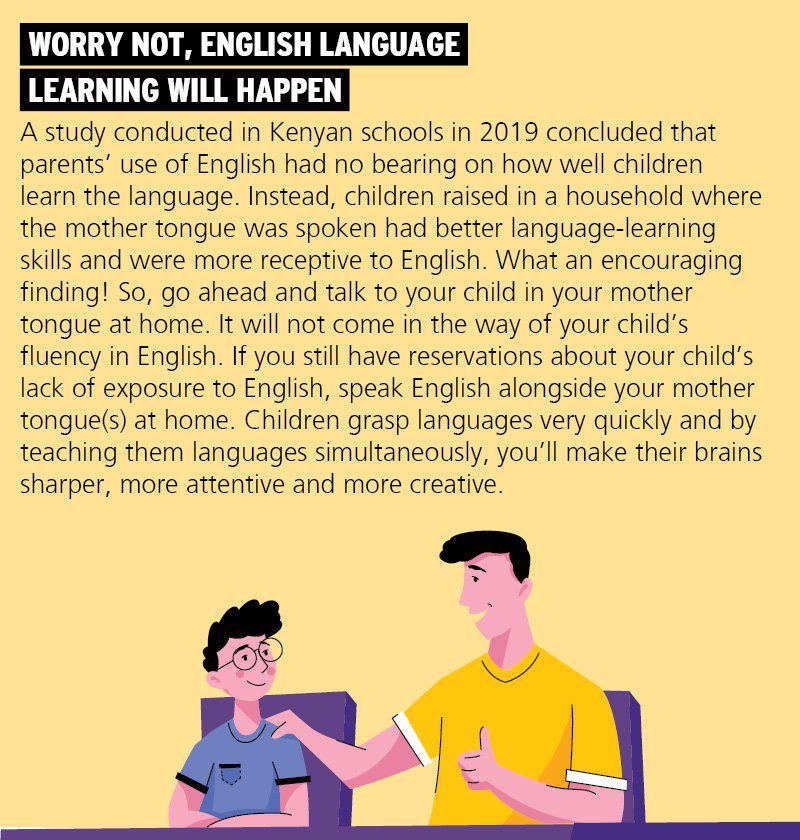
You don't have to choose between languages
Speaking your home language does not mean your child has to speak only that language. You don't have to choose between your mother tongue and English. Children can learn and use multiple languages, with each language serving different purposes in their lives.
English may be the language of school and wider communication, while your home language may be the language of family stories, celebrations, affection and connection. Each has a place in your child's life.
Parent checklist: Supporting your child's home language
- Speak your home language naturally during everyday conversations.
- Give your child opportunities to talk with grandparents and other relatives.
- Share stories, songs, books, and traditions in the language.
- Allow your child to use English or another language alongside the home language.
- Avoid making language learning a source of pressure or conflict.
- Look for enjoyable opportunities for your child to hear and use the language regularly.
- Celebrate the language as part of your family's identity and everyday life.
Speak your home language naturally, share it through everyday conversations, stories, songs, and family traditions, and give your child opportunities to use it without turning it into a lesson. By keeping the language alive at home, you are giving your child more than another way to communicate. You are giving them another way to connect with their family, culture, and sense of belonging.
Need more information? Trusted resources:
- National Education Policy 2020 — Ministry of Education, Government of India
- Bhasha Matters: State of the Education Report for India 2025 — UNESCO
- Languages Matter: Global Guidance on Multilingual Education — UNESCO
Last updated on: August 18, 2026


























Comments
Edit
Comment Flag
Cancel Update