
Time to introduce solids to your baby. A look at some first foods for baby led weaning
Divya Ramesh
author parentcircle author parentcircle author parentcircle author parentcircle author parentcircle author parentcircle author parentcircle author parentcircle author parentcircle author parentcircle
Introducing solids to babies is a special moment, often celebrated as annaprasanam in our culture. But, instead of feeding babies can we get them to eat by themselves from Day 1? Read on and find out.
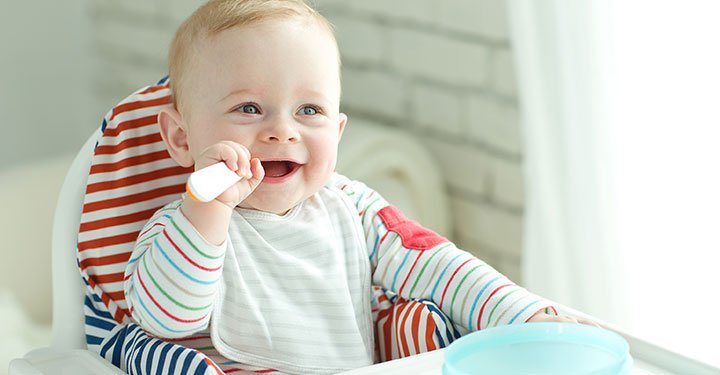
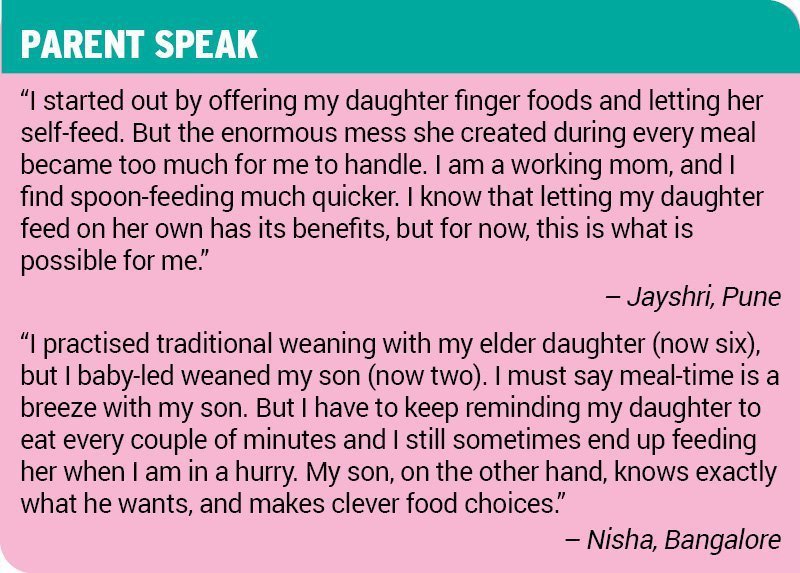
Two-year-old Sonia refuses to sit in one spot when she is eating. Her dad runs behind her with a spoon, cajoling her to eat. Sometimes, he imitates an airplane, and when Sonia is amusedly looking at him, he quickly pushes a spoonful into her mouth. Sounds familiar? Well, on the other hand, my one-and-a-half-year-old daughter sits on her highchair and picks up food on her own and feeds herself. What makes this possible? The answer is baby-led weaning.
What is baby-led weaning?
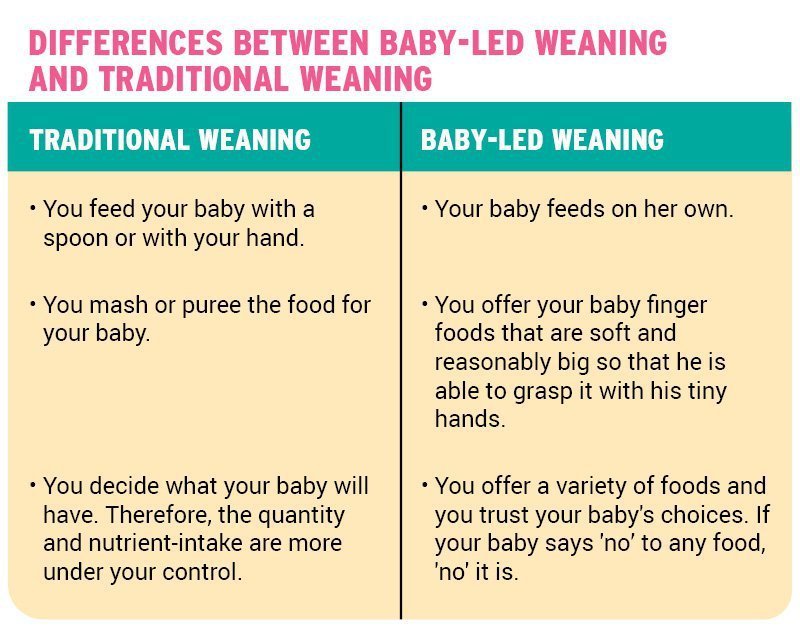
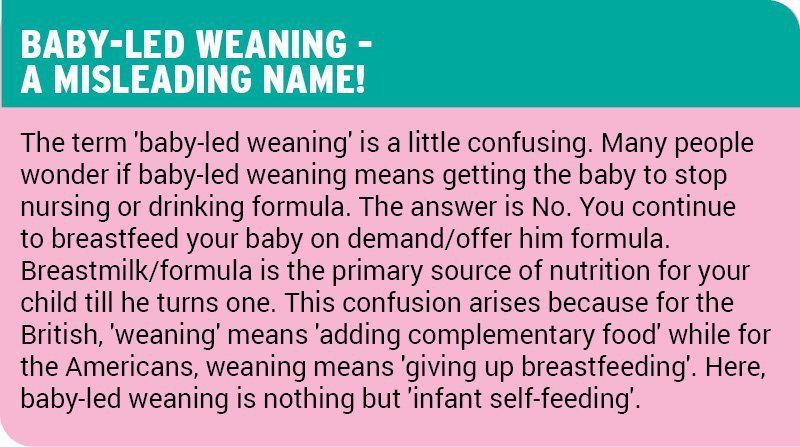
The term 'baby-led weaning', coined by Dr Gill Rapley, has been around from about 2002. Gill Rapley, a mom, whose PhD thesis involved research comparing spoon-feeding and self-feeding calls baby-led weaning "the fuss-free way to introduce solids." Baby-led weaning is a way of introducing your baby to solid foods, where your baby feeds on her own from day 1. In this method, you don't spoon-feed your baby, nor do you puree her food before offering.
Baby-led weaning has been growing in popularity in the West, over the last decade, though it has not yet been officially recognised by the American Academy of Paediatrics, Indian Academy of Paediatrics or the World Health Organisation (WHO). This practice is catching on in India too, with online baby-led weaning support groups for Indian parents having thousands of members!
Upsides of Baby-led Weaning
Allowing babies to feed on their own from Day 1 has many benefits:
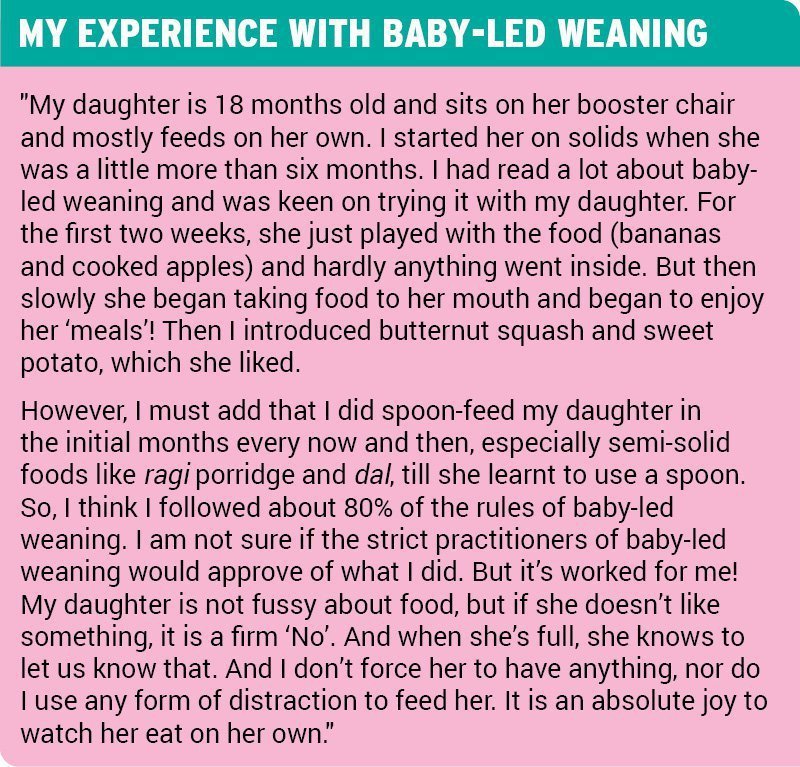
- Self-feeding can improve children's hand-eye coordination, grasp and motor skills. They explore food on their own, feel and squish food and understand different textures.
- Baby-led weaned babies learn to chew right from the start, whereas babies who start with purees learn to chew much later.
- They learn self-regulation early on. Since they feed on their own, they are less likely to overeat and learn to say 'No' to food when they feel full.
- When a baby is self-feeding, eating becomes a positive experience. She looks forward to having the food.
- Some studies have shown that babies who are exposed to a variety of foods early on and allowed to explore the food by themselves are less likely to be fussy eaters.
- This exercise makes it possible for the family to sit together and enjoy their meal. That's valuable family time!
- There is no need to invest in special baby food, blenders, etc.
Downsides of baby-led weaning
1. Some babies are extremely fussy eaters and may consume very little if left on their own.
2. Since a baby-led weaned baby is trying to feed on her own and is also exploring the food, there is likely to be a huge mess, after every meal. Dr Madhu Purushothaman, a renowned paediatrician and Director of the Glanis Institute of Medical Sciences in Madurai, says,
"The average birth weight of Indian babies is lower than their western counterparts. In the initial phase of baby-led weaning, one can expect spillage, wastage and ensuing caloric deficits. Babies must be able to withstand this wastage with their caloric reserve."
3. Baby-led weaning could be a time-consuming affair. This is because the baby is likely to play with the food and take his own sweet time to eat the food in front of him. Compare this with spoon-feeding a baby when he is distracted by a story. That's a pretty quick exercise!
4. It's hard to know how much a baby who is self-feeding is actually eating because a lot of it ends up on the floor.
5. It's often said that with baby-led weaning, there is no need to cook separately, and the baby can be offered what the adults in the house eat. But that's not always the case, especially in the earlier months. For example, if you are used to spicy food, that's not something you can offer your eight-month-old. Separate finger foods need to be prepared. There is no escaping that.
Self-feeding can improve children's hand-eye coordination, grasp and motor skills.
Recommended points for baby-led weaning
- Babies should not be left alone in their chairs with food. Always supervise and dine together.
- A big washable/reusable cloth can be placed on the floor, which can be cleaned easily after every meal.
- Babies should be offered a variety of foods rich in iron, proteins, and healthy fats, especially after they turn one.
- Foods should be introduced one at a time. This will help identify allergies in babies.
- The food offered should neither be too hot nor cold.
- Meal-time should be treated as a natural activity - no praising/scolding babies when they eat enthusiastically or refuse to eat.
- Others at home should be informed about what baby-led weaning is, so they know what to do.
- Babies will need a spoon made of soft material; regular stainless-steel spoons may hurt babies' lips. Silicone spoons are a popular choice. Spoons free of BPA, lead, PVC, and other chemicals are ideal.
Food chart for baby-led weaning
Here's a rough age-wise food chart. But remember, age recommendations for foods can vary, with some organizations suggesting that items like meat can be introduced as early as six months, and others being more cautious.
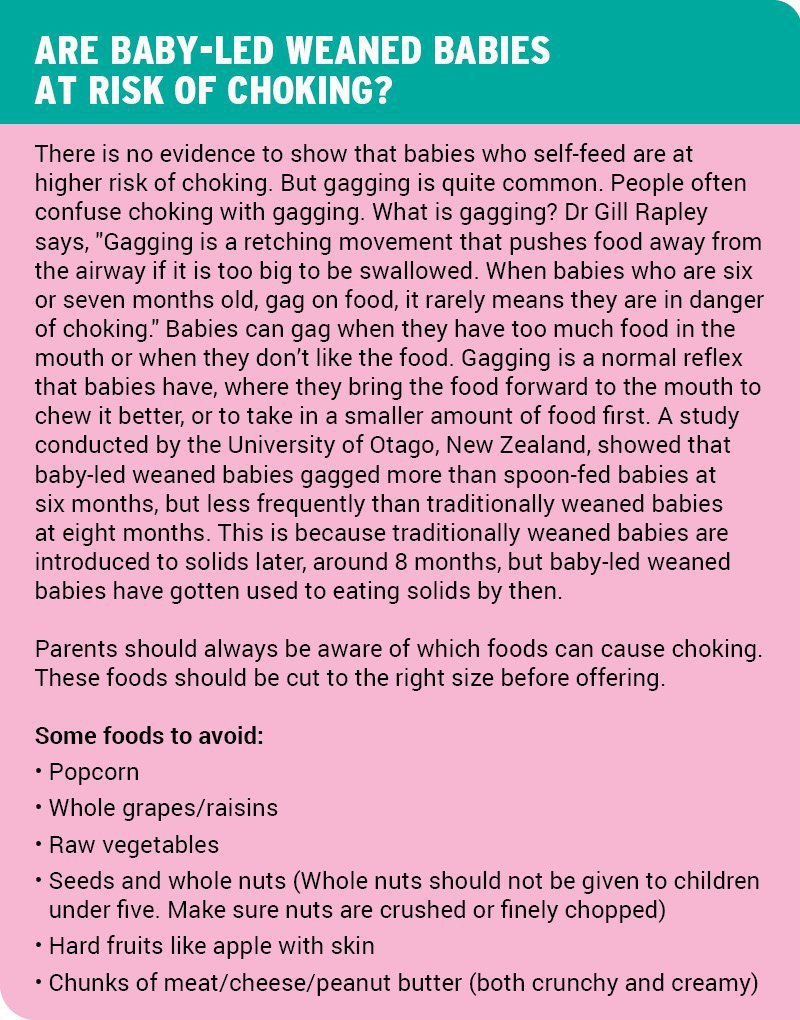
The chart we have provided below can serve as a rough guide, but make sure you also consult your child's pediatrician before introducing solids to your baby. Take into consideration your baby's needs and risks of allergic reactions. Make sure the food you offer is soft and cooked well. Babies should be able to mash the food easily using their tongues or finger.
6 to 8 months
The very first foods can be fruits and vegetables that are easily digestible. One meal a day will do at this stage.
- Soft cooked slices of apple, pear
- Bananas
- Cooked butternut squash
- Steamed sweet potato wedges
- Soft cooked carrot sticks
- Avocado slices
- Idli
8 to 10 months
Include a greater variety. Babies can now have two meals (and a snack if needed).
- Oats
- Rice balls
- Steamed peas (squished)
- Cooked turnip slices
- Cooked broccoli florets
- Cooked cucumber/zucchini sticks
- Cooked beans
- Cooked pieces of chicken and fish (avoid shellfish as it is a common allergen)
- Egg yolk
- Blueberries
- Peach and plum
- Watermelon and muskmelon
- Dosa (non-crispy)
- Cottage cheese
10 to 12 months
Babies can be given three meals plus a snack.
- Mango
- Papaya
- Cooked pieces of red meat
- Chapati
- Pasta
12 months +
Babies can have three meals and two snacks.
- Egg white
- Strawberries
- Raspberries
- Citrus fruits
- Tomatoes
- Nuts (crushed or finely chopped)
- Cooked beetroot
- Cooked spinach
When is a baby ready to start self-feeding?
There are some important milestones that a baby should hit before he is ready to be allowed to self-feed.
- Babies should be able to sit upright without support and hold their heads up.
- They should be able to grab and hold onto objects using their index finger and thumb (also called pincer grasp).
- They should have lost the tongue-thrust reflex. (Young infants have the tendency to push foreign objects out of their mouth using their tongue, and this reflex is lost as they grow.)
Most babies are ready by the time they turn six months. But there may be slight variations/delays.
Dr Madhu says, "There are ethnic and genetic differences among babies when it comes to developmental milestones. For example, African-American babies achieve certain developmental milestones earlier (like walking at 10 months of age) than Caucasian or Indian babies (whose average walking age is 12 months)."
So, do not worry if your baby is a little late in hitting a milestone. Wait till she is fully ready before you baby-led wean her. Also, if your baby was born preterm or if she has any health issues, consult her pediatrician before you introduce solids to her while also being certain if she is ready to sit up and eat on her own.
Both baby-led weaning and traditional weaning have their pros and cons. One method may not suit all babies/parents. After all, every child is different. Do whatever works for you and your baby. Make an informed choice. Here's wishing your baby and family numerous enjoyable meal times!




















Comments
Edit
Comment Flag
Cancel Update