
Are Shyness And Introversion The Same? Smart Ways To Help Your Shy Child Gain Confidence
Team ParentCircle
In our Parent-Expert series, we explore some strategies you can use to help your shy child feel more at ease in social situations.

We know that not all children are alike. Some children are naturally outgoing. They enjoy making new friends and like being the center of attention. Others want to meet new people but have trouble making friends. If you're the parent of a shy child, you probably ask yourself questions like, "Growing up, will my child have friends?" or "Is she lacking in confidence?" Arundhati Swamy, Head of Parent Engagement Programs at ParentCircle, answers some of your questions and provides insights into how you can help your shy child feel confident and comfortable in social situations.
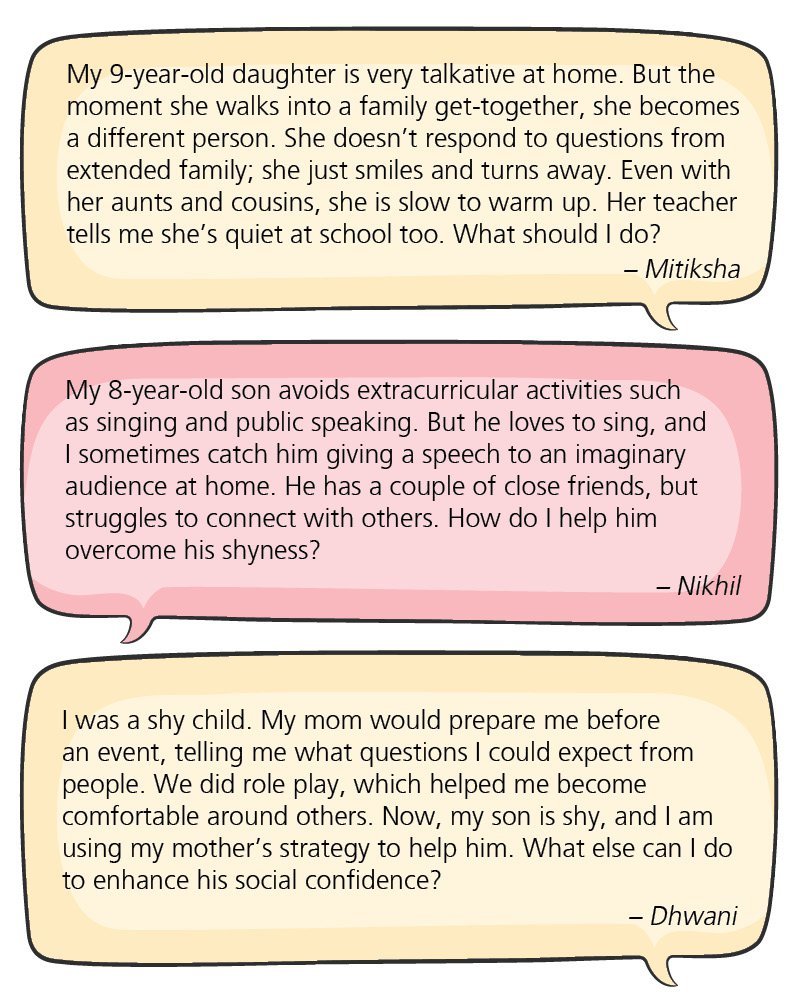
Mitiksha, wouldn't you feel so much better if your daughter talked at least half as much elsewhere and at school? So, home is where she expresses herself freely. There must be something holding her back once she steps out of home. What could it be? Maybe a peek into her personality traits will provide some clues.
Your child could be an introvert or an extrovert, and still be a shy person. While introversion and extroversion are natural traits, shyness is a behavior pattern. Although shyness can be present in both introverts and extroverts, introverts are often misjudged to be shy, and vice versa. Extroverts tend to be admired for their vibrant personalities. Introverts, on the other hand, are often considered to be uninteresting people. But that's a myth.
In general, introverts:
- Need alone time to recharge because they feel drained after socializing
- Are quiet and reflective
- Love daydreaming and ideating
- Are highly creative and innovative
- Are deep thinkers who enjoy being in a state of flow
- Have few but strong friendships
- Dislike small talk
- Are great conversationalists on things they're passionate about
- Are leaders in the making. They are naturally inclined to step back, assess people and facts, and mull over ideas before sharing them.
If your daughter is an introvert, you must help her acquire basic social skills and courtesies. Teach her how to initiate conversations and tolerate small talk. It will help her learn to feel comfortable in social situations.
Here's how you can support your introverted child:
- Understand that being an introvert is just as natural and beneficial as being an extrovert. This may require extra effort if you're an extrovert yourself!
- Love and accept your child for who she is. You'll see her deeply happy and liberated from the struggle to fit in where she doesn't belong.
- Demonstrate how to enter and exit conversations with courtesy and respect.
- Help her balance the odd occasion when she must step out of her comfort zone at a social gathering. Give her extra downtime the next day to help restore her balance.
Now you may wonder, "If my daughter is an introvert, how come she's so talkative at home?" Well, maybe you're giving her the space to talk about things that matter deeply to her. Or if it's just chatter that she indulges in, it could be a release of nervous energy caused by the pressure to change herself to gain the approval of others. Or maybe she's an ambivert - a mix of both introversion and extroversion. Nobody is a complete extrovert or a complete introvert; we are all somewhere on the spectrum of the introversion and extroversion scale.
But what if you are sure your daughter is not an introvert? Could she be an extrovert at home but shy with other people? Extroverts need to be with people to feel energized. Does the shyness mask an extrovert nature?
Shyness is a behavior pattern a child uses to protect herself against what she imagines might happen in the presence of people. Will she be ridiculed or laughed at, criticized, and judged? She may very much want to socialize, but these fears could stop her from doing so.
The good news is that because shyness is a learned or acquired behavior pattern, it can be overcome with your support. Here are a few tips to help your child overcome shyness:
- Avoid making excuses for her such as, "Oh, she's very shy." It's best not to label her as shy.
- Help your child talk about difficult feelings. Facing these feelings with you by her side reduces their negative impact. You can say, "You seem to be uncomfortable being with other people. It must be so hard for you." Your empathy shows that you care and you're willing to help her. Ask her, "What are you thinking when you meet people? What feelings come up and where do you feel them in your body?" These questions help her become aware of her thoughts and feelings. Talking about it helps her name her feelings and gain control over them. Only then she will be emotionally ready to leave her comfort zone.
- Prepare your child for an upcoming social gathering by talking about what's going to happen. Build her self-confidence by rehearsing a few ways to greet people, smile, make eye contact, and respond to their questions. Ask her what she thinks of people she needs to interact with. Joke lightly about them. The laughter can help diffuse the stress associated with those people.
- At an event, let her stay by your side for as long as she wants. From this safe position, she will have more confidence to try out what she has learned during the rehearsals.
- If your child finds large groups of people overwhelming, introduce her to small groups. Be at her side initially when she attempts to engage in social interactions and try to reassure her with a knowing look or a special smile.
- Appreciate her every small win, and let her talk freely about the whole experience.
- Arrange playdates with a couple of her friends in your home. This will help her socialize in a setting where she is comfortable.
As your child gradually overcomes her shyness, the extrovert or introvert she's meant to be will emerge, minus the shyness. Accept her for who she truly is and watch her flourish!
Prepare your child for an upcoming social gathering by talking about what's going to happen.
Nikhil, could your child be an introvert? Or is he shy and an introvert? Confusing, isn't it? If you have already read the response to the previous query, we hope you are beginning to understand your son a lot more. There's yet another angle we could explore. What prevents a child from doing the things he loves and enjoys most, especially when the opportunities are freely available at school? Typically, parents offer advice and suggest solutions with the hope that something will work - a one-way communication where we do all the talking! How about we flip it around and allow the child to talk while we just listen? The trick is to help your son become aware of his thoughts and feelings.
You can start a conversation along these lines:
You: "I know it's difficult for you to sing and speak in front of people. It seems to make you uncomfortable. I can imagine how it makes you feel."
Son thinks: My father gets what I feel inside me!
Your son is now willing to share more with you, knowing that you value his feelings.
You: "I remember this time when..." and go on to share your own experience of a time when you felt reluctant to do something despite being good at it. Doing so will revive the emotions that welled up inside you during that experience. Now you'll know exactly how your son feels in a similar situation.
You: "Does it feel the same for you? Would you like to tell me more about what makes it difficult for you?"
When he has shared all his thoughts and feelings, he will feel relieved. He is now ready to find solutions to help himself, with your support. Remember to have more such conversations.
The key is to listen more, be supportive, and find solutions together. The bigger takeaway is the trust your son builds around you, trusting that you will help him sort out those mixed thoughts and big emotions. Soon, he will learn how to regulate and manage those emotions on his own. All the best with your conversations!
Dhwani, your mom's approach is bang on! She created a safe space for you to experiment and experience different responses and emotions you were likely to encounter in a variety of social situations. Knowing what to say and how to say it can be empowering.
We hope the previous answers have helped you gain new insights into your son's temperament. Select the relevant tips to help your son feel more comfortable with other people. Please continue to use a variety of role plays to prepare your son for improved social interactions, to strengthen the skills he already has, and to acquire skills more suited to the kind of person he is. Play on!
If you have any parenting concerns write to editorial@parentcircle.in
The Dot social emotional learning program is designed to help each child feel emotionally safe and ready to learn. The program also helps children learn how to manage their emotions and behaviours in different situations. The SEL program builds self-acceptance, confidence, resilience, and a growth mindset in young children.





























Comments
Edit
Comment Flag
Cancel Update