
Making Learning Fun: Creative And Engaging Use Of Technology For Collaborative Learning
Team ParentCircle
Schools used various strategies and tech tools to make online classes engaging, interactive and joyful during the pandemic. And they are still as useful now!

It has been more than a year since the school gates closed. Things have not been the same. The recess bell and PT classes are becoming a distant memory. Virtual classes are the new reality and shall be so for quite some time. In such a scenario, let's see how schools have stepped up to keep learning fun, interesting and engaging for the children who are adapting to online learning.
Dr NK Charles
Principal, Vikasa School, Tuticorin
The first steps
We had arranged orientation sessions for teachers, parents and students to enlighten them about the measures to be taken to enrich online education with their collaboration. We developed a system of submitting lesson plans a week ahead so that teachers could plan and execute their teaching using tools, such as PowerPoint presentations, YouTube videos, visual aids, and notes.
We use the MS Teams platform for our interactive virtual classes. We also record and post our sessions for the benefit of the absentees. Students have to work on assignments and seminar topics, and they are encouraged to post their homework every day through Teams. Writing is a compulsory exercise and we insist on students using pen and paper. Our teachers use Google Forms to conduct periodic tests. Parents are informed regularly about their child's progress. We conduct one-on-one virtual sessions with parents, seeking their cooperation for their child's success in school. Moreover, we encourage them to give us feedback and based on that, we take corrective action.
Keeping it fun
Our classes begin with an icebreaker or fun activity to motivate the students. Art and craft classes and life skill activities are also a part of the online curriculum.
Business as usual
As students are the future citizens of our country, we didn't want them to miss out on the democratic process of school elections, and therefore the children voted virtually for the school council. The whole process was welcomed with excitement and enthusiasm.
We also take pride in focusing on the physical well-being and fitness of the students and therefore continue to offer ECA (extracurricular activities) and CCA (co-curricular activities) through virtual platforms. Competitions are conducted every month to promote the competitive spirit, and sports and games continue to be a regular feature.
Nandini Ghatak
Academic Head (Middle School), Aditya Birla World Academy, Mumbai
Collaborative learning
Today, students are becoming true digital natives adept at using digital tools. In our school, we give students group projects to work on. Thus, the students act as agents of learning for each other, even as they work across a multitude of virtual platforms to complete their projects. Our teachers use interactive books, gaming tools, virtual quizzes, simulations, graphics, documentaries, and podcasts to make teaching and learning effective in virtual classrooms.
STEAM education
Applying STEAM in education is important to nurture 21st-century skills such as critical thinking, communication, creativity and collaboration. Inquiry and a process-based approach are at the heart of STEAM education, which inculcates in students a love for science, technology, engineering, arts and math. This educational approach ignites curiosity in children, making them innovative thinkers. In a remote learning environment, STEAM classrooms can be highly engaging and collaborative. Students get an opportunity to make interdisciplinary connections to try and find solutions to real-life problems and situations. This helps develop metacognitive abilities and critical thinking in students while improving the quality of learning and teaching.
Our ninth-grade math teacher helped his students experience integrated learning when he took them through the lesson, Research Shows. The objective of the lesson was to show how statistics can be misleading, with data and numbers giving a far-from-perfect view of the world. This was primarily a math lesson but it used topics from geography, biology, and global perspectives to showcase to the audience how data can be manipulated to prove something that is not necessarily true. Advertising consumer surveys and studies published in the media may use data to show ideas graphically, but they need to be verified. This kind of data, where the source is not authenticated and reliable, can be misleading. Through presentations, our ninth-grade students tried to prove this exact point.
By helping his students learn how to look at different kinds of data and recognize and understand patterns that could potentially mislead the public, the teacher was able to take his students' thinking and their learning to the next level. Now, our students know that statistics conceal as much as they reveal! An interesting tool that we use quite extensively is Nearpod, a student engagement platform that helps create interactive lessons. It enables teachers to include short quizzes and other interesting features in lessons and assess the conceptual understanding of the students. Such engaging activities encourage student interaction, improve the level of student engagement, and strengthen a student's learning capacity.
Roger D'Costa
Head of English Department, Jasudben ML School, Mumbai
Social Media for Learning
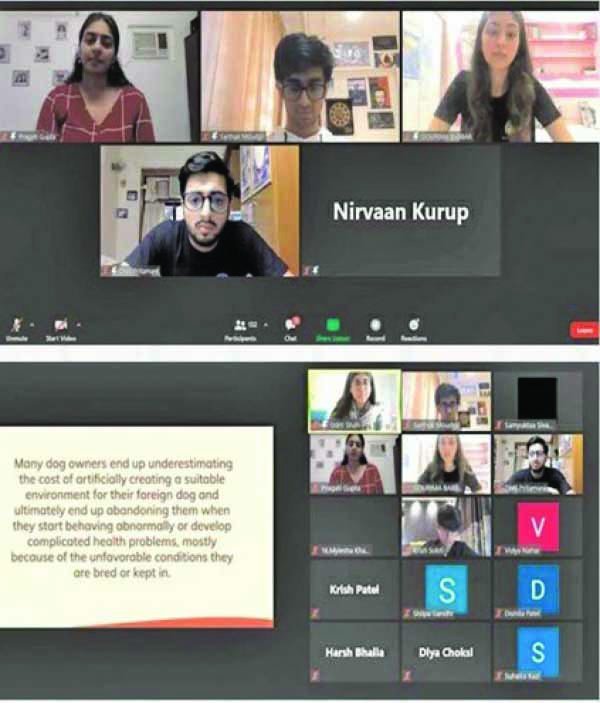
We let our children use social media as a tool for learning. We have a student-initiated forum called Junoon JML. This homegrown platform invites experts, who share their learnings and life lessons on a Zoom call to inspire the students. We also have student-led discussions and presentations. Experts talk about a variety of topics, such as career, work-related issues, environmental concerns, and studying abroad. These profound talks have given our students valuable insights into their field of interest and an idea of where to start when it comes to pursuing their passion. They have also helped our students network with professionals. Anyone can view these sessions on YouTube where they are livestreamed.
Some of the interesting topics covered in the Junoon JML forum:
- The Green Scene: About climate change, pollution and sustainability, and how the youth can make an impact on the environment.
- Aid to Educate: Highlighted the admirable work done by the youth during the pandemic to help underprivileged girls, and raise funds and awareness for those dealing with autism.
- Paw-sitive: Delved into topics ranging from animal welfare to the need for supporting stray animals.
Ongoing session: Paw-sitive
Tech-based learning platforms
- Kahoot!: This is a game-based platform that facilitates learning. Teachers can create fun learning games in different formats (quizzes and puzzles), assign student-paced challenges for review, and gather student feedback.
- Canva for Education: This platform is a real godsend for teachers looking to create and share engaging lessons and activities with interesting pictures, videos and animations. Even students can create attractive posters and presentations with this design tool. They can do the assignments at their own pace and get them reviewed by the teachers.
- TED-Ed: This lesson-creating platform allows teachers to structure assignments around videos. Teachers can select templates and use videos and pictures to create customized, engaging lessons. The lesson format consists of a lesson title, a written introduction (Let's Begin), a series of multiple-choice or open-ended questions (Think), a place for additional resources to encourage further exploration (Dig Deeper), an interactive class discussion (Discuss), and a closing (And Finally).
Preeta Pillai
Principal, Podar World School, Vadodara
Flipped classrooms
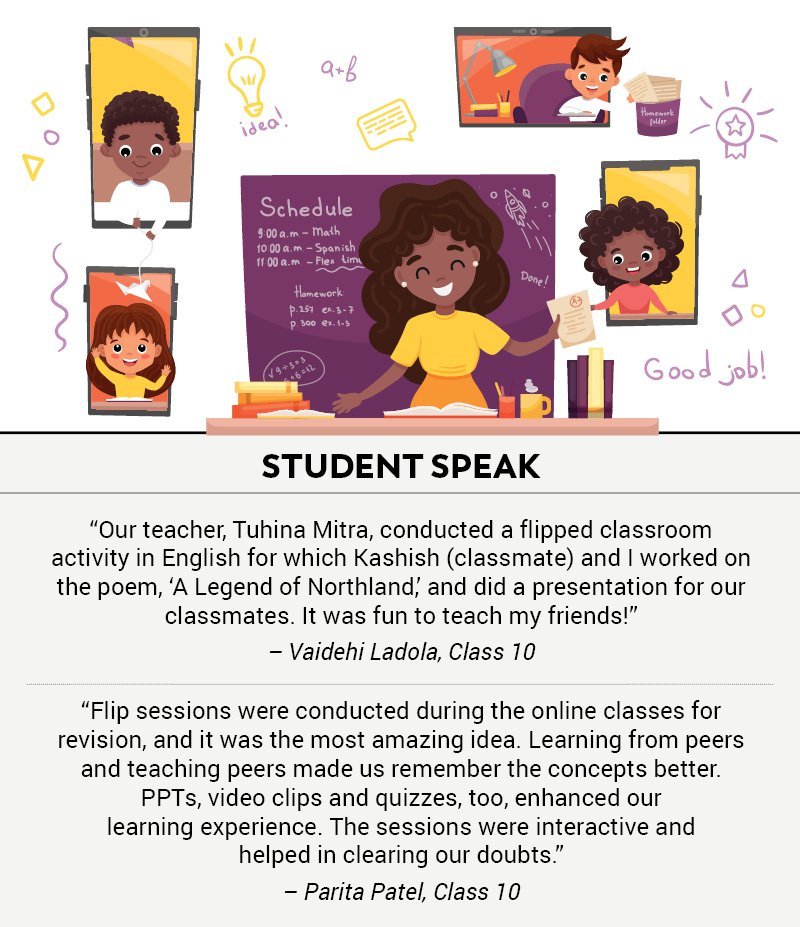
In our school, we extensively use the concept of flipped classrooms for students of classes 6 to 10. This means keeping the children actively engaged during class hours while giving them learning materials to refer to, before or after their classes. For subjects like English, teachers share videos of poems or stories and ask students to create a presentation on their own.
The students work in groups or individually outside class hours and deliver their presentations in class. The teachers follow it up with a brainstorming session and a quiz to help the children understand the finer details of the topic. This way, students take ownership of their learning. The approach has boosted student confidence while strengthening their conceptual understanding.
Real-world learning
Our teachers carefully design their teaching sessions to kindle curiosity in children while keeping them attentive. Instead of focusing merely on explaining concepts from the books, teachers use real-life examples and references. They share movie clips for history, conduct experiments for science, and ask students to analyze bank statements to help them understand the concept of compound interest in math.
Prajodh Rajan
Co-founder and Group CEO, Lighthouse Learning
Using chatbots
We use our proprietary Learning Management System (LMS) which uses two apps Argus and Billa-box. Through these apps, we share digital textbooks, Q&A sessions, and home assignments with the students. These apps also provide students with a platform for constructive project-based discussion and collaboration online. Our app integrates AI technology and chatbots which help assess our students' level of understanding and performance. We have been able to leverage technology to a level where chatbots can be used as virtual assistants that provide 24/7 assistance be it for a teacher to analyze a student's performance and understanding or for the student to have their doubts clarified, check on assignments, etc. They also play a significant role in the admission process by helping parents and students with all the necessary information about admissions, facilities and courses. The apps greatly help in reducing the workload of teachers.
Leveraging technology
We also use video-conferencing solutions, Massive Open Online Courses (MOOCs), virtual reality, and augmented reality to make learning as interesting as possible. This will not only enhance the learning experience but also help students learn at their own pace. Going forward, the integration of information technology into classroom teaching will be further accelerated and online education will eventually become an integral component of school education.
By using technology, our core objective is to facilitate:
a) Personalised learning from home
b) Collaboration between students & teachers
c) Invite parents to partner in their child's learning journey through periodic updates and counsel.
Does your school have an interesting method of teaching that makes learning fun? Mail us at editorial@parentcircle.in and we'd be delighted to feature your school in our magazine.































Comments
Edit
Comment Flag
Cancel Update