
FEATURED
Interesting Facts About Indian Languages
Team ParentCircle
One sub-continent, many languages. The cultural and linguistic diversity of India is what makes it unique and one of the most sought-after destinations for visitors from across the world.
While India has 22 official languages spoken across the country, Hindi is the mother tongue for 44 per cent of the entire Indian population, according to the latest data released by Census 2011. Bengali is the second most widely spoken language after Hindi. However, the mother of all Indian languages, Sanskrit is the least spoken of all the 22 languages.
Learn about more interesting facts in this ClipBook and share it with your child to educate him about India's different languages and teach him about the importance of his mother tongue.
Discover The Dot Learning Circle’s language and communication program for pre-primary, designed to nurture early literacy skills and social interaction skills.
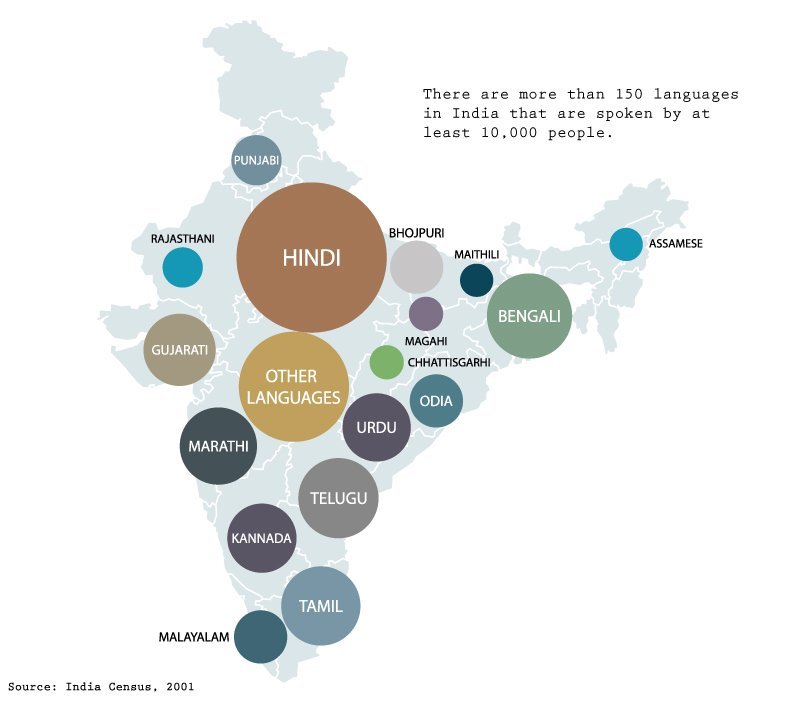
Facts and Data on The Languages of India
Language is an important attribute of a population, and has great relevance and significance in a pluri-lingual and pluri-ethnic land like India. The Census of India has been the richest source of language data collected and published at the successive decennial censuses for more than a century. The language data is particularly useful in the country having diverse people since no separate question is asked on their ethnicity
except in respect of the scheduled tribes.
Read this clip for more information.More..
Hindi is the mother tongue of 44 per cent of Indian population
The percentage of Indian population with Hindi as their mother tongue has risen to 43.63 per cent from 41.03 per cent in 2001, according to data on language released as part of Census 2011. Bengali remains the second most spoken language, while Marathi has replaced Telugu in third place.
Sanskrit was the least spoken of the country's 22 scheduled languages. With just 24,821 persons listing it as their mother tongue, it was slotted below Bodo, Manipuri, Konkani and Dogri languages in terms of number of speakers.More at: timesofindia.indiatimes.com
History of Indian Languages
Read this clip to know about some interesting historical facts about the numerous Indian languages.
More at: www.nriol.com
The Classical Languages of India
The first call for a classical language was given by Tamil academicians. They claimed that the Sangam anthologies should be considered as classical languages. It's an ancient language and the old Tamil is the prototype of the Dravidian family of languages. The government took a note and then consulted the experts of the Sahitya Academi. Later a committee was established and some criteria were established to grant the status of classical languages.
The following six languages are included in the list of Classical Languages:
Tamil (since 2004), Sanskrit (since 2005), Telugu (since 2008), Kannada (Since 2008), Malayalam (since 2013) and Odiya (since 2014).More at: www.gktoday.in
The Top 10 Most Spoken Languages in India
There is an astonishing wealth of languages spoken across India, ranging from widely spoken ones such as Hindi and English, to those at threat of extinction, such as those of the Great Andamanese family.
Read this clip to know about the most spoken languages of India.More at: www.listenandlearnusa.com
10 Amazing Facts About Sanskrit
Remember how we used to dread our Sanskrit classes? Those dangerous words that never seemed to make any sense used to give a cold sweat to many in the examination hall. But with time, we realised the importance of this ancient language. One of the oldest languages known to mankind, it's heartening to see Sanskrit finally getting the mainstream respect it deserves. So here are 10 amazing Sanskrit facts that'll definitely make you want to learn the language asap.
More at: www.scoopwhoop.com
All About The Indian Linguistic Space
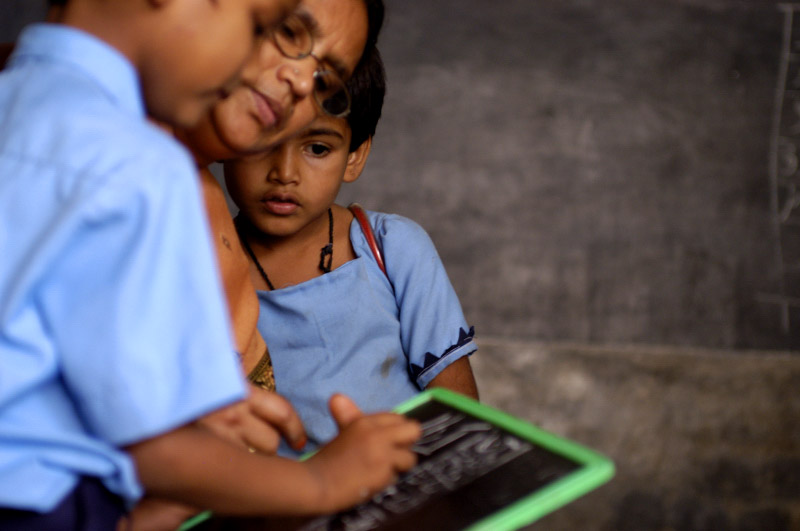
India writes in many languages and speaks in many more voices.
And yet, communication has never broken down in this sub-continent.
With about 2.4 per cent of the world's land surface and a total
of 16 per cent of the world's population (India: A Country Study by James
Heitzman and Robert L. Worden eds. Federal Research Division;
1995), India houses according to one estimate, 1,652 "mothertongues"
- including 103 foreign mother tongues (Census 1961 &
Nigam 1972: p. xv).More at: mhrd.gov.in
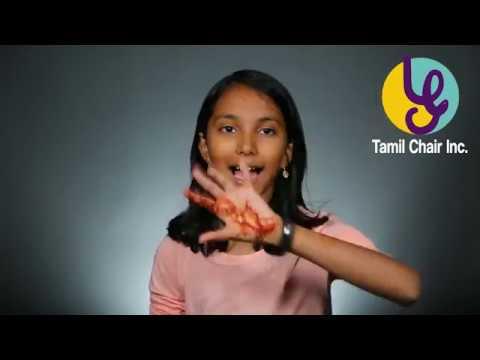
How did Tamil qualify as a chair at Harvard University
How did Tamil qualify as a chair at Harvard University? And what surprised Harvard the most when considering Tamil? Let's find out.
























Comments
Edit
Comment Flag
Cancel Update