
Inclusion Starts At Home: How Parents Can Teach Children Empathy, Kindness And Respect
Reeta Arora
Parent Circle Author ................................................................
Inclusion starts at home, where children first learn how to treat others. This article shares simple ways to teach children about inclusion - accepting differences, showing empathy, practicing kindness, and respecting others. Discover practical parenting tips for raising inclusive children who value diversity and make everyone feel welcomed and respected
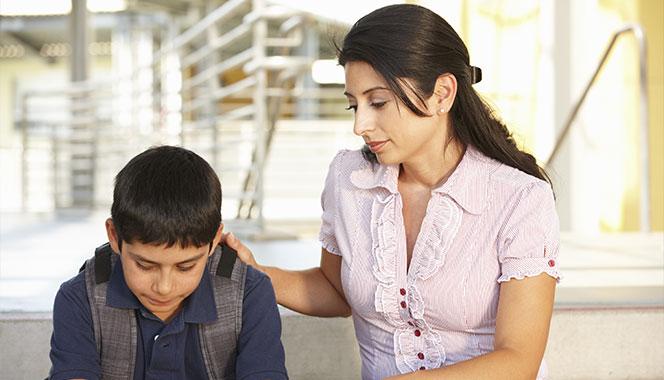
It was an ordinary afternoon at work when my phone buzzed. "Please meet the principal before 2 p.m. Your son will remain with us until then." Like any parent, my mind raced ahead of the facts. Had he fallen? Was he hurt? Had he been in a fight? When I entered the principal’s office, I braced myself for bad news. What I wasn't prepared for was the conversation that followed. My seven-year-old son had hurt a classmate by calling him a ‘monkey.’
The school responded exactly as it should have. My son was helped to understand that his words had hurt another child.
The principal's office was where my son faced the consequences of his words and was encouraged to reflect on kindness, respect, and inclusion. It was also where I first faced the consequences of my assumptions. Like many parents, I had taught my child to say "please", "sorry," and "thank you.” I had quietly assumed he would learn along the way how to respond to people whose appearance, abilities, or experiences were different from his own.
I was wrong.
Children begin making sense of difference long before school
Why children notice and what adults teach through their silence
Research in child development shows that difference is a natural part of early childhood. Children are curious and try to understand these differences. How adults respond will determine whether those early observations lead to empathy or misunderstanding.
What kinds of differences children encounter
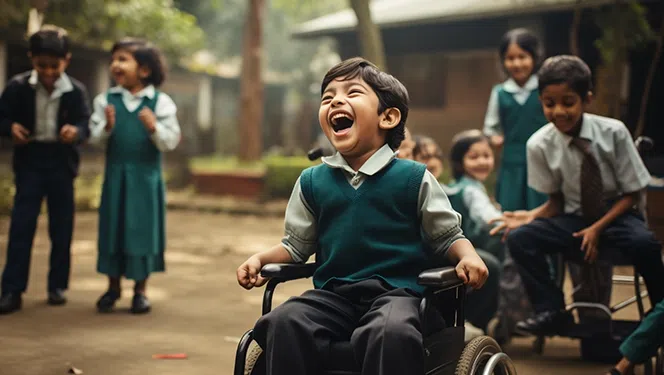
Children notice differences every day. A classmate who wears an eye patch to treat amblyopia. Another who uses a wheelchair. A child who needs more time to understand. A child who communicates in unexpected ways. A child whose language, food, and festivals are different from their own. Some differences are visible immediately. Others are revealed slowly and quietly, over time.
Differences are often easier for children to accept than it is for adults to explainMany of us are not entirely comfortable when young children ask about differences. We try to divert their attention, ask them to stay quiet, or ignore it, hoping the moment will pass. Yet children learn from our discomfort as much as they learn from our words. By the time a child enters school for the first time, ideas about people have already begun to take shape. Looking back, I realize my son, too, carried assumptions and an incomplete understanding of a world that none of us had consciously helped him interpret. |
What schools can and cannot do
How inclusive classrooms are changing
Many of us assume that simply sharing a park or classroom will naturally teach children empathy. Yet empathy grows from understanding, not merely from being together.
Pratham's Annual Status of Education Report (ASER) 2019, covering 26 districts across 24 states, found that only half of all six-year-olds in India could identify basic emotions. If children cannot yet recognize how others feel, we cannot expect them to respond with empathy.
Some schools are making thoughtful efforts to create inclusive classrooms. Guided by the values of the Right to Education and the National Education Policy, they encourage children to learn, play, and grow alongside classmates with different abilities, appearances, and backgrounds.
Many teachers thoughtfully respond to children’s hurtful behavior and help them learn to be kind. These efforts matter deeply.
The gap that schools cannot close alone
Schools may not be able to undo what children have already begun to learn even before they start school.
When incidents like the one involving my son occur, both children deserve to feel emotionally safe and respected. The hurt child’s feelings must be acknowledged with empathy: “That was a hurtful thing for him to say. I can see how bad it makes you feel.”
Understanding what caused my child to hurt someone helped me recognize the social and emotional skills preparation I may have missed, and how similar incidents can be prevented in the future.
A child who seems different to others should not have to explain or answer everyone's curiosity. All children deserve the freedom to learn, play, and make friends without having to take the responsibility of helping everyone else understand them. That responsibility belongs to all adults who raise and guide children.
When children cause hurt, accountability and understanding stand together
Many schools try to nurture inclusion every day. Some parents prepare children for it long before the first school bell rings. When both walk together, children are far more likely to grow into classmates who connect and help others feel that they belong.
So, what can parents do?
How parents can prepare children for a diverse world
Nothing elaborate. The most meaningful lessons are woven into everyday conversations.
Let curiosity lead the conversation
When children notice something unfamiliar and ask about it, resist the urge to silence the question. Instead of saying, "Don't ask," try saying, "That's a thoughtful question. People are different in many ways. Let's think about it together."
Children learn not only from the answers we give, but also from the comfort with which we answer them.
Help children understand that people learn and communicate differently
As children grow, help them understand that people do not always learn, communicate, or express themselves in the same way. You might say, "Some people understand best by listening, some by watching, and some need a little more time. We all learn differently, and that's perfectly okay."
The words we use at home shape the values children carry to school
The words we use at home matter. Children notice how we speak about neighbors, adults, people with disabilities, and those whose lives are different from our own. Long before they form their own opinions, they borrow ours.
Teach fairness, not sameness
Children also need to understand that fairness does not always mean everyone receives the same support. Think of two children learning to ride a bicycle. One quickly finds balance, while the other wobbles and needs a little more time and encouragement. We don't expect both to learn at the same pace; we support each child until they get there. In much the same way, people sometimes need different kinds of support to participate fully.
These conversations need not be long or formal. Woven naturally into everyday life, they help children grow into classmates who not only accept others but also help them feel that they belong.
Inclusion starts with a conversation at home
Looking back, I often think about that afternoon in the principal’s office.
If I could revisit that day, I would still want my son to face the consequences of his words. They mattered, and so did the hurt they caused.
But before that day, I wish I had had a different conversation with him.
I would have told him that people are different in countless ways and that those differences are a natural part of life.
I would have told him that it is perfectly normal to notice them and to be curious, but that curiosity should always be guided by kindness and respect.
That he could always talk to me about differences in people he noticed but did not understand.
The earliest lessons in belonging begin long before a child enters a classroom. They begin at home, in ordinary conversations that quietly shape how children learn to see one another, and how they help one another belong.
A simple checklist for parents of young children
Tick each item you already do and use the rest as a starting point.
Is my child ready to welcome difference?
Conversations at home
- When my child asks about someone who looks or behaves differently, I answer their question rather than changing the subject.
- I have explained to my child that people learn and communicate in different ways and that this is perfectly normal.
- My child understands that fairness doesn't always mean everyone gets the same thing. Sometimes people need different kinds of support.
- My child knows they can come to me with questions about people they notice but don't yet understand.
Language and modelling
- I use respectful, accurate language when speaking about people with disabilities or from different backgrounds —
- I model curiosity and kindness when we encounter difference in public.
Expanding their world
- We have read at least one book together featuring a child who is different from my child, in ability, appearance, background, or experience.
- My child has regular opportunities to interact with people whose lives, abilities, or backgrounds differ from their own.
Need more information? Trusted Resources:
- ASER Early Years Report 2019 — Pratham
- The Teacher Foundation — ISELF
- Harvard's Making Caring Common Project
Reeta Arora is a postgraduate in Psychology from the University of Delhi. She taught Psychology in public schools in Delhi. She is currently engaged in counselling and educational consultancy, with a special interest in inclusive education, child development, teacher professional learning, and parent engagement.
Published on: August 20, 2026



















Comments
Sangeeta Bajaj Aug 21, 2026
An eye opener. Never thought that inclusion has to be learn from the beginning. Once the mind is set ,it will be difficult to change the notion.
-

1Edit
Comment Flag
Cancel Update