
Interesting Facts About Hummingbirds For Kids
Arun Sharma
Hummingbirds are one of the smallest birds. Here are some interesting facts about hummingbirds for your child which will surely fascinate her.
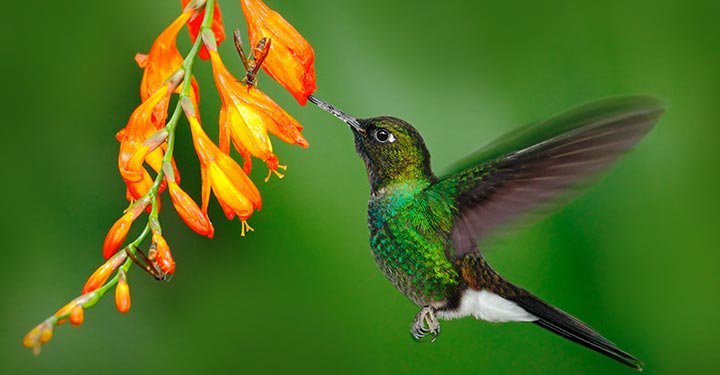
Covered in bright feathers and native to the Americas, hummingbirds are neither found in India nor in any other part of the world. Those of us who have visited the countries in the continent of America may have had a chance to see hummingbirds.
Although hummingbirds are the smallest of all bird species, some of the things they do are fascinating and awe-inspiring. For example, they fly between 30 to 40km a day and travel around 2,000km when they migrate during the breeding season.
Let us get acquainted with some interesting hummingbird facts like the various species of hummingbirds, physical features of hummingbirds, and diet and habitat of hummingbirds.
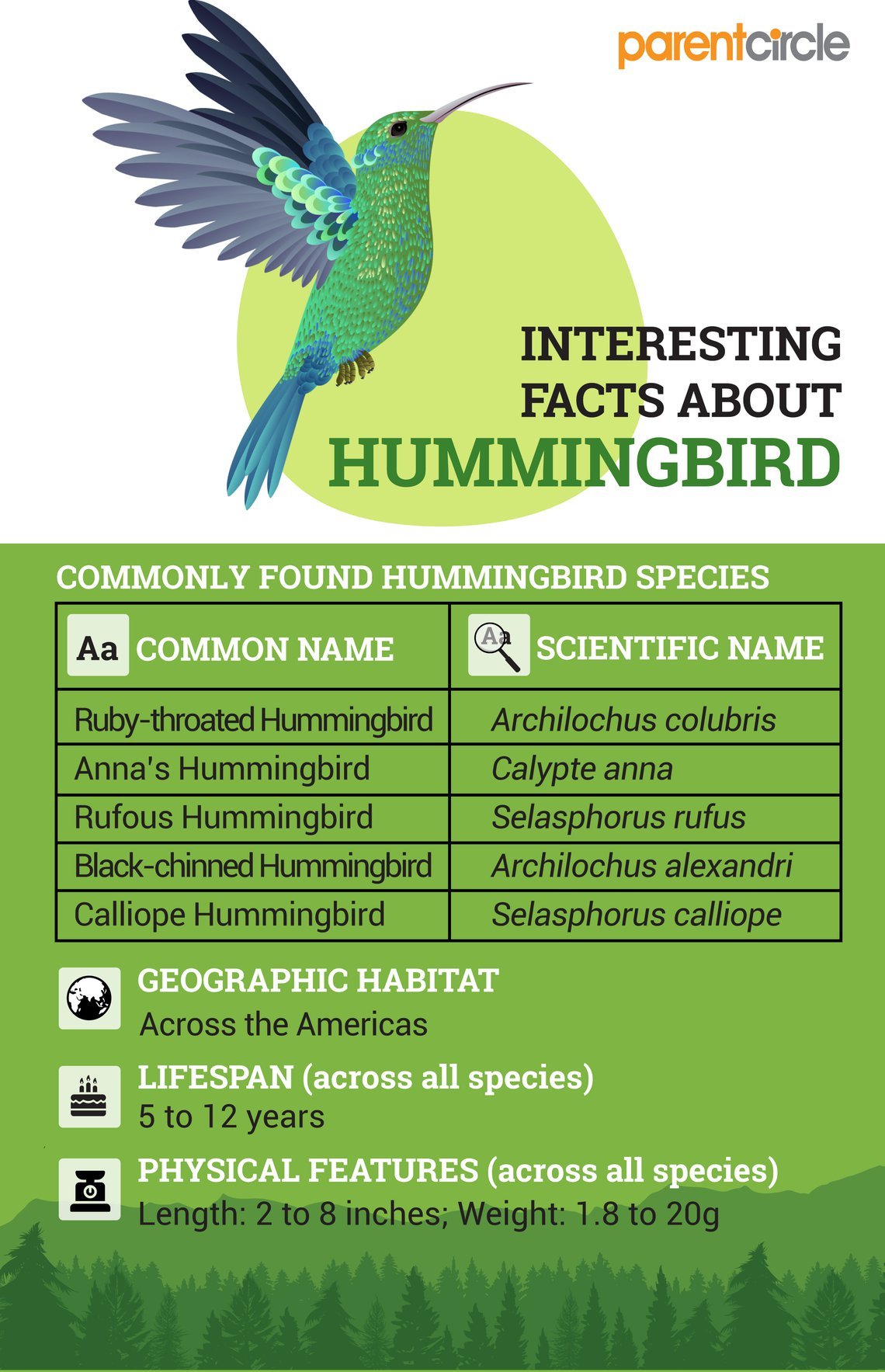
Hummingbird species
- Hummingbirds belong to the family Trochilidae.
- The hummingbird family is very large. It includes more than 115 genera and 325 species.
- Most species of hummingbirds are found in Central and South America. However, they are also found in the north, as far as Alaska.
- Mellisuga helenae or the bee hummingbird is not only the smallest hummingbird but also the smallest bird in the world.
- Patagona gigas or the giant hummingbird is the largest hummingbird in the world.
- Calypte anna or Anna's hummingbird can dive at speeds of 98kmph. At this speed, it covers 385 times its own body length every second. This is higher than a flying fighter jet or a spaceship re-entering the Earth's atmosphere.
- Archilochus colubris or the ruby-throated hummingbird has about 940 feathers on its body.
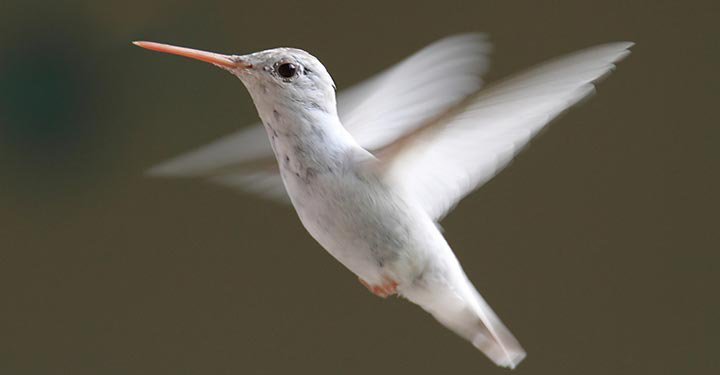
- Although hummingbirds are very colourful, a genetic mutation results in the birth of albino hummingbirds.
Hummingbird habitat
- The habitat of the hummingbird extends across the continent of America - from the northern part of Alaska up to the southern part of Argentina.
- Since this bird is found in such a large area, it inhabits a variety of landscapes. The different species of hummingbirds live in areas best suited to their needs like rainforests, cloud forests, deserts, canyons, marshes, grasslands, woodlands and gardens.
- The hummingbird prefers areas where there is plenty of food, as it needs to feed itself every few minutes. There should also be a good supply of water, as the hummingbird likes to take a bath to keep itself clean.
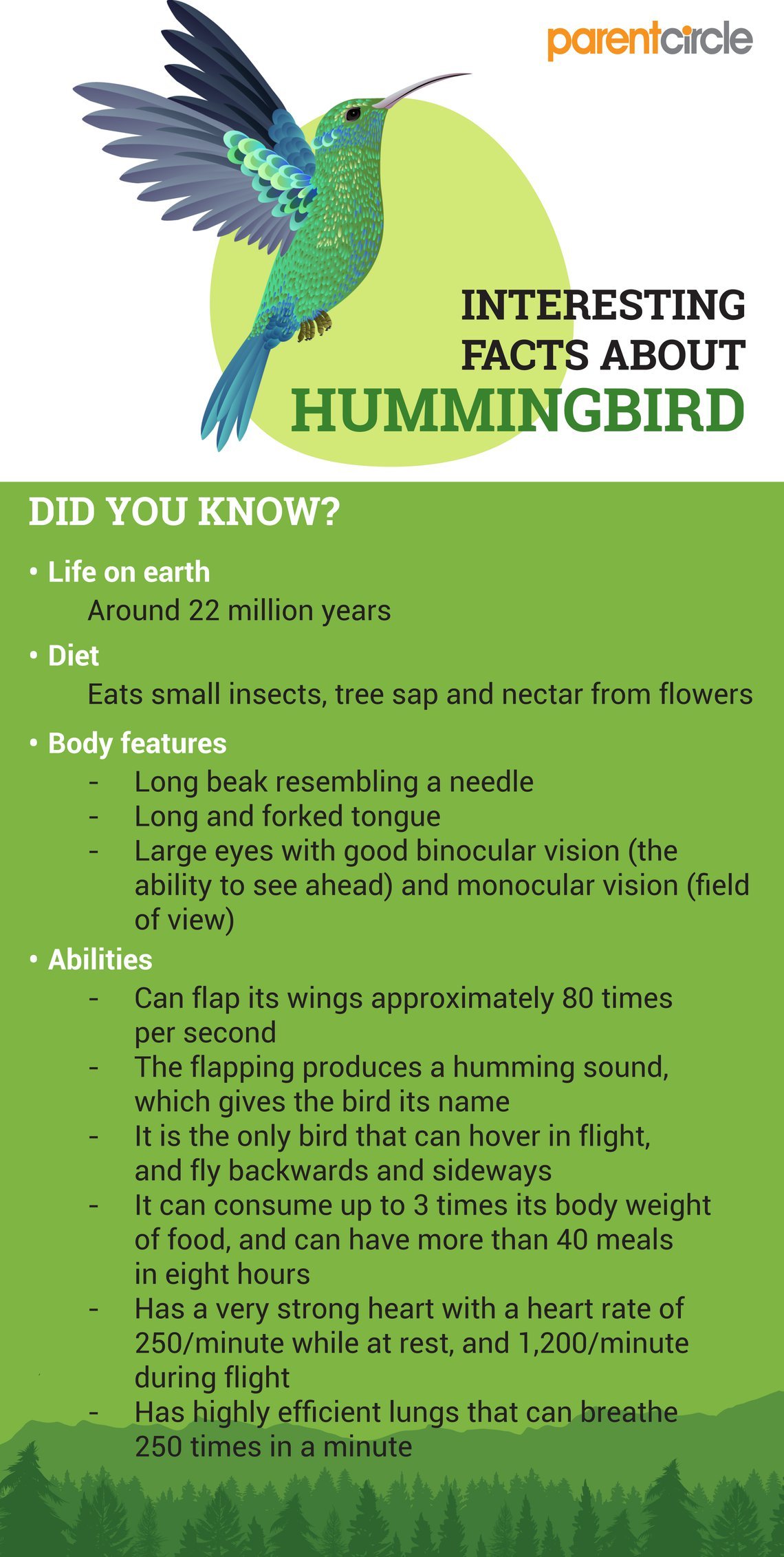
Physical features of hummingbirds
Size: The body length of different species of hummingbirds varies between 2 and 8 inches. This makes them the smallest species of birds. The length of the bee hummingbird is around 2 inches or 8cm, which makes it the smallest warm-blooded animal, while the size of the giant hummingbird is around 8 inches or 21cm.
Weight: On an average, the weight of hummingbirds of different species ranges between 1.8 and 20g. While the bee hummingbird weighs around 2g, the giant hummingbird weighs 20g. In most hummingbird species, the females are approximately 25% larger than the males.
Wings: Hummingbirds are the only birds that can hover in flight. And, to do this, a hummingbird must flap its wings approximately 80 times per second. Flapping the wings at such a high speed produces a humming sound, hence the name hummingbird. The wing length of different species of hummingbird ranges between 35 and 152mm.
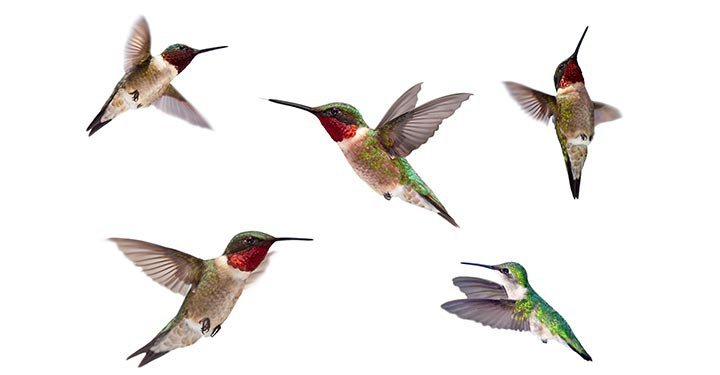
Beak: The beak of a hummingbird is long and resembles a needle. Depending on the hummingbird species, the beak length could vary between 8 and 119mm. Among all the species of hummingbirds, the sword-billed hummingbird (Ensifera ensifera) has the longest beak length of around 10cm. In some species like the fiery-tailed awlbill (Avocettula recurvirostris) and mountain avocetbill (Opisthoprora euryptera), the bill curves upwards. The beak length and shape dictate a hummingbird's choice of flowers from which it feeds. The beak is designed to reach deep inside a flower.
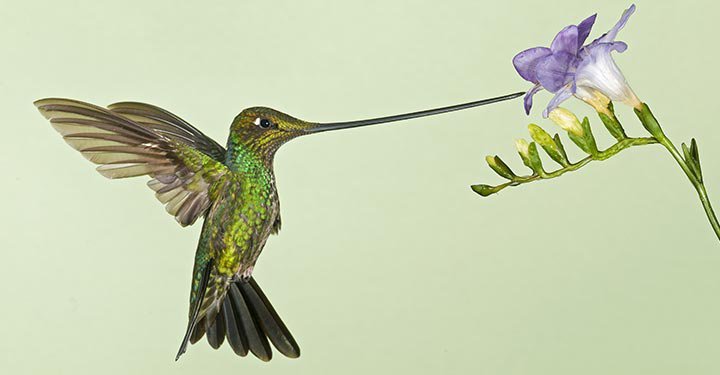
Tongue: The tongue of this bird is very long and forked. It is lined with bushy hair-like structures called the lamellae. When the bird extends its tongue to lick nectar from a flower, the liquid gets trapped in the lamellae. A hummingbird can extend and pull back its tongue about 13 times per second. When not lapping up nectar, the hummingbird wraps its tongue around the hyoid apparatus, a structure in its skull.
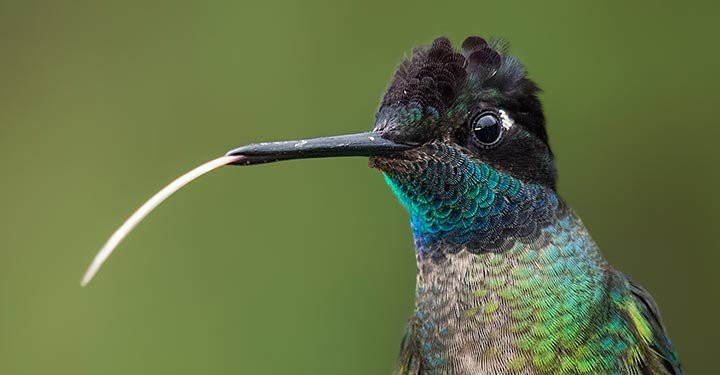
Brain: The hummingbird's brain is larger than that of most birds. So, it is no surprise that the hummingbird can remember the flowers it has visited previously and how long it would take for the flower to replenish itself. The weight of a hummingbird's brain is about 4.2% of its body weight.
Eyes and ears: In proportion to their body size, the hummingbird's eyes are larger. They are set on the sides of the head. This gives the hummingbird both good binocular vision (the ability to see ahead) and monocular vision (field of view). The ears are also located on the sides of the head
Feet and claws: The legs of a hummingbird are very small and weak. So, it can't hop or walk on the ground. However, it has long toes and claws, which it uses to perch itself and move sideways while perched.
Heart and lungs: The flying ability of a bird not only depends on its flight muscles but also on its heart and lungs. A stronger heart means more blood gets pumped into the muscles. The hummingbird's heart is very strong. When the bird is at rest, its heart rate is about 250 a minute, but during flight, the rate increases to about 1200 a minute. Together with the heart, a hummingbird's lungs are also highly efficient. To cool the body and transfer enough oxygen to the blood, a hummingbird breathes about 250 times a minute.
Hummingbird behaviour and communication
Behaviour
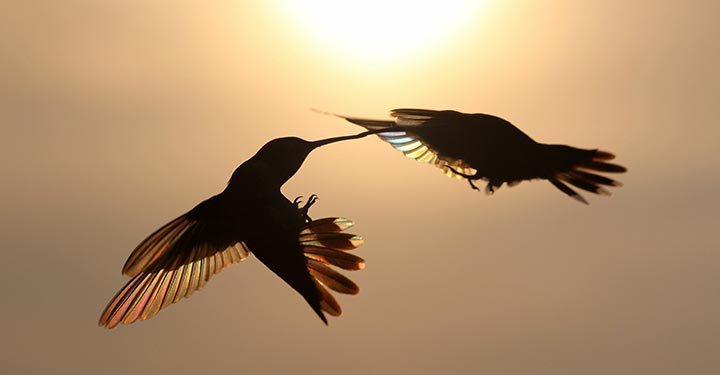
Territorial: Although tiny, the hummingbird can get very angry. Hummingbirds of both genders can be aggressive. Tempers rise, especially during the breeding season, when the bird is building its nest or defending it from intruders. A mixture of chirping or buzzing, flaring the tail or raising the feathers of the crown, hovering and diving before the intruder, and attacking with its beak and talons are the different ways of showing aggression.
Tidy: A hummingbird loves to stay clean and preens itself often. It uses its beak and claws to groom itself. It has an oil gland at the base of its tail from which it takes droplets of oil and rubs it on its feathers. The bird also loves to take a dip in water or rub itself against wet leaves to clean itself. To dry its feathers, the hummingbird takes a sunbath.
Intelligent: Once a hummingbird laps nectar from a flower, it remembers the flower and will revisit it only after the flower is refilled. The bird knows how long it would take for the nectar to be replenished. A young female hummingbird can learn how to build a nest by looking at how older females go about doing the job. It also remembers the places where it found food during migration and will try to find food at the same place during the next trip.
Theatrical: To attract a female, a male hummingbird indulges in an elaborate display of showmanship. To grab a female's attention, the male flies high up and then dives at a high speed, breaking off only inches from the female. The male also shows off its colourful feathers by puffing its chest and shaking its head or flying in front of the female with its body stretched out to show himself to the female.
Communication
There are many ways through which a hummingbird communicates with other birds. It makes sounds like chirping and chattering, singing, flying in different ways like darting, diving and making U-shaped loops, and puffing up their chest. All these mannerisms are used to signal the different intentions of the hummingbird.
Hummingbird nesting habits
- Since the hummingbird has a good memory, every year, it returns to the same place where it had nested before.
- This tiny bird is solitary by nature. So, the males and females come together only during the breeding season. The male doesn't take part in bringing up the chicks
- Females build the next on trees. The nests are built between 10 and 90 feet above the ground.
- The shape of the nest resembles a cup. The nest is fixed to the branch with the help of plant fibres and twigs to prevent it from falling.
- The nests of different species of hummingbirds look different and are of different sizes.
- Approximately 3 weeks after birth, the baby hummingbirds leave the nest and fly away to be on their own.
Hummingbird feeding habits
- The hummingbird spends an enormous amount of energy in flying. As a result, it has to feed a lot to maintain its energy levels, and stay active and alive.
- In a day, a hummingbird can consume up to 3 times its body weight of food. In eight hours, it may have more than 40 meals.
- Apart from nectar from flowers, the hummingbird also feeds on pollen and tree sap. At times, it also ingests sand and ash to fulfil its requirement of essential minerals
- Insects, insect eggs and larvae are also a part of a hummingbird's diet. It also eats spiders and the insects trapped in a spider's web.
- Before migrating, a hummingbird eats so much that it doubles its body weight. This is done to survive the rigours of the long journey it would make.
- To conserve energy at night, when it cannot forage for food, the hummingbird goes into a state of deep sleep. This state is called torpor. In torpor, the body temperature of the bird drops, the heart rate decreases to around 50 per minute, and the metabolism rate comes down by 60%. All this helps in conserving energy until the next morning when the bird can again set out to find food.
- After waking up from torpor, the hummingbird may eat up to 25% of its daily food requirement within a very short time.
Hummingbird lifespan
- Most hummingbirds die within the first year of birth. But, on average, the life expectancy of a hummingbird is 5 years. The oldest hummingbird was believed to have lived for around 12 years.
- In captivity, the life expectancy of the bird increases and some of them have lived for up to 14 years.
Hummingbird conservation
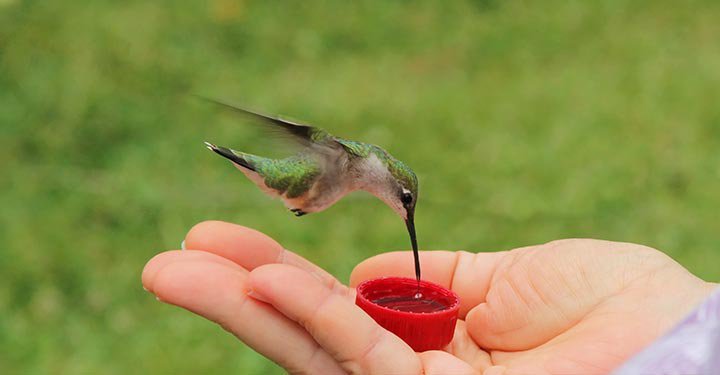
- The relationship between hummingbirds and nature is unique. Both depend on each other to grow and stay healthy.
- Although small in size, hummingbirds require enormous amounts of energy to survive. And, for this, they depend on nectar provided by flowers.
- In return, hummingbirds help nature too. While feeding on nectar, the hummingbird's head rubs against the flowers and picks up pollens. When the hummingbird visits other flowers, the pollens get transferred. This way, hummingbirds help pollinate flowers, and are among nature's best pollinators. They also feed on small insects and keep their population in check.
- A loss of habitat or food sources can lead to a decrease in the hummingbird population. This, in turn, would affect nature also, as loss of pollinators would adversely affect the dispersal and distribution of seeds.
- Therefore, we need to ensure that hummingbirds are provided with an environment where they can survive and thrive.
Hummingbird in art, literature and movies
Hummingbirds are not only an important and beautiful part of nature, but also of humankind's imagination. They have been a subject of several movies, books and works of art.
Movies on hummingbirds
- First Flight: A Mother Hummingbird's Story
- Hummingbirds: Jewelled Messengers
- Super Hummingbirds
- Hummingbirds: Magic in the Air
- Wings of Life Movie
Stories on hummingbird
- Flight of the Hummingbird
- The Hummingbird and the Forest Fire
- The Little Hummingbird
- A Hummingbird's Story: How I Came to Be
- The Hummingbird Who Chewed Bubblegum
The swallow-tailed hummingbird is the national bird of Jamaica. A hummingbird taking flight is also depicted on the flag of Collectivit Territoriale de Martinique.
The recent years have seen a drop in the population of hummingbirds. Although, this tiny and delicate bird is not found in India, we can be sure of the fact that those involved in its conservation are doing their best.
Also read:
Amazing facts about birds for kids
Amazing fun facts about animals for kids
About the author:
Written by Arun Sharma on 6 March 2020
The author was associated with the healthcare industry before becoming a full-time writer and editor. A doting father to two preteens, he believes in experiential learning for his children. Also, he loves mountain trekking and nature trips.
Looking for expert tips and interesting articles on parenting? Subscribe now to our magazine. Connect with us on Facebook | Twitter | Instagram | YouTube
Join our Circles to share, discuss and learn from fellow parents and experts!

























Comments
?
Anonymous Soul Apr 2, 2023
thanks for the info. great article.
Edit
Comment Flag
Cancel Update