
How To Encourage Healthy Competition Among Peers At Exam Time
Aruna Raghuram
As your child prepares for the board exams, competition is one factor that causes considerable stress. Find out how to encourage healthy competition that is beneficial

"The evidence overwhelmingly suggests that competition is destructive. It's a toxic way to raise children. The absence of competition seems to be a prerequisite for excellence in most endeavors" - Alfie Kohn, author, and speaker
"Life is not a competition. Life is about helping and inspiring others so we can each reach our potential" - Kim Chase, producer, and actress
"Competition is very good... as long as it's healthy. It's what makes one strive to be better" - Christine Lahti, American actress, and filmmaker
"It is nice to have valid competition; it pushes you to do better" - Gianni Versace, Italian fashion designer
As can be seen from the diverse quotes above, competition is a hotly debated subject. While those in favor believe that it keeps children motivated and on their toes, there are opponents who believe competition is not desirable. So, how do parents deal with the competition children experience in the academic sphere, especially while facing Class 10 or 12 board exams?
Competition is inevitable
Social psychologist Dr Camille Johnson writes in Psychology Today that competition among children is inevitable. It is a fact of life in many situations that not everyone can win. There are three types of situations children face, she explains. In “zero-sum situations” like individual sports, there is only one winner. Quoting research by Stephen Garcia at the University of Michigan, Dr Johnson says that in such situations, the negative aspects of competition rear their head. Children are less likely to act in a friendly or cooperative manner.
However, in “non-zero-sum situations,” such as class grades, more than one child can get an “A.” Here, the negative side of competition is less likely to come out. There is a third “mixed-motive situation,” exemplified by team sports, where children may be competing with peers as well as cooperating. Here, the success of a teammate is both good and a threat for each member.
Dr Johnson goes on to write that each of these three kinds of competitive situations can teach children different lessons. The zero-sum situation is a lesson in losing gracefully and working to improve your performance the next time round. In the situation where there can be many winners, parents can guide their children to help peers in the group who require help. This can foster leadership skills. Finally, mixed-motive situations like team sports are rich learning environments, according to Dr Johnson. They enable children to look at the bigger picture and develop “citizenship and compassion.”
Healthy vs unhealthy competition
The thumb rule is that when competition triggers feelings of inadequacy and jealousy in a child, it is unhealthy. Also, when a child looks at a peer who is doing better than him and feels that the peer’s success is reducing his own chance of succeeding, it is unhealthy. This happens when competition is perceived to imply that the desired outcome is scarce. For instance, there can be only one overall topper in a class.
When competition motivates a child to vie for attention and seek validation from others, it is normal but not healthy. The worst form of competition is if you harm another person’s chance of success to further your own ends. In contrast, in healthy competition, the primary goal is fun, and learning and growth are valued above results.
Why healthy competition is good
Healthy competition - whether in academics, sports or the arts, is not a bad thing at all. Here are some benefits:
- It promotes interest and engagement with activities
- It encourages a child to do his best and master a task
- Encourages teamwork, effective communication, and cooperation
- It instils strong work ethic
- Competition helps a child learn about himself - his strengths and weaknesses
- It helps children cope with stress, and stress management is an important life skill to acquire
- It teaches lessons in sportsmanship, humility, and respect for others
- It gives lessons in the importance of preparation and discipline and builds mental toughness
- Comparison with peers offers vital life lessons in success and failure
- Competition builds a child's character and helps her get ready to shoulder adult responsibilities
- Friendly competition in school promotes curiosity and critical thinking
- It enhances social and emotional learning
The dark side of competition
- Alfie Kohn (quoted above), who focused on the negative aspects of competition, believed that competition can cause anxiety, damaged self-esteem, worsen performance, and lead to disengagement with studies.
- Apart from hurting a child's growing sense of self-esteem, competition can promote the wrong values. For instance, children may resort to cheating to get good grades.
- Competitive children may not take failure well. In fact, competitiveness may breed bitterness in the peer group. Some children may brag and gloat (if they are doing well) or bully their peers (if they themselves are performing poorly). The 'toppers' may lack empathy for their less fortunately placed peers.
- Fear and anxiety are common reactions to the competition that exams bring. Some children may give up and get depressed if they are not getting good marks. Low self-esteem may propel them into a cycle of making mistakes, poor performance, failure, and lower self-worth.
Needless to say, academic competition when inappropriately handled will lead to a mindset focused on marks and results while learning takes a back seat.
STRATEGIES FOR PARENTS
Here is an apt analogy. When we plant seedlings, they compete with weeds and other plants for water, sunlight, and other nutrients in order to survive and flourish. In the same manner, children need “nourishment” and support in order to develop a healthy competitive spirit.
The Dos
Encourage your child to study in a “friendly” yet challenging environment: Here, marks take a back seat—children compete for the fun of the challenge. Some ways this can be brought about are:
- Children could compete over who can do a task first/faster
- They could check each other’s papers
- Children could quiz each other
- They could play friendly games based on the syllabus
- They could brainstorm and motivate each group member to think more
- Children could solve each other’s problems
- They could give peers ideas to improve the overall performance of the group
Be conscious of your child's individuality: It is important to recognize your child’s unique personality traits and allow her to compete in her own way. Your child may not be as competitive as other children. Also, some children prefer studying alone while others do well in group study.
Explain the importance of doing one's best: While you inculcate this value in your child, also ensure you focus on effort rather than the outcome. Praise your child for working hard, but do not overly focus on marks or results. This will ensure that competition among peers does not get stressful or ugly.
Stress on mastery and learning: When parents highlight that the goal of education is learning and mastery over skills, and not obtaining good grades and making it to the top of the class, competition takes on a healthy hue.
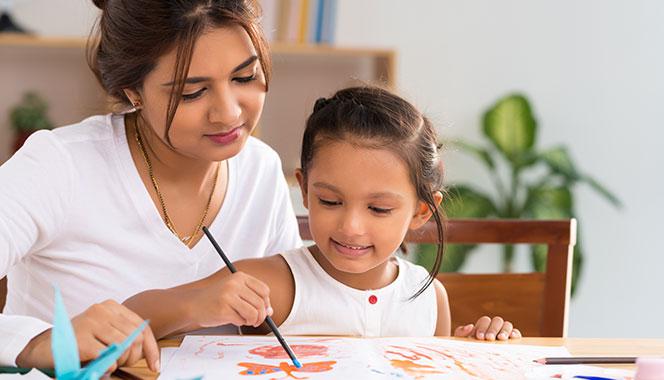
Encourage combined study: It has been said, “Competition makes us faster; collaboration makes us better.” Encourage your child to set up study dates with like-minded peers for group study. This will enable the children to help each other and cooperate so that they can all give their best. Provide a suitable place without distractions for combined study.
In his book Transformative Classroom Management: Positive Strategies to Engage All Students and Promote a Psychology of Success, Dr. John Shindler observes that in a collaborative project (for instance, combined study or a group project), students are not likely to exclude or ignore peers whom they see as less skilled or valuable.
Encourage a growth mindset: Dr. Carol Dweck’s well-known book Mindset describes how important it is for children to have a growth mindset where they believe they can improve on their attributes and better their performance. Healthy competition is one way to encourage a growth mindset. This is because competition sets benchmarks for children to monitor their own progress.
Make competition a fun and positive experience: Dr. Shindler also emphasizes that games (and quizzes) could be used to make competition fun. “They will raise the level of interest and excitement while accomplishing essentially the same degree of content processing,” he writes. Identify games and activities your children think are fun and also have cognitive benefits and encourage these, he advises.
Give unconditional love: Don’t make your love conditional on your child’s performance or success. Shower him with physical affection, time, and attention, especially during exam time. This will enable your child to face competition confidently.
The Don'ts
Do not judge or compare: Comparing your child’s performance with that of her peers is a surefire way to promote unhealthy competition. Tell your child that there will always be someone who performs better than her and someone who does worse. It is all relative. It is also important to instill empathy in your child for peers who have not performed as well as her.
Don't push children: Encourage your child to work as per his abilities. Each child’s potential and limitations are different. Ultimately, although competition with peers is a reality, it is more important to compete with oneself and improve past performance.
Says Meenu Kaul, media professional and mother of a 13-year-old, “I don’t pressurize or force my child academically in any way. He does whatever is within his capacity during exam time. I never compare his performance with that of his peers.”
Parent SpeakNalini, mother of a Grade 12 student says, "My son and his best friend both compete in academics but theirs is a healthy competition. They will try to figure out a problem on their own and discuss which method was better. They aren't worried about grades but like to challenge each other, to push each other to think better, to do better, to take it to the next level." |
Finally, competition is part of growing up and if it is healthy, it renders several benefits. In fact, in today's highly competitive world, it is important for children to have a healthy competitive spirit.
In a nutshell
- The pros and cons of competition among children in the academic sphere are a subject of much debate.
- But competition is a reality of life, and if it is healthy, it can be beneficial for children.
- Parents can encourage healthy competition among children during exam time by following certain strategies.
What you could do right away
- Stop asking your child how many marks his classmates obtained in an exam.
- Encourage your child to invite friends over for combined study.
- Try to make the competition fun by organizing games and quizzes based on the syllabus.






























Comments
Simi Ramesh Feb 8, 2020
Edit
Comment Flag
Cancel Update