
Beating The Exam Blues: How Parents Can Help Children Cope With Exam Stress
Aruna Raghuram
Worried about your child’s exam stress? Learn practical ways to support your child emotionally, build healthy routines, and reduce exam anxiety at home

Why exam season feels stressful for both children and parents
It's exam season, and nerves are on edge. While you give your child anxious looks and oodles of advice, your bleary-eyed teen may snap at you in irritation. It's a tightrope walk for parental involvement during exam season. If you are too involved, there may be friction that will adversely affect your child's ability to concentrate on their studies. But not being involved is not an option either. Parents must strive to achieve that fine balance.
Why parental involvement during exams truly matters
Research supports the view that parental involvement during exams really matters. According to the 2013 US study, 'Does Capital at Home Matter More than Capital at School?: Social Capital Effects on Academic Achievement', parental support and involvement during exams can do more than good schools to improve a child's results! The authors write: "Our study shows that parents need to be aware of how important they are, and invest time in their children - checking homework, attending school events, and letting kids know school is important." The study examines the impact of 'family social capital' and 'school social capital' on a child's academic achievement.
In the study, family social capital refers to the bonds between parents and children, including trust, open lines of communication, and active engagement in a child's academic life.
School social capital refers to a school's ability to provide a positive learning environment and teaching effectiveness. The study concluded that while both school and family involvement are important, family is more important for the academic success of children.
How parents can support children during exams without micromanaging
Exams are a stressful period for both children and parents. However busy, parents must try to get more involved with their pre-teens and teens before and during exam time. Not all parents may be able to play a significant role in helping their children with their studies. But even behind-the-scenes support is invaluable.
Be aware and organised about your child’s exam schedule
- Get familiar with the exam syllabus and schedule (date and time of each exam) so that you can help your child prepare a study timetable to manage time better.
- Ensure your child has all the stationery and other requirements for each exam.
- Ensure they arrive at the exam center at least 15 minutes ahead, and they carry their admit card.
- Be in touch with your child's teachers so that you know what areas they need to work on.
- If you are concerned about your ability to help your child study, take the help of a tutor or enroll your child in a tuition class.
Be emotionally available, not judgmental
This is to ensure you have time for discussions, to help prepare a study plan, and to address your child's concerns. Parents can be effective sounding boards to their children when they listen without being judgmental and offer encouragement.
One key support is asking questions that encourage the child to think about how they study, their difficulties, and plan to study. Allow the child to drive the needed support.
Support your child with the right food during exam time
- Ensure that your child eats nutritious food, preferably with the family, so they get a break from studying.
- Keep the conversation at the dining table light. Keep healthy snacks like nuts and fruits handy,
- See that they avoid sugar-rich foods, which may give an instant energy boost but will also cause the blood sugar levels to crash soon.
- Avoid giving your child heavy food, as it may make them lethargic and sleepy. Too much caffeine can make a child hyperactive, irritable, and moody.
- On the morning of the exam, a breakfast rich in complex carbohydrates and proteins is ideal as it will improve concentration.
Protect your child’s sleep during exams
Ensure your child gets a good night's sleep. Discourage late-night study. This is particularly true for the day before the exam. Refreshing sleep will improve exam performance. Apart from keeping your child alert, it will calm exam nerves. Your child must sleep for at least six hours the night before an exam. This ensures REM sleep, which helps consolidate memories. It will help them remember what they studied during the day.
Motivate your child to exercise
Ensure the study schedule leaves time for physical activity, like a game of football or tennis, which is a great stress reliever. A brisk walk, too, can clear the head, and fresh air works wonders.
Being in nature helps relieve stress, too. A 2008 study titled 'The Cognitive Benefits of Interacting with Nature' by Berman and others published in Psychological Science, observes that nature can promote improved cognitive functioning and overall well-being. That's why students who take a break to connect with nature feel refreshed and perform better on returning to their studies.
Factor in breaks and recreation
Continuous study is not just impossible, nor effective. After hours of study, children are bound to experience fatigue and waning concentration. A short break of 10-15 minutes every hour is ideal. Your child could stretch, walk around the house, and have a snack during the break. Breaks reduce stress, boost memory, and sharpen concentration. See that your child has enough time for recreation so they can connect with peers or watch a television show.
Motivate gently, without making marks, the only goal
Motivate your child with the promise of a picnic, a movie, or a visit to their favorite restaurant after exams are over. However, your child needs to develop intrinsic motivation. One way to help them do this is to encourage your child to think about their goals in life and see how studying and exams relate to them.
Create a calm and supportive study environment at home
- The study area should have a comfortable chair, sufficient light, and the required books and stationery.
- Ensure a quiet, distraction-free environment for your child to study.
- However, see that your child does not feel isolated. They must continue to interact with friends and family members outside study hours.
- Help your child keep away from digital distractions and manage mobile phone use.
- Avoid arguments at home so that your child can concentrate on the task at hand in a stress-free environment. During exam time, do not get into conflict mode over minor issues, like keeping the room messy.
Help your child recognise and manage exam stress
As a parent, you must ensure that your child is neither too relaxed nor too anxious.
Teach your child relaxation techniques, like deep breathing. You can also help them with visualization techniques to develop a positive attitude.
While 'optimal' stress is desirable during exam time, know when it is getting too much for your child and seek professional help.
It is important to be clued in to your child's mental well-being. While 'exam nerves' are normal and some amount of moodiness is to be expected, if your child has sleep disturbances, loss of appetite, or is making very negative statements (like "I am a failure"), it may be time to consult a certified counselor or clinical psychologist.
Focus on effort and learning, not only results
Agreed, it is important for parents to have academic expectations of their children and inculcate in them a value for education. However, it is equally important to adjust one's expectations according to the child's aptitude and abilities.
Why parents should never compare children during exams
- Tell your child that no exam defines their self-worth. This unconditional love and support is the biggest gift you can give them at this stressful time.
- Make it clear to them that, in your opinion, effort matters more than the result.
- Don't hesitate to praise your child for working hard.
- Nagging and pressurizing them are, of course, a no-no.
- Avoid statements that make exams sound like a life-and-death matter.
- Do not communicate your stress to your child.
Helping children develop a healthy attitude to mistakes and failure
A 2016 study authored by Haimovitz and Dweck, published in Psychological Science, titled 'Parents' Views of Failure Predict Children's Fixed and Growth Intelligence Mind-Sets' focuses on the views parents have of failure. The study observed that parents can see failure as debilitating or enhancing, and these mindsets predict parenting practices and children's intelligence mindsets. Children can keenly figure out their parents' mindset. If parents see mistakes and failures as opportunities to learn, the children are more likely to develop a 'growth mindset' and feel that they can make a difference in their abilities (especially intelligence) and performance.
In contrast, when parents see failure as debilitating, they focus on their children's performance and ability rather than on their children's learning, and their children, in turn, tend to believe that intelligence is fixed rather than something that can be developed.
Practical ways to stay involved in your child’s academics
These are some steps you can take without getting into micromanagement:
- Understand how your child learns best.
- Get your child to teach you to strengthen their concepts.
- Monitor their progress in terms of how much of the exam portions have been covered and discuss exam strategy.
- Encourage a regular, consistent study schedule.
- Encourage them to take mock tests regularly and evaluate their performance to know the weak areas.
- Help them prepare self-help aids such as small sheets or flashcards with mathematical formulae, historical dates, science facts, or vocabulary lists.
- Encourage them to develop the habit of independent study by not hovering around all the time.
- Ensure your child is regular with their homework throughout the year so that they can develop study skills.
- Develop questions in various subjects and quiz them.
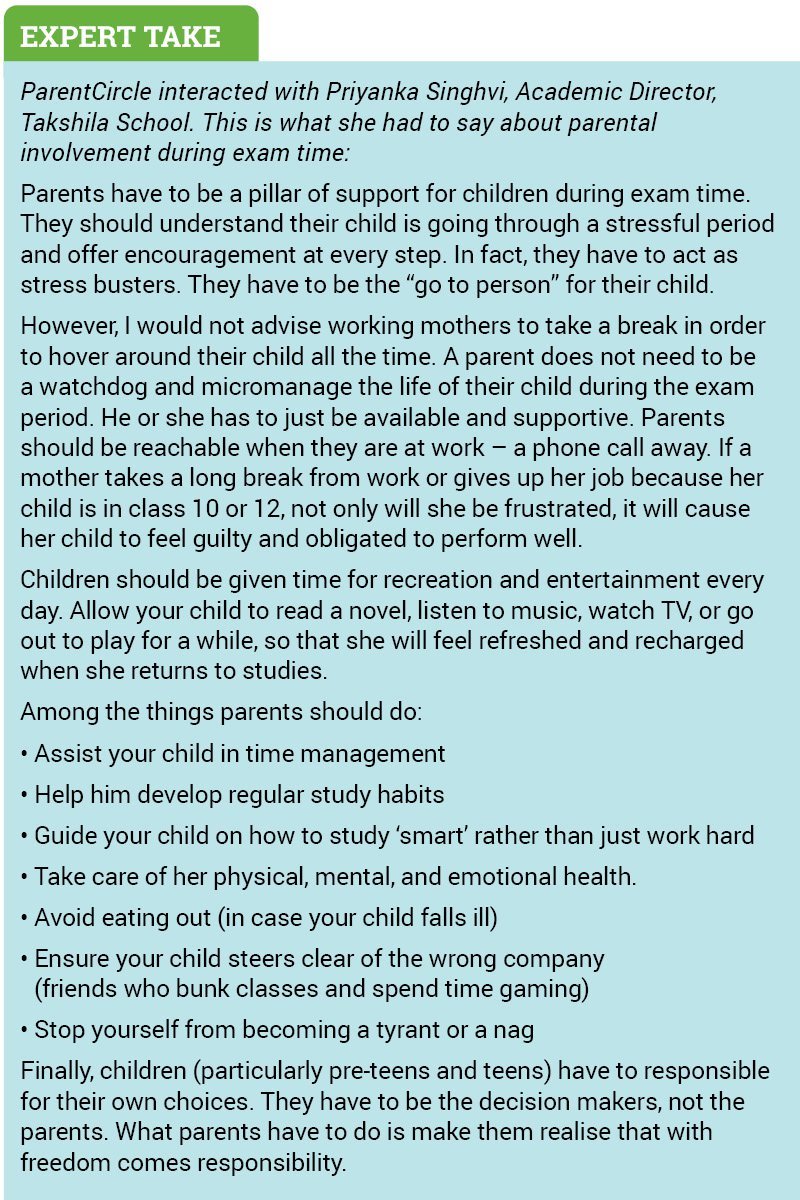
Parent speak: A real-life exam-time routine at home"I am a parent of a primary schooler and a middle schooler. My approach to exams has always been to keep it simple and stress-free right from when I was a student myself. I see exams as a process of evaluation for learners to understand where they stand with respect to understanding the concepts and expressing their subject knowledge for others to understand. Here is what we practice in our home for both children:
- Aarthi Prabhakaran, mother of Madhumitha and Rohan |
Whether parents play an active (helping them with studies) or supportive (ensuring a healthy routine, being a good listener, and encouraging and motivating them) role, at exam time, their involvement is vital. It will not only ensure good performance but also help in reducing exam-related stress.
In a nutshell: How parents can reduce exam stress at home
- Parental involvement during exam time is vital for academic success and to reduce children's stress levels
- Parents need to be aware of the exam schedule as well as be available to lend a listening ear and support
- Not all parents can play a significant role in helping their children with their studies. But even behind-the-scenes support is invaluable
A quick exam-season parent check
Have I reminded my child that my love is not linked to marks?
Have I kept home calmer and conflict-free this week?
Has my child slept enough during exam days?
Did I check in emotionally, not only about studies?
Did I support breaks, food, and movement today?
Do I know when to seek professional help if stress increases?
What you could do right away
- Give your child a warm hug to assure them of your unconditional love and that your love is not related to their exam performance.
- Display a copy of the exam schedule so you can refer to it easily.
- If you find your child is very anxious or stressed, approach a counselor or clinical psychologist.






























Comments
Edit
Comment Flag
Cancel Update