
Considering sending your child for outbound camping? Here is how it can facilitate experiential learning
Ruchi Mohunta
How could being in nature serve as a powerful educational tool for children? Read on to find out how outbound camping facilitates learning
The twelve-year-old Ashna rarely interacted with her peer group. She preferred the company of her gadgets instead of playing with her friends. No amount of coaxing from her mother convinced her otherwise. Her excuse? "But I don't know what to play with them. They seem to be busy amongst themselves."
At her wit's end, Ashna's mother took up her friend's suggestion to send Ashna for an 'outbound camp' during the holidays. To persuade Ashna was a difficult albeit worthwhile task. Seven days at an outbound camp and the transformation happened. An introverted, timid, and self-conscious child liberated into a happy, confident one, beaming with positivity.
Fourteen-year-old Raghav's scenario is different. A happy child he enjoyed popularity, good grades and an exciting bunch of friends. The teachers were content with his performance as well. However, in one Parent Teacher Meeting, his class teacher pointed out something from her observation. When asked to do something different or out of the ordinary - Raghav usually backed out. "It's almost as if he is scared of making a mistake," said the concerned teacher. It was a disturbing revelation for his father.
Raghav's father, who works for a multinational company understood the repercussions of this statement. He knew what the teacher was trying to say. Raghav didn't want to step out of his comfort zone and was inclined to do only the activities that he was familiar with. No parent would like his child to have an attitude that is detrimental to them. He didn't want his child to shy away from challenges and not take up tasks fearing failure.
Not wasting time, he acted on it right away. He enrolled him for an experience that would bring back home a Raghav who's willing to apply his theoretical expertise from the books into practical situations without the fear of failure.
Two diverse children, two different challenges, one common experience that helped them - Outbound Camping.
Demystifying outbound camping
Outbound camping is a type of experiential learning technique that helps in the transformation of an individual through an experience. This is an important tool in learning as it allows the student to firsthand explore and create new meaning out of the experience. This model of learning engages the learner in critical thinking, logical reasoning and problem solving based on their own learning and experience.
Outbound camping draws heavily from the benefits of 'Experiential Education' in cultivating sustainable life skills in students. Outbound camping then is any sort of learning that takes place outside the four walls of the classroom. It can be in the form of adventure and leadership camps, culture and heritage immersions or even wildlife and ecological conservation camp. It can span from as little as a day-long field trip to three to four days. Sometimes it can also be taken up for more than ten days when the goal is to teach children to give back to society through community service.
Although the term used today is fancy - it goes back to many decades ago. Let's go back to our childhood days. Our parents didn't have fancy summer camps that they sent us to. Instead, we were packed off to our grandparents' home for the vacations. This in itself is the precursor to an outbound camp. We learned to take care of our belongings, help around the household chores, and spend endless hours playing games with our cousins (helping build social skills) If you were lucky and your grandparents lived in a village or on a farm, you had the added advantage of climbing trees and staying outdoors for a minimum of four to five hours. At the end of the summer holidays, we came back refreshed for the school year to begin. Unstructured play and sub-conscious learning helped in the creativity of the mind. It is like when a farmer allows the land to remain fallow for a few months. This helps in increasing the nutrients of the land for a better yield. Exactly what the summer break would do to us.
Let's fast forward to the present day. Due to various reasons, we are unable to give the children the summers that we had. Hence, we need to create opportunities that are similar, though definitely not replaceable to the summer homes. Short outbound camps help in recreating experiences for our children which can have similar benefits of independent living, outdoor play and bonding.
Outbound camps have leadership as the learning outcome and draw heavily from the theory of experiential learning. This theory was proposed by psychologist David Kolb who was influenced by the works of John Dewey and Jean Piaget. According to Kolb, this type of learning can be defined as "the process whereby knowledge is created through the transformation of experience."
He also identified two ways of transforming experience- reflective observation when during the debriefing of an activity, the participant is made to reflect back on the mistakes that were made and active experimentation when the previous learning is used for further solution-seeking. According to Kolb, concrete experience provides information that serves as a basis for reflection. From these reflections, we gather the information and form abstract concepts.
Lieutenant Seshadri - ex-Indian Navy, NALS, director of operations speaks - "The physical strength and neural networks of children dramatically alter when they participate in challenging activities. Outbound and experiential activities are a great way to trigger the inner strength, self-confidence and social skills of young people. "
A typical day at camp
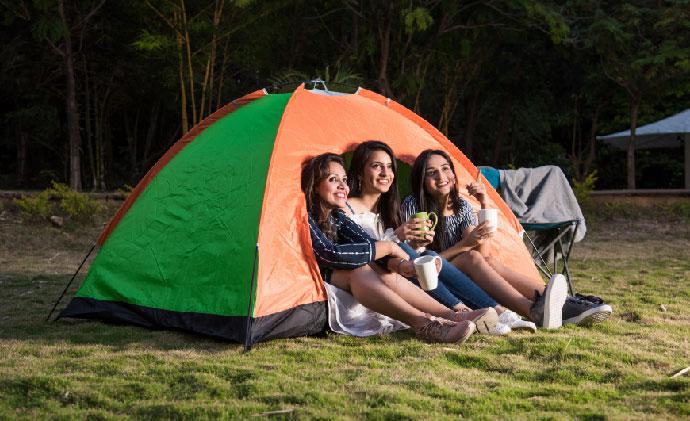
While each campsite has its unique day plan- most of them have a schedule in common. A child is woken up early and begins her day with some physical exercise. It could range from simple stretches to yoga and all the way to a short trek. This is followed by a healthy breakfast of local food. Post breakfast the children spend time in some form of adventure activity such as treks, rappelling, rock climbing, Burma bridges, or rope courses. The activity is followed by a healthy lunch- again kept local and simple. Most campsites also encourage children to wash their own plates and also help in serving the meals.
Post lunch is another activity - usually in the form of a game that has a debriefing session for the learning to be consolidated. Around 4pm time is given for freshening up and free time. 6pm is time to come together for some fun and team-building games. Dinner is usually early and is served by 7:30pm. The day comes to an end with a bonfire with songs, dances and games. Most times children are sent to bed by 9pm so that they can catch the chirp of the birds in the early morning hours.
Outbound camping adding value
- Nature-deficit disorder: Yes, believe it or not - but this is becoming a fast known and proven disorder - not only amongst children but amongst adults too. Richard Louv, recipient of the Audubon Medal award, presents in his book Last Child in the Woods cutting-edge studies that point to direct exposure to nature as essential for a child's healthy physical and emotional development. In this book, he reflects the growing body of evidence linking the lack of nature in children's lives and the rise in obesity, attention disorders, and depression. Hence, being amongst nature has not only many benefits but has become a need of the hour.
- Moving from the known to the unknown: There is an element of thrill when the child boards a train. The anticipation of the experience of a new environment overrides the anxiety. The journey in itself becomes a part of the learning process and not just the destination. The child is open to new learning and assimilates it with the previous learning.
- Real-world learning: Moving away from the structured school environment of learning - this is an opportunity to learn without the four walls of the classroom. Activities in the campsite are designed for the child to learn from nature and the environment. The treks and hikes are a means for the child to understand various species of flowers and insects which they have probably been only reading about in their textbooks. Having experts in the field take the child through the experience also helps the child to learn firsthand.
- Facing your fears: Activities such as rope courses helps the child to get over their fear of heights. It helps them move out of their comfort zone. Once they have successfully completed the task it leaves them with a high sense of achievement which in turn motivates them to use the same learning back at home.
- Collaborative learning: With more and more couples opting to have a single child, camps become an important environment for children to learn to share and co-exist. Through various group tasks, they are taught the art of collaboration and team building. The debriefing of the activity helps them to take back the learning as a sustainable life skill.
- Becoming independent: Right from the moment that they are on camp they are expected to care and be responsible for their belongings. Tasks such as making their own beds, which motivational speaker Robin Sharma has called the first sign of setting the mood for a productive day, are taught and expected from the child. They carry their own luggage and take care of their belongings as a part of the camp rules. They decide what they wish to eat and in what quantity without the constant supervision of the parent. This also helps them to make decisions on their own. They learn the importance of avoiding food wastage.
- Gadget free time: Camps are places where the children are away from gadgets. The emphasis is on interacting with their peers face to face and not through social media. Games aren't played in the virtual world but in the real world.
There are progressive schools, like Harishree Vidyalayam to name one, who strongly believe in the many benefits of outbound camping trips. Hema Malini, a teacher at Harishree Vidyalayam, expresses - "Nature is the best teacher. Care, compassion, determination, resilience opens the doors to nature's bounty. And the best way to leave nature's imprint on young minds is through experiential learning opportunities. Our school believes in providing such surroundings for the students, under safe and supervised care. Every year students at Harishree look forward to their outbound trips with their peers and teachers.'
Worth the effort?
Like everything in life, outbound camps come with their own share of challenges in their organization.
- As the camps have adventure as a part of the program, some schools are hesitant to take responsibility of the injuries that may occur on-site. Although most of the premier campsites have certified trainers from prestigious Institutes such as the Himalayan Institute. Appropriate gear is used to ensure the utmost safety of the children in using the equipment
- The other challenge often seen in the schools is the lack of time to incorporate these camps. With the focus being on academic completion of portions, schools often do not give priority to such camps. The school calendar year requires 4-5 working days excursions and camps. Schools often do not plan in advance and hence the lack of time to engage students in these activities
- The cost of the camp also plays an important role in being a deciding factor for it. Campsites are often in open, hilly areas and the children need to travel overnight by train and for a couple of hours before they reach the campsite. Although the accommodation is in tents, the running of the campsite is a factor that the vendors do account in.
What you can do as a parent
Your child need not be bound by the constraints of their school to incorporate camp learning. Apart from schools, these experiences can also be made a part of your child's learning by sending them on such trips with companies that specialize in the same. Bibi Rani Nangia, director India of Les Elfes International Camp, Switzerland has been running the camps for the past twenty years. She says, "Outdoor camping facilitates a new experience which makes a child more independent and confident about his or her own capabilities! I have witnessed learnings that provide foundation building for holistic development which formal school education may overlook due to academic pressure."
Similar to these camps there are a number of service providers who do the same. They have fixed dates for departure to the camps that can be booked in advance. One such website that holds details of information of the same is www.campmonk.com. However before enrolling the child it is advisable to look at the profile of the service providers and the child-adult ratio that they follow. These can be deciding factors for a parent.
As parents too, these camps can be a part of your vacation trips. Apart from all the above-listed advantages of these camps, the greatest one is the parent-child bonding that it can inculcate. One of the best ways to get children to take part in these activities is to see their parents as role models. Once they see their parent take up an activity - it gives them the confidence to do it.
How to get ready for a camp? Action plan for the parent
- Decide on the location and the activities that you would like to do with your child. These could range from the mountains for camping, treks and adventure sports such as rappelling, etc. to water-based activities such as river rafting and scuba diving
- Look up places and vendors that offer these services not just to larger groups but also to smaller family groups too. Write to them asking them questions regarding the best time to visit and the ways to get there (most of these questions are answered through their website FAQ)
- Ask another family with children of the same age to accompany. This not only gives company to the children but will also bring down the cost of the adventure
- Packing for these trips can be a fun bonding activity in itself. With the help of the child, make a list of all the items that may be needed on the campsite. Pack the things together
- Decide the learning outcomes as a family. Sit together and list out what each is expecting to learn by the end of this trip. As a parent write down your goals too from the camp. This will help the child to feel focused as well.
In the world today where lives are being reduced to technology on every front, being in the lap of nature to enjoy, learn and grow in its wisdom must be a conscious effort. A young mind needs to be given the space, environment and a chance to explore and develop itself. Outbound camps prove to be a great memory and experience to add to your child's life book which would fondly be remembered for the fun and learning it provides.
In a nutshell
- Outbound camping is a tool for experiential learning, learning that takes place outside the four walls of the classroom
- Outbound and experiential activities are a great way to trigger the inner strength, self-confidence and social skills of young people
- Outbound camping serves many learning advantages, including enhancing collaborative learning, becoming independent, facing fears, and dealing with uncertainty, among others
What you can do right away
- For the next school break, decide on the location and the activities that you would like to do as a family
- Sit together and list out each member's goals and what each is expecting to learn by the end of this trip






















Comments
Edit
Comment Flag
Cancel Update