
Exploring The Indian Tradition Of Storytelling: A Rich Legacy Of Tales And Narratives
Sindhu Shivalingam
You've most likely been listening to stories and telling stories ever since you started to talk. Ever wondered about our country's rich tradition of storytelling?
My mother remembers stories of tigers who were considered to be guardians to certain clans in the community. She recalled a story from her grandmother about a great-great-grandmother who safely traveled from one village to another, with a tiger following her steps and guarding her. She never saw the tiger, but felt its presence, says Lapdiang Syiem, a Shillong-based theatre artist, writer and performer.
Intriguing, isn't it? All of us have grown up with so many such stories. Even in the tech-led world we live in, storytelling remains one of the simplest modes of communication.
Stories to inform
India has a rich storytelling tradition, thanks to the numerous languages, communities and religions. There are poems, songs, chants, and dance forms that pass on myths, legends, religion, instructions, and even fairy tales. Every village or town has its storytellers. In the olden days, people would gather around and listen to stories in awe. This was indeed one of their major sources of not just entertainment, but also knowledge.
Over time, stories have been used as powerful tools to communicate important ideas and spark imagination, creativity and thought. One of the finest proponents of storytelling in India, Geeta Ramanujam, the founder of Kathalaya, a renowned academy of storytelling, explains that over the years, we have preserved and passed on stories not just for entertainment, but also for learning. She adds, "The gurus and masters in the Gurukula system of education used stories to teach concepts and values. One of the famous stories is that of Dattatreya, the three-headed leader of the Avadootas. This immortal sage is said to have understood the essence of existence from 24 gurus in nature, including the sun, moon, wind, deer, trees, and earth. This story illustrates how every moment of awareness can be a learning experience and how we can learn from Prakriti, the environment/nature into which we are born."
Theatre dramas are sometimes used to inform and propel action. For instance, take the Indian Independence movement where theatre was an important instrument to protest colonial rule. Even in the 1970s, Koothu, an ancient street-performance-based art, was used by the government to emphasize the importance of family planning.
The gurus and masters in the Gurukula system of education used stories to teach concepts and values
Stories give us our roots
Stories from our local cultures have given us our history and mythology, haven't they? Lapdiang says, "Stories are my roots and my identity, especially in my profession as an actor and a storyteller. We come from an oral culture, so folk tales play a pivotal role in keeping cultural connections alive. We remember the days of sitting around the hearth and sharing stories with our families, especially on cold winter nights."
Geeta Ramanujam explains, that in every state, the stories, and especially the folk tales, had localized characters that became the culture of each state too. You will not find the kangaroo in any of the Indian tales. In the same way, you will not find an elephant or a peacock in a Swedish folk tale.
Stories in Parenting
Storytelling is an excellent medium to build strong connections with your child. Have you ever seen a child not amused by a good tale?
Geeta Ramanujam recounts her own childhood experience. "I vividly remember my mother telling me a story of how EEEE.. (housefly in Tamil) forgot his name. My father told me stories about Hitler, Napoleon, and the Romans, and narrated stories from classics like Ivanhoe, The Scarlet Pimpernel, Oliver Twist, and David Copperfield. The styles adopted by them were so different. My mother had an exaggerated expression when she narrated stories while my father concentrated on the language and the tone of the hero as he told the story.
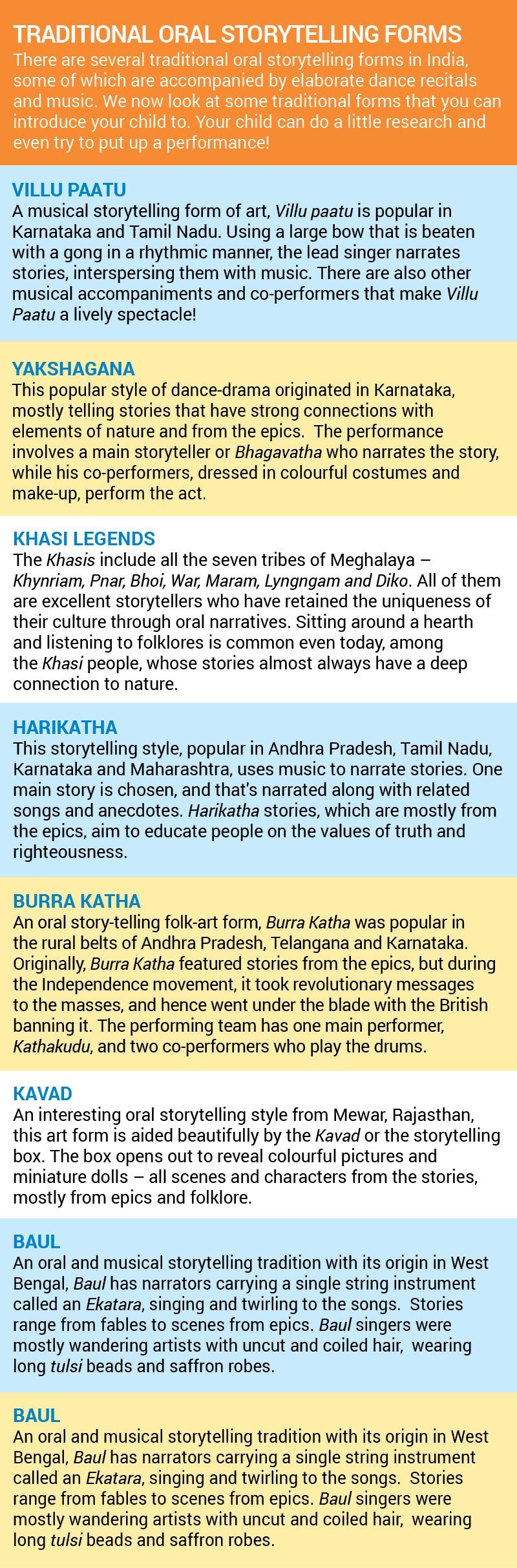
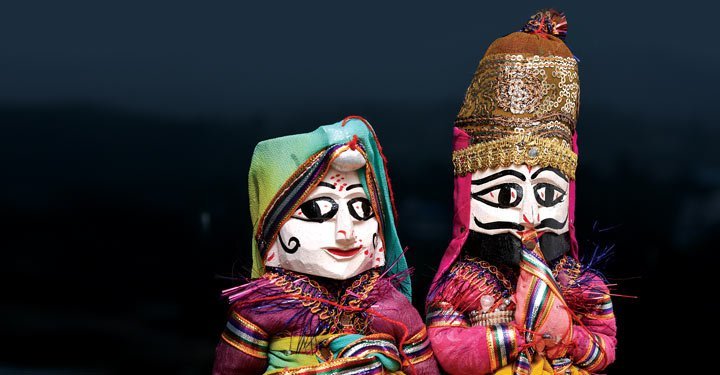
There are several other traditional storytelling forms like Pandvani, Glove Kathakali, Pandu ka Katha, Bommalattam or puppetry, Kattai kuthu, and Dastangoi. Visual art like Kalamkari, the sculptures on our temples, and carvings on caves are also different ways through which our people told stories!
Storytelling is not just an art, it is an emotion. So, go ahead and connect with your child using this beautiful form of art.



























Comments
Edit
Comment Flag
Cancel Update